
Your code works.
That is the problem.
It runs. It passes tests. It gets merged. Everyone moves on.
Three months later, someone rewrites it.
Six months later, it becomes a production issue.
One year later, nobody wants to touch it.
This is the moment most developers never question. The quiet success that hides a louder failure. Because working code is not the finish line. It is the starting point.
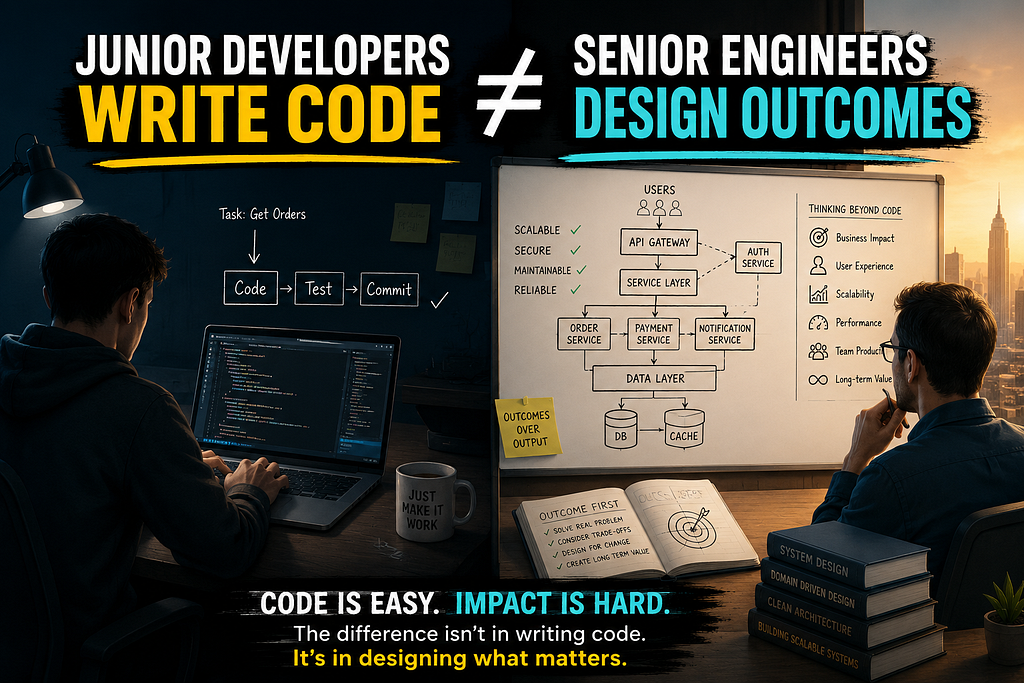
The difference between a junior developer and a senior engineer is not intelligence. It is not years. It is not even skill.
It is perspective.
The Illusion of “Done”
A junior developer solves the ticket.
A senior engineer solves the problem behind the ticket.
On paper, both deliver the same feature. A button works. An API responds. Data flows.
But under the surface, they are building very different systems.
A junior thinks in terms of output.
A senior thinks in terms of impact.
Here is a simple example.
// junior approach
public int total(List<Integer> nums) {
int sum = 0;
for (int n : nums) sum += n;
return sum;
}
It works. Clean. Simple. Nothing wrong.
Now look at the same logic from a different angle.
// senior mindset
public int total(List<Integer> nums) {
if (nums == null || nums.isEmpty()) return 0;
int sum = 0;
for (int n : nums) {
if (n < 0) throw new IllegalArgumentException();
sum += n;
}
return sum;
}
The difference is not the loop.
The difference is awareness.
Edge cases. Data integrity. Future misuse. Silent failures.
A senior engineer writes code that defends itself.
Code vs Outcome
Junior developers ask:
What should I write?
Senior engineers ask:
What will this change cause?
That question reshapes everything.
A small feature is never just a feature. It touches performance, cost, reliability, and people.
Consider a simple API.
@GetMapping(“/orders”)
public List<Order> get() {
return repo.findAll();
}
It works perfectly in development.
Then production happens.
Ten thousand records. One lakh. Ten lakh.
Memory spikes. Latency explodes. Database struggles.
Now look at the same endpoint designed with outcome in mind.
@GetMapping(“/orders”)
public Page<Order> get(Pageable p) {
return repo.findAll(p);
}
One small decision.
Massive difference in behavior.
Senior engineers think about scale before scale arrives.
The Invisible Work
The most valuable engineering work is often invisible.
No one celebrates removing complexity.
No one applauds preventing a future bug.
No one writes a Slack message saying, “Nothing broke today because of you.”
But that is exactly where senior engineers live.
They reduce risk before it appears.
They simplify systems before they collapse.
They design paths that others can walk without fear.
Think of architecture like this:
Junior mindset:[ UI ] –> [ Service ] –> [ DB ]Senior mindset:[ UI ]
|
v
[ API Layer ] –> [ Service Layer ] –> [ Domain Rules ]
|
v
[ Data Layer ]
|
v
[ DB / Cache ]
It looks similar at a glance.
It behaves very differently over time.
The first one delivers speed.
The second one survives growth.
Speed Is Easy. Sustainability Is Rare.
Anyone can ship fast.
Very few can keep shipping without breaking everything.
That is where real engineering begins.
Junior developers optimize for today.
Senior engineers optimize for change.
Because change is the only constant in software.
Requirements change.
Traffic changes.
Teams change.
And code that cannot adapt becomes a liability.
A senior engineer writes with future readers in mind.
Not just the compiler.
Not just the reviewer.
But the unknown developer six months later who will try to understand the intent behind every decision.
Thinking in Trade-offs
There is no perfect code.
Only trade-offs.
Junior developers look for the right answer.
Senior engineers look for the least harmful compromise.
Performance vs readability.
Speed vs safety.
Flexibility vs simplicity.
Every decision costs something.
The skill is knowing what to spend.
The Shift That Changes Everything
The transition from writing code to designing outcomes does not happen with a promotion.
It happens with a question.
Not “Is this correct?”
But “What happens next?”
That question turns code into responsibility.
It forces you to think beyond your screen.
Beyond your task.
Beyond your sprint.
It connects your work to the system, the business, and the people using it.
Final Thought
Writing code is a skill.
Designing outcomes is a mindset.
One makes features.
The other builds systems that last.
If your code works, that is good.
If your code continues to work, scale, and remain understandable long after you wrote it, that is engineering.
That is the difference.
And that is the level worth aiming for.
Junior Developers Write Code — Senior Engineers Design Outcomes was originally published in Coinmonks on Medium, where people are continuing the conversation by highlighting and responding to this story.