
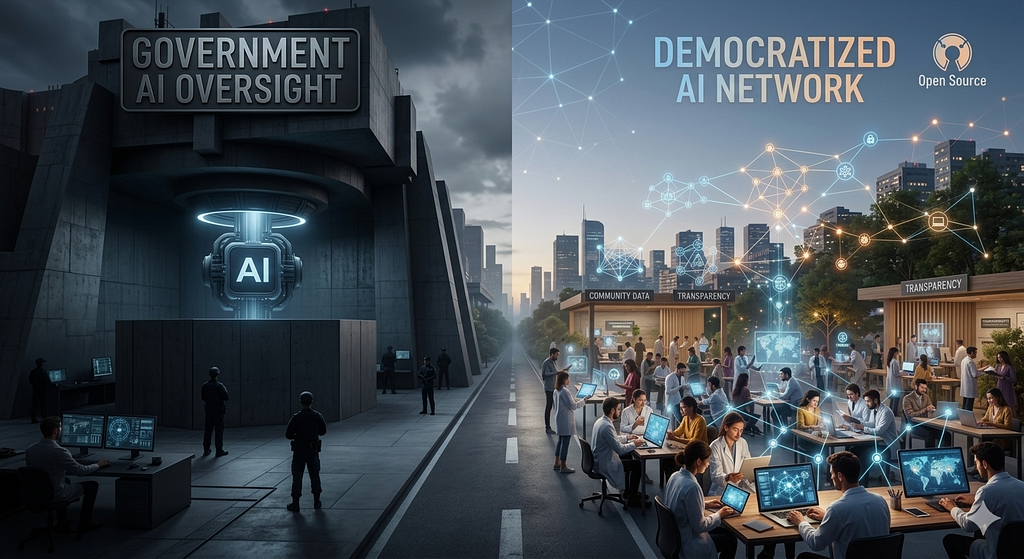
When regulators lockdown the cloud, the true democratization of AI will happen decentralized and at the edge.
Source: Image generated by author
After the release of Claude Mythos and Fable, the AI community was elated. There was endless discussion about the sheer quality of the models’ outputs, and a palpable anticipation that had been building for months. When they finally dropped, Anthropic was all over the news.
As an independent researcher, stress-testing your hypothesis with the smartest AI models available and prototyping fast has become an essential survival skill. It’s the only way to avoid exploring dead-end research paths. Having access to these frontier models was like having a brilliant, broad-minded research assistant with the entire web’s knowledge in their head.
I was excited to try-out Fable a few days after launch, only to realize I was already late to the party. Anthropic was back in the news, but not for a new benchmark. This time, it was the government asking them to pull the models and restrict access, particularly for users outside the United States.
That single decision changed the trajectory for independent researchers and the industry as a whole. It immediately sparked a cascade of uncomfortable questions: If the US restricts its most advanced models, will Europe or China follow suit and wall off their own? What does a fragmented, restricted internet mean for the future of an advanced, globally collaborative AI ecosystem?
Unsurprisingly, the restrictions were welcomed by factions already calling for aggressive AI regulation. These activists and researchers, including voices from within Anthropic itself, have been lobbying the government to slow the rate of AI advancement, arguing we need to pause to ensure we can properly monitor and control the intelligence we are unleashing.
Whichever camp you fall into, the accelerationists or the safety hawks, there is no denying a fundamental truth: AI’s own deep research capabilities have become the primary engine for AI advancement. This recursive self-improvement loop is arguably the most significant leap in digital technology since the Open Source movement.
We also have to acknowledge the sheer speed at which independent researchers can now spin up prototypes. Thanks to AI-assisted development, the solo researcher or small startup has gained a massive leverage advantage, capable of producing world-class work without the billion-dollar budget of a hyperscale lab.
But here is the catch: None of this matters if the foundational tools are locked behind geopolitical firewalls.
When governments restrict frontier models, they aren’t just slowing down development; they are actively centralizing power. They are ensuring that only state-approved, heavily regulated, centralized cloud providers can play the game. They are killing the indie hacker, the university lab, and the localized startup.
The Antidote is the Edge
So, what is the solution for the independent researcher and the democratization of AI?
We stop relying on the centralized cloud.
If the future of AI is restricted to a few massive, heavily monitored server farms, then the true revolution must happen where the regulators aren’t looking: At the edge.
The next great era of AI won’t be defined by who has the largest trillion-parameter cloud model. It will be defined by who can build the most efficient and localized models that run on a $300 NVIDIA Jetson or a local NUC. This will take distribution away from the big labs and with distribution comes leverage and access to more data with methods like federated learning on edge devices.
When you can’t rely on an unrestricted cloud API, you are forced to innovate. You are forced to build lightweight, highly specialized models. You are forced to solve the actual physics of the real world, locally, on the device, in real-time, without sending your project draft or a single frame of video to a restricted server.
Government restrictions on frontier cloud models are a massive short-term headache. But in the long term, they are forcing the industry to solve the hardest problems in computer science: finding ways to build decentralized frontier level AI models and making AI truly understand the physical world locally.
The walled gardens are being built. It’s up to the independent researchers to build the keys that bypass them.
Government Restrictions on Frontier AI are Derailing Advancement (And What Comes Next). was originally published in Coinmonks on Medium, where people are continuing the conversation by highlighting and responding to this story.