
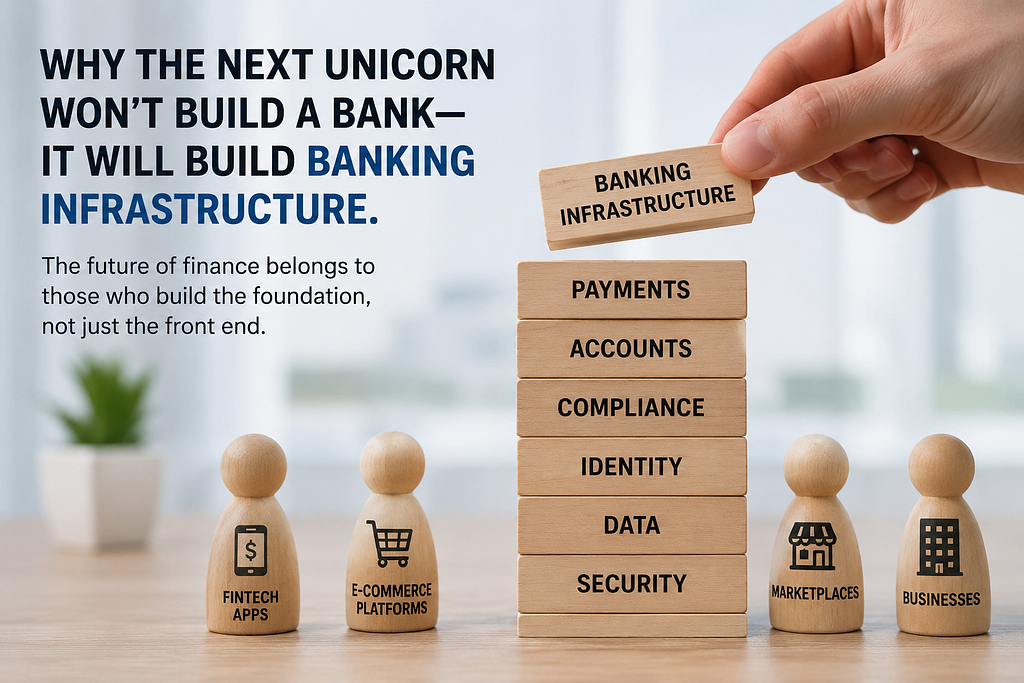
The biggest opportunities in fintech are no longer about becoming a bank. They’re about becoming the technology that powers thousands of them.
For decades, the dream for every ambitious financial company was remarkably similar: get a banking license, attract deposits, issue cards, offer loans, and become the next banking giant. Success was measured by branch networks, customer accounts, and balance sheets. That model created some of the world’s largest financial institutions.
Today, the rules are changing.
The most valuable companies emerging in financial technology are taking a very different path. Instead of trying to become banks, they are building the infrastructure that allows others to launch financial services faster, cheaper, and across multiple markets. The next billion-dollar fintech may never open a single customer account of its own. Instead, it will quietly power hundreds of banks, fintech startups, marketplaces, SaaS platforms, and global businesses behind the scenes.
This shift is not simply another fintech trend. It represents a fundamental transformation in how financial services are created and delivered.
Modern businesses no longer want to spend years securing banking partnerships, integrating payment networks, navigating regulatory requirements, and building complex compliance systems from scratch. They want ready-made infrastructure that allows them to focus on customer experience and growth while someone else manages the underlying financial technology.
This is where Banking-as-a-Service, embedded finance, payment orchestration, digital wallets, card issuing, compliance automation, and API-driven financial platforms have become the real engines of innovation.
Think about how cloud computing changed software. Years ago, companies purchased servers, managed data centers, and maintained expensive infrastructure themselves. Then cloud providers emerged, making infrastructure available on demand. Businesses no longer built data centers — they built products.
Financial services are moving in the same direction.
Developers now expect banking capabilities to work like cloud services. Need virtual accounts? Connect an API. Want to issue payment cards? Integrate a platform. Looking for multi-currency payments or cross-border settlements? Infrastructure providers already offer the building blocks.
The winners are increasingly those who make financial services easier to build rather than those trying to compete directly for every customer.
This evolution is also changing who can participate in finance. A logistics company can embed payment services into its platform. An e-commerce marketplace can provide digital wallets to merchants. A software company can offer business accounts without becoming a licensed bank. Healthcare providers, travel platforms, creator economies, and B2B marketplaces are all discovering that financial services can become a natural extension of their products instead of a separate business.
Infrastructure makes this possible.
Another reason infrastructure businesses are becoming so valuable is scale. A consumer-focused bank grows one customer at a time. An infrastructure company grows by enabling hundreds or even thousands of businesses, each serving their own customer base. Every new client expands the platform’s reach without requiring the provider to acquire millions of retail users directly.
This creates powerful network effects. As more businesses build on the same infrastructure, the platform becomes stronger, more reliable, and more attractive to future partners. Over time, the infrastructure itself becomes difficult to replace.
Investors have started recognizing this pattern across technology. The companies that build the foundation often become more valuable than the companies built on top of it. Whether in cloud computing, payments, communications, or artificial intelligence, infrastructure consistently creates durable competitive advantages.
Finance is following the same playbook.
Of course, building financial infrastructure is far from simple. Reliability is non-negotiable. Security must be uncompromising. Regulatory compliance is continuous, not optional. Every API call carries real financial responsibility, and every transaction depends on trust. Companies operating in this space must solve technical, operational, and regulatory challenges simultaneously.
Yet those challenges also create high barriers to entry, making successful infrastructure providers exceptionally difficult to replicate.
Perhaps the most interesting part of this transformation is that consumers rarely notice it. When someone sends money instantly, opens a digital wallet, receives a virtual card, or pays internationally in seconds, they see the brand they trust. Behind that seamless experience is often an invisible layer of infrastructure connecting banks, payment networks, compliance systems, and financial data in real time.
The companies building those invisible layers are becoming some of the most influential players in modern finance.
The next unicorn may never advertise to consumers. It may never build branches or launch a traditional banking app. Instead, it will provide the technology that enables thousands of other businesses to offer financial services with confidence and speed.
In the next decade, the biggest winners in fintech may not be the companies trying to become banks.
They will be the companies that make banking available to everyone else.
Because in the future of finance, infrastructure is no longer hidden in the background.
It is the business.
Why the Next Unicorn Won’t Build a Bank It Will Build Banking Infrastructure was originally published in Coinmonks on Medium, where people are continuing the conversation by highlighting and responding to this story.