
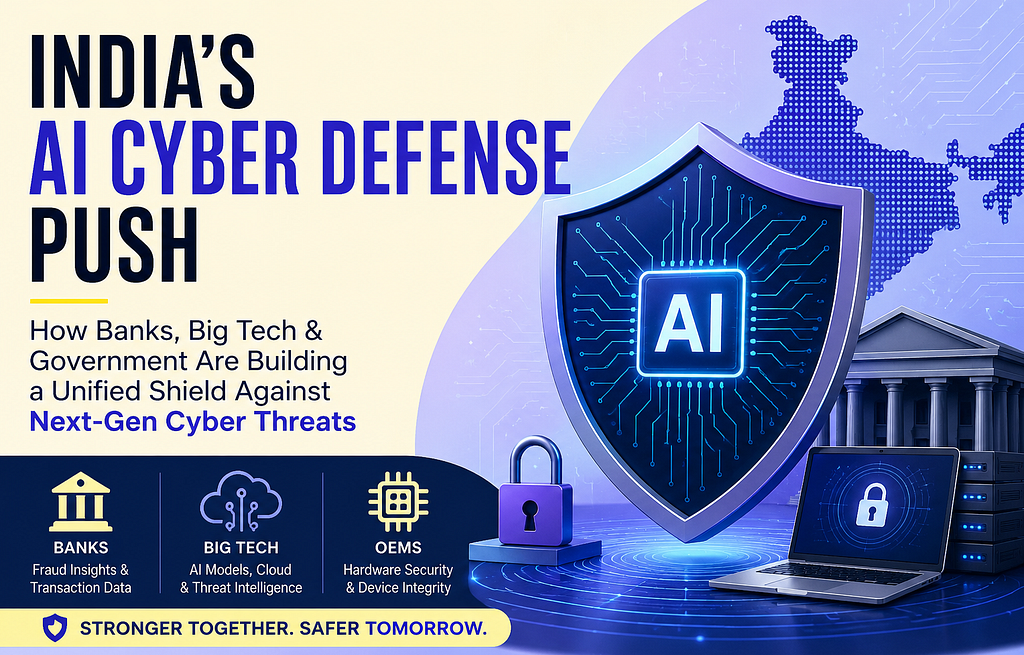
India’s AI Cyber Defense Push: How Banks, Big Tech, and Government Are Building a Unified Shield Against Next-Gen Cyber Threats
A collaborative intelligence network is emerging to fight AI-driven cybercrime before it happens, not after
Speeding ahead, India’s digital economy grows faster than most nations manage. Instant UPI transfers now share space with artificial intelligence handling loans. Financial tools respond quicker, act smarter, rely heavily on live links across networks. Real time rules, automation spreads, connections run deeper each day.
Yet when the system grows, attacks against it grow sharper too.
Now stepping up, the government moves past old fixes, instead shaping an AI-powered shield where banks link with tech giants and hardware makers, sharing live threat data through one connected system.
Now things are changing fast, cybersecurity doesn’t stand alone anymore. Built on artificial intelligence, it’s turning into a unified network that spans the country.
Image Is Generated By ChatGPT
India’s AI Cyber Defense Collaboration Initiative
Firewalls to forecasting shaping cyber defense
Old security setups mostly just respond after something happens.
When they spot a break-in, alarms go off while systems start reacting. A sign of intrusion sets off warnings followed by automated steps kicking in. Breach found, notifications fire up then actions unfold automatically. Once access is compromised, alerts activate alongside countermeasures launching. Spotting unauthorized entry makes signals sound as responses begin without delay.
Not long ago, digital dangers followed predictable patterns. Yet today they shift on their own mid-attack. A message might seem harmless at first glance, then reveal tricks built by learning software. Fake voices in phone scams sound just like someone you know. What once stayed static now changes form every few seconds. Even harmful programs alter their structure to dodge safety tools.
Now security moves ahead of threats instead of chasing them. Predicting risks shapes how teams respond before problems strike.
Out front, artificial intelligence shifts the aim from stopping threats to seeing them coming. Instead of reacting, systems now spot risks ahead of time, guided by smart algorithms learning patterns others miss.
Collaboration As A Security Necessity In Modern Work Environments
What stands out most about this effort isn’t the tech. It’s how everything fits together, timing, people, goals, all pulling in the same direction.
One by one, separate defenses are giving way to joint efforts across India.
What once stood apart now leans into common systems. Not alone anymore, groups work under a single shield setup. Together shapes how protection grows nationwide.
This is where every participant lands in the setup
Banks: The data backbone of financial threats
Most movement of money passes through banks. Because they offer services like: storage for funds, ways to send payments, tools for borrowing, plus systems that track spending habits
Real-time fraud signalsCustomer behavior patternsTransaction anomaly dataBig Tech Shapes AI and Cloud Intelligence
Technology companies bring:
Large-scale AI modelsCloud-based threat detection systemsCross-platform intelligence capabilities
Manufacturers build gadgets. Security lives inside each machine. Devices come with hidden shields. Protection starts before first use. Every gadget hides a fortress. Machines guard data by design. Hardware holds secrets tightly
OEMs strengthen the system with:
Secure device ecosystemsFirmware-level protectionHardware authentication systems
Side by side, these layers build a network that spots dangers in systems, software, and gadgets all at once. Not one piece works alone, each links to another, catching risks where they show up first.
The Real Catalyst AI Driven Cybercrime
What pushes this effort forward isn’t theory. It’s real. Machines now help break in, not just defend. That shift changes everything. The edge has moved. Offense leads. Tools once imagined are active. Hackers run them daily. Speed matters more than ever before.
Modern cyber threats now include:
Deepfake voice scams targeting banking customersAI-generated phishing campaigns that mimic trusted institutionsAutonomous malware that adapts in real timeBot networks executing large-scale fraud attemptsNow the area open to attacks keeps shifting instead of staying fixed.
Because of this, standalone defense setups are obsolete right from the start.
Creating a Shared Intelligence Layer for India’s Digital Economy
Right there in the middle of it all sits an idea strong enough to carry weight, intelligence that belongs to everyone. What matters most isn’t hidden; it spreads through connection, grows because people pass it on.
Image Is Generated By ChatGPT
One group’s experience with an attack could help another. When one faces a threat, others might learn from it. Learning happens across groups now.
What one team goes through becomes useful elsewhere. The process shifts how knowledge moves around. Information flows where it’s needed most. A single event can spark wider awareness. Insights travel beyond their origin point
Real-time threat sharing across banks and institutionsAI models trained on collective fraud patternsFaster identification of emerging attack vectorsCoordinated response mechanisms across sectors
Security shifts when shared effort replaces one-upmanship. What once set firms apart now binds them together through mutual support. Strength grows not by standing out but by linking arms. Protection becomes less about edges and more about connections holding firm.
How This Affects Companies and People
For businesses:
Stronger regulatory expectations around AI governanceIncreased investment in AI-based security infrastructureGreater reliance on cross-industry threat intelligence networks
For consumers:
Safer digital transactionsQuick spotting of scams, followed by swift action to reclaim fundsReduced risk of AI-driven impersonation scams
Put simply, trust is woven into the fabric of the digital economy, never tacked on later.
India Emerging as a Global Example in Cyber Defense
This move might just set India ahead on the world stage when it comes to handling cyber threats with smart tech. How well it rolls out will shape its real impact.
Most countries are still building fragmented cybersecurity systems.
India is attempting something different:
One system ties together defense across digital space. Intelligence flows between agencies through smart software. Machines learn threats fast, adapting on their own. Protection works as one effort, not separate parts. Speed comes from shared data and automated responses. The nation watches back, constantly aware.
Still, getting it right hinges on how things unfold, key among them:
Data privacy safeguardsWorking together without hiccups when people are involved
Scalable AI infrastructure
Regulatory clarity around information sharing
Final Thought
Cybersecurity stopped being just strong barriers a long time ago.
Defense systems grow smarter when they learn nonstop, connect widely, one step at a time. Shared knowledge becomes their backbone, slowly shaping how they adapt. Learning never pauses, it shifts quietly beneath the surface. Each update feeds into collective awareness, layer by layer.
Intelligence spreads through constant feedback, unannounced yet steady.
When machines change how threats work, standing apart won’t help.
Learning shifts happen where people share what they know. Change comes slower when no one talks. Defense grows stronger through shared effort, not isolated moves.
A fresh approach in India, linked to shared AI tools for cybersecurity, could quietly shape how countries guard digital confidence. While others watch, this shift might redefine safety online without loud promises or grand claims.
India’s AI Cyber Defense Push: How Banks, Big Tech, and Government Are Building a Unified Shield… was originally published in Coinmonks on Medium, where people are continuing the conversation by highlighting and responding to this story.