
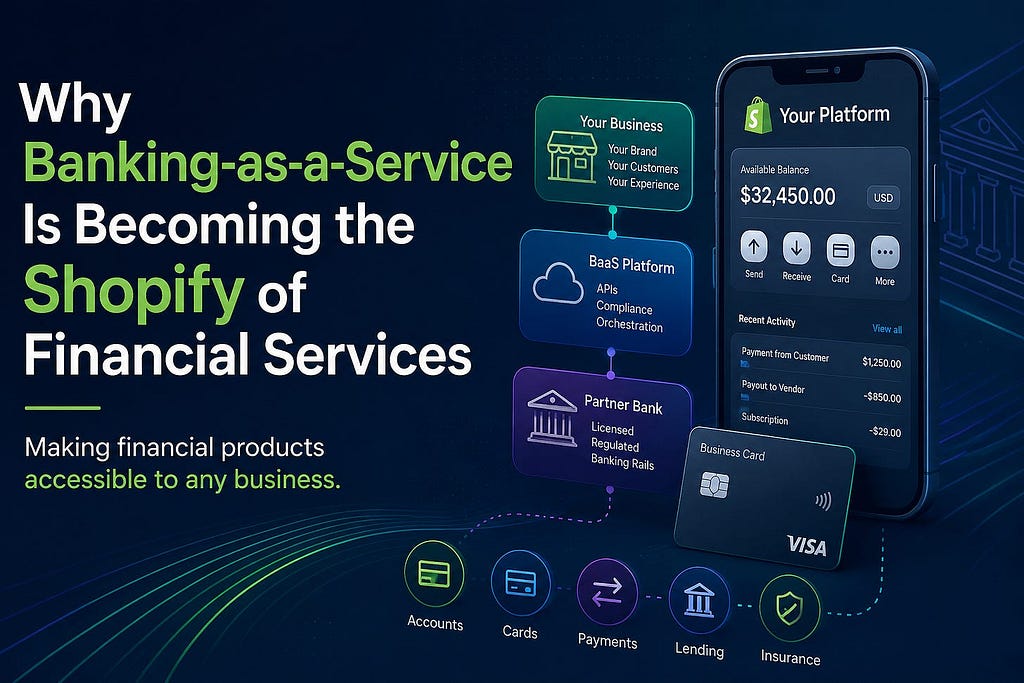
Making financial products accessible to any business without the baggage of a banking license
The Thesis: BaaS allows non financial companies to embed accounts, cards, and lending directly into their workflows without becoming a bank.The Logic: It mirrors Shopify: by layering money movement over existing customer relationships, a brand transforms into a financial platform.The Trade off: Speed is the headline (weeks, not years), but the complexity is just displaced. Compliance, fraud, and governance are massive, expensive hurdles.The Winners: Forget the broad platforms; the winners will be vertical specialists with tight risk design and operational discipline.
Opening Hook
In 2013, a Kansas City furniture maker spent months begging her bank for basic merchant processing. She provided financial statements, personal guarantees, and endured six weeks of bureaucratic purgatory. She lost two massive wholesale contracts while waiting for a yes.
A decade later, a candle maker in Austin launches her store on Shopify. She accepts payments within the hour, secures a working capital advance three months later, and manages her revenue in a dedicated account — all without ever filing a single bank application.
That transition — from months of friction to near instant access — is the promise of Banking as a Service (BaaS). It is no longer just for e commerce giants; it is the engine behind gig economy wallets, B2B marketplaces, and SaaS lending. Financial services are no longer a destination; they are an ambient feature of the software we use every day. The real competition isn’t about if you should embed finance, but who captures the data, carries the risk, and controls the economics.
Context & Problem
For a century, financial products were a walled garden. You needed a charter, a compliance army, and a legacy tech stack to participate. This created a structural blind spot: companies with the deepest customer trust retailers, logistics firms, payroll platforms couldn’t provide the financial tools their customers actually needed. They were forced to pass the baton to traditional banks, losing the data, the relationship, and the revenue.
Traditional banks, meanwhile, were optimized for high balance, low risk clients. They weren’t built for the creator with a six figure following but no W 2, or the small business with irregular monthly volume.
BaaS bridges this gap by decoupling the plumbing from the product. The bank holds the license and manages the rails; the platform provides the brand and the customer experience.
System Breakdown
BaaS is a three layer stack that turns regulatory heavy lifting into an API call:
The Licensed Institution: The sponsor bank. They own the charter, maintain reserves, and carry the ultimate regulatory burden.The BaaS Platform: The middleware (e.g., Marqeta, Unit). They translate banking capabilities into clean, developer friendly APIs, handling KYC/KYB, ledgering, and transaction monitoring.The Brand/Platform: The end user application. They own the interface, the distribution, and the data.
When a user swipes a card or sends funds, the request ripples through this chain from the app, through the middleware, onto the bank’s rails, and back in milliseconds. It looks like magic to the user; it is a highly orchestrated regulatory handoff under the hood.
Deep Dive
The Shopify analogy isn’t just marketing; it is a blueprint. Shopify didn’t just build a store builder; they built a data moat. By owning the commerce workflow, they understood merchant health better than any bank. When they launched Shopify Capital, they weren’t guessing creditworthiness they were acting on real time transaction data.
That is the BaaS playbook: own the workflow, leverage the data, monetize the trust.
This creates a structural information advantage. A construction platform knows a contractor’s true cash flow better than a loan officer; a logistics platform sees a carrier’s financial health in real time.
However, Generic BaaS is failing. The winners are vertical specialists. A platform building specifically for the gig economy understands the fraud patterns and micro transaction complexities of that sector better than any horizontal provider ever could. These vertical nuances are your true competitive moats.
Key Metrics
The Opportunity: While projections vary, the addressable market for SaaS embedded finance is estimated at $185 billion, with less than 20% currently captured.Speed: De novo banking charters take years and millions; BaaS programs can go live in weeks.The Trap: Watch the compliance to revenue ratio. Early on, shared infrastructure makes BaaS look cheap. At scale, the costs of fraud monitoring, dispute resolution, and regulatory audits often balloon, leading to margin compression just as the program hits its stride.
Risks
The risk in BaaS is structural. It is a chain of dependencies: the sponsor bank, the ledger, the processor, the ID vendor. If one node fails like the Synapse collapse in 2024 the entire architecture can buckle, leaving users stranded.
Fraud is the front line. Synthetic identities are specifically engineered to exploit the speed of BaaS onboarding. Furthermore, regulators are tightening the screws. Sponsor banks are now held directly responsible for their partners’ behavior, leading many to slash their partner lists. If your bank exits the market, your program has nowhere to run.
Bull vs. Bear Case
The Bull Case: Demand is structural. AI promises to slash the compliance drag by automating KYC and dispute resolution, making even small, niche platforms economically viable.
The Bear Case: Regulatory gravity. The compliance architecture is becoming significantly more expensive. We are likely to see a great consolidation where only the largest, best funded platforms survive, stifling the original promise of democratized finance.
Scenario Analysis
Vertical Dominance: Horizontal providers consolidate while vertical specialists (e.g., Construction only, Healthcare only) thrive.The AI Pivot: AI enabled compliance turns the small program market into a viable business, allowing niche communities to launch their own fintech tools.The Sponsor Squeeze: Regulatory pressure forces the industry to consolidate around a few mega sponsor banks, raising costs and increasing systemic concentration.
What Most People Miss
It’s Bank Distribution, Too: We frame this as tech eating banking, but it’s actually a lifeline for mid sized banks trying to reach the long tail of customers they could never acquire through branches.The Visibility Gap: In traditional banking, the person holding the customer’s hand is the same one doing the compliance. In BaaS, that role is split. The bank is responsible for compliance but often blind to how the brand is actually acquiring users. This is the BaaS death zone.The Speed Trap: The fastest programs are often the ones with the most porous fraud controls. The best performers are those that embrace friction as a feature — using behavioral monitoring rather than just upfront gate keeping.
Key Variables
Sponsor Bank Posture: How many more banks will exit the game due to regulatory heat?AI Efficiency: Can AI actually lower the marginal cost of compliance, or will it just create new black box risks?Regulatory Clarity: Countries with clear, standardized rules for third party risk management will win the next generation of fintech innovation.
Strategic Impact
For Brands: Stop asking if you can offer financial products, and start asking if you should. Do you have the data to underwrite risk, or are you just becoming a compliance liability?For Banks: Decide your identity. Are you the infrastructure backbone (sponsor bank) or the product leader (D2C)? Trying to be both often leads to mediocrity.For Investors: Stop looking for BaaS companies. Look for the platforms that own the data and the distribution, then check if their compliance architecture is actually defensible.
Conclusion
BaaS isn’t a feature update it’s a fundamental restructuring of financial distribution. The Shopify analogy works because Shopify didn’t just add a payment button; they created a self reinforcing loop of data and trust.
But do not be fooled by the ease of an API. The technology is the easy part. The real, and often underestimated, cost of BaaS is the operational discipline required to run a regulated business. The winners won’t be the companies that launch the fastest; they’ll be the ones that treat banking as a core competency rather than an add on.
Personal Note
I remember a founder spending eleven months, two lawyers, and three bank partners just to launch a simple payout feature. Today, the tech takes a fraction of that time.
But the paradox is that while our ability to build has scaled exponentially, our ability to manage that risk has lagged. The APIs are flawless, but the question of who owns the customer when things go wrong remains the industry’s great, unresolved tension. BaaS is the right destination, but the path forward requires less move fast and break things and more operate with the discipline of a bank.
Why Banking as a Service Is the New Shopify of Finance was originally published in Coinmonks on Medium, where people are continuing the conversation by highlighting and responding to this story.