
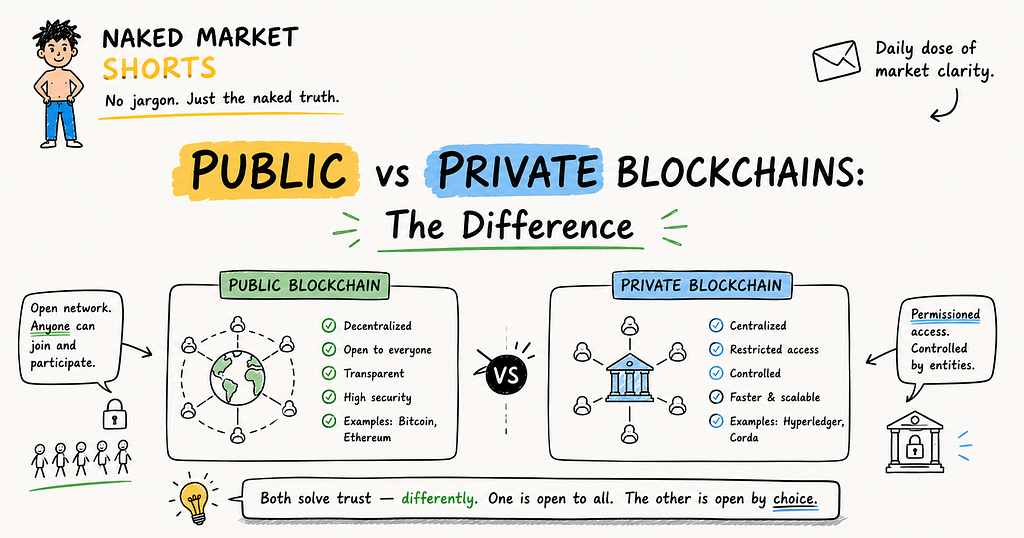
Most people think private blockchains are the serious, grown-up version. Often theyre a database with extra steps. Heres the real difference and why the firms that bet on private are quietly moving.
Naked Market breaks down macro finance, blockchain infrastructure, AI systems, and automated trading to help readers understand the future of global finance before the mainstream catches up.
Heres a question that sounds simple and isnt: is it “on the blockchain”?
Most people treat that as a yes or no. It isnt. Two systems can both be called blockchains and have almost nothing in common, one open to the entire planet, the other locked inside a single company where one administrator can quietly edit a row.
And theres a stubborn myth wrapped around all of this. The myth goes: public blockchains are the wild, speculative crypto stuff, and private blockchains are the serious, grown-up version that real institutions use all the benefits of blockchain, none of the chaos.
Its a tidy story. Its also mostly backwards.
Because a private blockchain usually throws away the single thing that made blockchain worth inventing. Strip that away and a lot of “enterprise blockchain” turns out to be a regular database wearing a costume — slower, more complicated, and no more trustworthy than the company running it.
That sounds harsh, so this piece is going to be fair to both sides. There are real reasons institutions reach for private chains, and real jobs they do well. But the distinction matters far beyond a tech debate because you cant build one planet’s money on rails that somebody owns the gate to. The whole idea of a shared global ledger lives or dies on this exact difference.
So lets clear it up properly.
Its really two questions, not one
“Public” and “private” actually smush together two separate questions, and pulling them apart clears up most of the confusion.
The first question is who can read it. Can anyone in the world pull up the ledger and inspect every transaction, or is the data walled off to a chosen few? The second is who can write to it — who gets to validate transactions and add new blocks. Anyone willing to play by the rules, or only names on an approved list?
Stack those two questions together and you get a spectrum. At one end, fully public and open to all: Bitcoin, Ethereum. At the other end, fully private: one company, closed doors, a permission slip for everything. In the middle sits the consortium — a handful of known organisations sharing the controls. As you slide from left to right, youre really just adding gatekeepers.
A public chain: nobody holds the keys
A public, permissionless blockchain has no gatekeeper at any layer. Anyone can download it, read every entry, submit a transaction, or even help run the network and validate blocks. No application form. No identity check. No one who can quietly kick you out.
If that sounds chaotic, remember what holds it together: cost. There is no boss vouching for the truth, so the network leans on the trick that runs every serious public chain — making a vote expensive, in burned energy or staked money, so nobody can cheaply seize control. The truth is simply the version too costly for anyone to overturn.
What you get out of that is genuinely new. The ledger is transparent, you dont have to trust anyone’s word, you can check it yourself. Its censorship-resistant no government or company can reach in and freeze your slice of it. And it doesnt care who you are. The trade is that its slower, every transaction is public, and fees swing with demand. The openness is the feature, and the openness is the cost.
A private chain: somebody does
A private, permissioned blockchain flips all of that. One organisation controls who joins, who can read, and who can write. Participants get verified and handed specific permissions — view-only here, write-access there. And crucially, the operator can usually override, edit, or delete entries. There is a hand on the controls.
In exchange, you get speed and secrecy. With a handful of known, trusted validators instead of thousands of anonymous ones, the network reaches agreement fast, easily thousands of transactions a second. The data stays confidential, visible only to permitted parties. And because every participant is identified, it slots neatly into compliance rules like KYC and anti-money-laundering. For a bank, those arent nice-to-haves. Theyre the law.
But notice the quiet thing that just happened. The moment one party can edit the ledger and decide who participates, youve put trust back at the centre. Youre no longer trusting math and cost. Youre trusting the operator to be honest, to be competent, and not to get hacked or leaned on. Which is exactly the dependency a public chain was built to remove.
And the middle: the consortium
Most real enterprise projects land in the middle, as consortium chains. Instead of one company in charge, a group of known organisations say, a set of banks, or shipping firms, or insurers jointly run the ledger and share governance.
Its a sensible compromise. No single member can unilaterally rewrite history, because the others are watching. But its still a members club: outsiders cant join, the data stays inside the group, and a big enough majority of members could, in principle, still collude. Less trust required than a one-owner chain. Far more than a public one.
So which is better? Thats the wrong question
Theres no universally “better” option here, and anyone who tells you otherwise is selling something. Theyre tools shaped for opposite jobs.
Public chains optimise for openness, neutrality and censorship-resistance at the cost of speed and privacy. Private chains optimise for control, confidentiality and performance at the cost of decentralisation, and the independence that came with it. If you need a neutral ledger that no single party can capture, you go public. If you need a fast, private, tightly governed system among known partners, you go private. Different priorities, not different IQ levels.
Which brings us to the question almost nobody in an enterprise meeting wants to ask out loud.
The uncomfortable question
If a single company controls every node on its “blockchain,” what is the blockchain actually buying it?
Think about what makes a public chain special. It solves an almost impossible problem: getting thousands of strangers who dont trust each other to agree on one history, with no referee. But inside one company, that problem doesnt exist. Theres no need to defend against an attacker spinning up fake identities to flood a vote because theres already a gatekeeper deciding who gets in. The hardest, cleverest part of the technology is solving a problem you no longer have.
It gets worse for the marketing. A blockchain’s famous tamper-resistance isnt magic — it comes from cost: rewriting history means out-muscling a huge, independent network, which is wildly expensive. But on a private chain there is no huge independent network. There are a few nodes, all under one roof. The people who run it can agree to rewrite the past over a coffee. The “immutable” ledger is only as immutable as the goodwill of its owners.
And then theres a delicious irony hiding in the compliance pitch. Privacy laws like Europe’s give people a “right to be forgotten” the right to have their personal data erased. But a real blockchain is built to never forget. So private chains end up adding special machinery to delete or hide data while keeping a placeholder behind. Which is reasonable engineering and also an admission that they need to break the one rule that defines a blockchain. At that point youve bent the technology so far it stops being the thing on the label.
Do you even need a blockchain?
Heres the test a good engineer runs before writing a line of code, and it fits on a napkin. Do multiple parties who dont fully trust each other need to write to the same shared record with no neutral middleman they all accept? If yes, a blockchain earns its keep. If the answer to either half is no, a boring database will be faster, cheaper and simpler every single time.
A lot of “enterprise blockchain” projects, run honestly through that flowchart, fail it. One company, full control, known participants that’s a database. Wrapping it in blockchain vocabulary adds committees, complexity and cost without adding the one thing blockchain offers: a way to cooperate without trusting a central party.
The graveyard nobody puts in the brochure
This isnt just theory. The track record of private enterprise blockchains is, to put it gently, humbling. By industry estimates roughly three out of four enterprise blockchain projects never made it out of the pilot stage quietly shelved after the proof-of-concept. A parade of splashy bank and trade-finance consortia from the last decade launched to headlines and then wound down.
Why so brutal? Partly because many were databases with extra steps, solving a problem a database already solved. Partly because the hardest part of a consortium isnt the technology its the politics. Getting rival companies to agree on governance, costs and who controls what turns out to be slower and more painful than any code. The blockchain worked. The committee didnt.
Now the plot twist
Here is the part that genuinely reframes the whole “public vs private” debate, and its happening right now.
The institutions that spent the last decade insisting finance would run on private, permissioned chains are quietly moving their flagship products onto public ones. The clearest example is JPMorgan. For years it built permissioned systems — Quorum, then Onyx, now Kinexys, private rails for moving money between big clients. Then in late 2025 it did something it once would have called unthinkable: it issued a tokenised dollar deposit directly on a public blockchain, an Ethereum network, transacted through public crypto wallets. Weeks later it launched a tokenised money-market fund on Ethereum too.
Its not alone. BlackRock — the largest asset manager on earth runs its multi-billion-dollar tokenised Treasury fund on Ethereum. Franklin Templeton runs a money fund across public chains. In 2026 a tokenised-Treasury settlement ran live across banks on a public ledger and cleared in seconds. The market for these tokenised real-world assets blew past $30 billion and almost all of it lives on public chains, not private ones.
Why the reversal? Because the things only a public, neutral network can give you turned out to be the things that actually matter at scale. Reach: anyone can connect, so your asset can move anywhere. Neutrality: no rival owns the rails youre standing on. Shared liquidity: everyone is in the same ocean, instead of a thousand private ponds that cant talk to each other. A private chain gives you control. It cant give you the network.
The future isnt public or private. Its both
So after all that, dont walk away thinking public simply “wins.” The honest answer is that the wall between the two is dissolving, and what’s emerging is a layered hybrid.
Picture public chains as the shared foundation — the neutral settlement layer everyone can reach with private, permissioned rooms built on top for the parts that must stay confidential. New privacy tools (the cryptographic kind that let you prove something is true without revealing the underlying data) increasingly let institutions keep their secrets on a public chain. Public when you need everyone. Private when you need discretion. Same foundation underneath.
The binary is fading. “Public vs private” is becoming “public, with private where it counts.”
The takeaway: the Gatekeeper Test
So heres the tool to keep in your pocket. Next time something is sold to you as a blockchain — a coin, an enterprise platform, a government pilot, a tokenised-anything dont take the label at face value. Walk it through four doors and ask who holds the key to each.
Who can read it? Can anyone inspect the ledger, or is the data walled off to a permitted few? Open is a public trait; closed is a private one.Who can write to it? Can anyone who follows the rules add and validate blocks, or only names on an approved list? A permission list means a gatekeeper.Who sets the rules? Can the protocol be changed by a diffuse, open community or by one named owner (or a small board) who can rewrite how it works?Who can reverse it? Is undoing history something only enormous cost can buy — or can a person, or a quorum of insiders, simply agree to do it?
Count the gatekeepers. Zero across all four doors, and youre looking at something genuinely public and trustless. One or more, and trust has crept back in which is fine, as long as you know thats what youre holding, and arent paying blockchain prices for database guarantees.
Why any of this matters
Zoom out, and the stakes get a lot bigger than enterprise architecture.
A single financial system for the whole planet runs into one unavoidable problem: who owns the rails? No country will settle its money on a ledger another country controls. No bank should hold that power over everyone else. A private chain, by its very design, has an owner of the gate which simply rebuilds the walled gardens and trust silos the world is trying to escape. You cannot get to one shared system by handing one party the keys.
Thats why the quiet migration to public chains is the tell. The path to One Earth, One Currency was never going to run through a thousand private fiefdoms that cant talk to each other. It runs through neutral public rails that no single nation or company owns the gate to with private rooms built on top for the parts that must stay sealed. Public for the shared truth everyone settles on. Private for the secrets that are nobody else’s business.
Get that split right, and a shared financial world stops being a fantasy. It starts looking like a foundation already being poured.
Signal over noise. Structure over price.
If you want to understand the architecture of where global money is heading before it becomes obvious — -subscribe. One clear breakdown at a time.
Keep going
One Planet, 180 Currencies: Somethings BrokenStart here — the whole thesis in one read.How Blockchain Actually Works, From the InsideWe build a chain piece by piece.Why a Blockchain Cant Be Secretly ChangedWhere immutability comes from — and why size matters.Tokenization: The $16 Trillion ShiftWhy real-world assets are moving onto public rails.
Public vs Private Blockchains: The Difference was originally published in Coinmonks on Medium, where people are continuing the conversation by highlighting and responding to this story.