
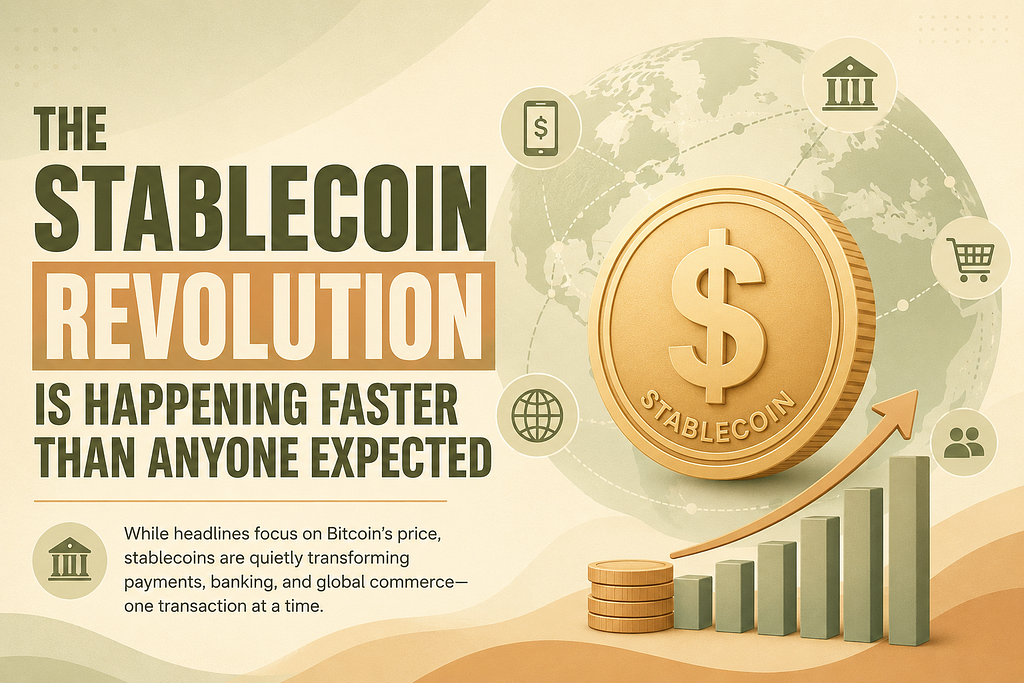
Beneath the noise of Bitcoin numbers, stablecoins shift how money moves — slipping into payments, reshaping banking, touching trade step by step. Not with fanfare, but flow.
Most folks see crypto, their mind jumps to wild swings.
Breathe. The price climbs — sudden, shaky. Then it drops without warning. Lines jagged on screen, jumping like sparks off a live wire. Up again? Maybe. Down for sure an instant later. Pulse racing in pixels.
Beneath the surface of all that commotion, a quieter shift is unfolding — steady, unnoticed, yet stronger than it seems.
A fresh start takes shape behind the scenes. Money’s foundation shifts without fanfare.
Image generated by ChatGPT
Not around speculation.
Far from the noise of trending waves.
Yet it circles back to a quiet truth
True digital cash that holds its value steady.
Here comes stablecoins, stepping into the scene.
The Quiet Shift Everyone Ignores
While Bitcoin grabs the spotlight in crypto, stablecoins quietly handle the groundwork
Price tricks aren’t their goal. Fixing something dull matters more
Everything now bends around that one question.
Out of nowhere, stablecoins such as USDC and USDT — along with newer, rule-following digital cash — now quietly power much of what happens in crypto. Yet here’s the twist: their reach is sneaking far beyond those circles.
Into everyday money matters they step. Real life numbers now part of their path.
Payroll systems.
Freelancer payments.
Cross-border settlements.
E-commerce checkouts.
Still, big company money handling too.
Faster than many regulators thought possible, this shift catches banks off guard too — even those betting on digital currencies didn’t see the pace coming.
Stablecoins Have Bigger Impact Than Bitcoin Today
Out of nowhere, Bitcoin shifted our view on what money can be.
Stablecoins are changing how money actually moves.
What sets it apart matters most.
Even though Bitcoin gets seen as digital gold, stablecoins work more like everyday money online.
A payment moves fast when someone working alone in India gets money from a small company based in Germany. Seconds pass before it lands in their account.
One way Nigerian businesses handle rising prices is keeping investments tied to the U.S. dollar, even without a stateside bank branch. Accessing stable foreign value does not require crossing borders or signing with American banks. Using dollar-linked instruments helps reduce losses when local currency weakens. Some firms rely on such tools instead of shifting money abroad. Protection comes through asset choice, not international paperwork.
One moment it sits on an exchange in Singapore, the next it floods into one based in Toronto — bank approvals never slow it down. Money shifts like weather fronts, rerouted before paperwork even begins. Settlement delays? They simply do not apply here. Speed hides in code, not couriers. A single decision sends value across borders faster than a flight departs.
No waiting days.
No expensive intermediaries.
Fees vanish when swapping currencies instantly. Money moves without waiting around.
Speed on the web shapes worth more than waiting ever could.
It’s the pace that unsettles financial institutions.
The Hidden Systems Fueling Growth
Surprisingly few people notice — stablecoins go beyond being mere tokens.
On top of blockchains sit these layered systems. Built like foundations, they support what comes after. One step beyond the base, they add structure slowly. These levels emerge directly from blockchain roots. Layered pieces form beneath the surface quietly.
Each transaction hides a web moving outside old banking paths
No SWIFT delaysNo correspondent banking chainsNo banking hoursNo geographic restrictions
This is why stablecoins are becoming especially powerful in emerging markets.
Where banks move like snails, cost too much, or slam doors shut, stablecoins aren’t seen as digital cash. People treat them more like lifelines than investments when traditional finance fails to deliver
Money keeps things moving when times get tight.
After people try fast worldwide payments, old methods just fade away.
The Banking System Watches Quietly
Facing change, traditional banks now notice this move.
Stablecoins didn’t catch on right away — many saw them only as digital coins made for swapping online money. People ignored their wider uses at the start, thinking they mattered just inside cryptocurrency circles. Over time, though, that view began shifting slowly.
Scientists today look at them like this:
Settlement layersLiquidity instrumentsTreasury optimization toolsCross-border payment alternatives
Banks are starting to see a truth they’d rather ignore
Ownership of the payment journey has slipped from their hands.
Participation is their sole role.
If a company sends funds across borders without relying on a traditional bank, then the institution fades into the background of that process. Suddenly, its role feels less essential, more like a choice than a necessity. When transfers happen freely outside banking channels, the old gatekeeper loses grip. Power shifts where it wasn’t invited. The system keeps running — just differently. Banking isn’t removed, just skipped. That quiet shift changes everything.
Over time, replacement happens for optional systems.
Not suddenly.
But steadily.
Stablecoins Gain Government Attention
Years went by while attention stayed fixed on Bitcoin, along with the wild swings of crypto markets.
These days, eyes are turning elsewhere.
Why?
Stablecoins resemble alternate money setups, not so much financial bets. What sets them apart is how they function day to day. Their design leans on steady value rather than growth promises. Instead of chasing returns, they aim for reliability across transactions.
Now the risks shift in ways nobody expected.
Now governments look into these options
Central Bank Digital Currencies (CBDCs)Stablecoin licensing frameworksReserve transparency requirementsCross-border compliance systems
Stopping stablecoins isn’t the aim now.
Keeping tabs on their entry into money networks matters. How they join shapes what happens next. Entry points define movement later. Watching each step ensures balance holds. Control starts where access begins.
Now they’re too visible to overlook.
The Real Use Case Is Payments Instead of Trading
Most people get crypto wrong because they think it’s all about buying and selling. Yet that’s just one piece of a much larger picture unfolding quietly beneath the surface.
Stablecoins prove otherwise.
What they do best isn’t guessing. Sticking around is. Their power lies in staying put, not chasing ideas. Grounded presence matters more than bold predictions. Waiting it out becomes the move that counts.
Think about how global payments currently work:
Transfer begins when you start itMultiple banks validate itBanks that handle transactions for others take care of itCurrency conversion happensA few days pass before the last payment shows up
Take a look at stablecoins instead
You send tokensRecipient receives instantly
That’s it.
It’s this straightforward setup that has payment firms, new financial tech ventures, and major corporations testing stablecoin networks more often these days.
For no reason tied to fashion.
Built that way on purpose. Efficiency shows up in how it works.
The Internet Native Dollar Is Growing
Stablecoins are effectively creating a new version of the U.S. dollar.
Run without a single bank’s grip.
Anywhere works just fine. Distance does not matter at all.
Open outside the usual nine-to-five. Still running when offices close. Always there, no clock-watching. Never locked to a schedule. Keeps moving while others stop.
Machines can handle it, built right into the web. It moves without banks, just code doing its job.
A change like this shifts things deeply. What follows feels different right away
Money stops being a banking product
Becomes a network protocol then.
Mail by post got swapped out when emails showed up.
Streaming came along, then DVDs faded out. What once filled shelves now lives online instead.
Out of sight goes the framework, leaving just what it does. What stays visible is purpose alone, while structure fades beneath.
Stablecoins seem headed in that direction. Their path leans toward what comes next without slowing down.
Risks That Remain Unavoidable
Still, change never slips through without catching on something.
Stablecoins still face serious challenges:
Regulatory uncertainty across jurisdictionsReserve transparency concernsDependence on centralized issuersPotential systemic risk if poorly managedIntegration challenges with legacy banking systems
Beneath it all, a quiet strain takes hold
Success in stablecoins brings them closer to old financial systems. When these digital assets grow, familiar banking traits start showing up. As adoption rises, their shape shifts toward what we’ve seen before. The stronger they get, the more echoes appear from past ways of handling money.
Here’s the odd part
What if a system made to challenge banks ends up joining them?
What’s coming next shows itself slowly.
True — though only if we set different conditions.
The Real Revolution Is Speed
Most folks look straight at gadgets while discussing crypto. Yet what really matters often hides behind screens.
Yet true upheaval skips the gadgets entirely.
It is temporal.
Faster movement happens when money stays put. Stablecoins make that possible.
Faster than ever before, tasks once measured in days fit neatly into a few seconds.
Direct exchanges replace what once needed middlemen.
Distance matters less once a connection kicks in. Where you are means nothing when the web works.
When money moves as fast as the web, older setups made for delays start failing. Not ready for that pace, they crack under pressure meant for another era.
Not loudly.
But structurally.
The Future Runs Alongside
Far from holding our breath, stablecoins aren’t something we’re expecting to show up.
Here they come. They arrived earlier than expected.
They are already:
Settling billions in transactions dailySupporting global trading infrastructureEnabling cross-border commercePowering fintech innovationReducing friction in global payments
What matters now isn’t if stablecoins will play a role.
What really matters now is whether old setups will keep overlooking newer ones that simply perform more smoothly alongside them.
Final Thought
Bitcoin may dominate headlines.
Yet behind the scenes, stablecoins keep reshaping how value moves without drawing attention
They are rebuilding the plumbing of global money.
Just skip the noise. Quiet moments often matter more.
No dramatic price narrative required.
Day by day, it simply blends in without notice.
Most big changes in money matters happen quietly, not with a bang but a whisper.
It’s these things that start small yet grow tougher to shake over time.
Right now, things are unfolding just like that.
The stablecoin shift has already arrived.
The stablecoin revolution is moving faster than expected was originally published in Coinmonks on Medium, where people are continuing the conversation by highlighting and responding to this story.