
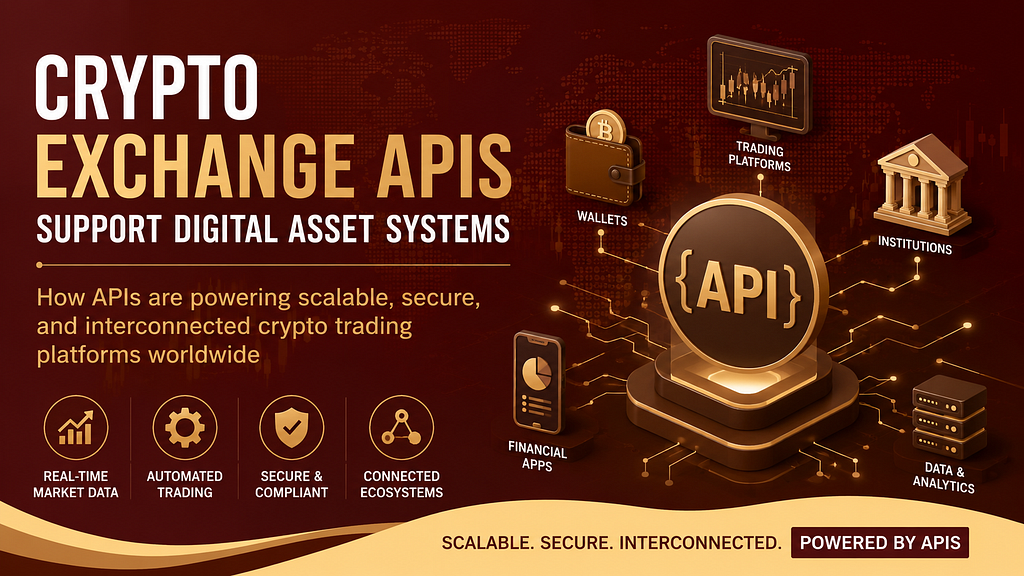
How APIs are powering scalable, secure, and interconnected crypto trading platforms worldwide
Today, crypto exchange APIs quietly link trading sites, wallets, and money apps across borders. These systems let pieces talk without fuss. Global markets shift under their quiet connections. Digital finance evolves, not loudly but through steady links behind the scenes.
ChatGPT Generated Image
Real time tools for accounts, trading, and live market feeds reach builders and firms through organized pathways, opening space for growth that stretches on demand.
With more people using them, APIs now underpin how trading platforms share funds, automate trades, sometimes even mix old-style exchanges with new blockchain ones. Their role quietly expands wherever data needs to flow without friction.
Crypto Exchange API Ecosystem Explained
Picture a network where software talks to cryptocurrency exchanges through special digital bridges. Instead of clicking buttons on a website, programs use these links to check prices across coins. One piece might pull live rates while another places trades at the same time.
Communication happens behind the scenes, smooth and constant. Each tool connects only when needed, doing its job quickly. Information flows both ways without delays or manual steps. Think of it like invisible threads tying apps to market movements.
Functions such as buying or selling activate remotely using coded signals. The whole setup runs even when users are nowhere near a screen. It simply works, quietly, continuously, precisely.
Most of today’s trading apps rely on these systems to connect smoothly with worldwide crypto exchanges, letting individual traders alongside big firms join quickly without constant hurdles while handling growth well. Because of them, creating financial tech tools takes far less effort than before.
Real-time market data feeds for price trackingOrder execution endpoints for automated trading strategiesAccount integration for portfolio and balance management
Basic Parts of an API System
Out of the gate, secure login protocols form the backbone of crypto trading platforms. Moving along, real-time market feeds keep information flowing without delay. Instead of just linking parts, live order processors handle buys and sells at rapid pace.
Behind each trade, clearing networks finalize deals across borders quietly. Taken one step further, these pieces sync up seamlessly under heavy load.
Secure API key authentication and OAuth protocolsWebSocket streams for live market updatesMatching engine integration for fast order processing
Most times, you’ll find these levels stacked to manage big waves of trades without slowing down. When things stay up and running smoothly, outside tools still plug in, think tracking software, automated programs, or bank-grade setups. Because of that flow, APIs end up acting like the core pulse inside today’s digital currency markets.
Role in Trading and Liquidity
Most of today’s trading runs on APIs, silent links moving data between platforms without delay. When prices shift across exchanges, those connections spot gaps fast. One system checks order depth while another adjusts exposure, all within seconds. Speed matters most when volatility spikes. Instead of waiting, automated tools react, balancing positions before losses grow. These flows depend entirely on live feeds pulled straight from exchange engines.
Cross-exchange arbitrage opportunities via unified APIsHigh-frequency trading execution with low latency systemsPortfolio re-balancing and automated trading bots
What happens next? Fragmented markets start acting like one big pool of money, linked through smart connections. As a result, prices get clearer while gaps between buy and sell levels shrink. When conditions shift, programs made by developers react right away instead of waiting around.
Efficiency climbs because everyday traders and large firms benefit at once. Execution speeds up, decisions grow sharper, markets stretch wider. Across digital assets worldwide, clarity improves along with how fast things move. Transparency gains strength just as much as performance does.
Security and Compliance Layers
Security shows up first when dealing with crypto exchange APIs, trust needs structure. Instead of just hoping things stay safe, strong rules back every move. Encryption wraps data tight. Access limits who can do what. Watching activity catches slips early. Compliance keeps actions within clear boundaries. Without these pieces, risks grow fast.
Multi-factor authentication and token-based access controlEnd-to-end encryption for sensitive financial dataContinuous monitoring for fraud detection and risk management
Meeting rules like KYC and AML gets built right into how APIs work, keeping things aligned with worldwide money regulations. Because of that, exchanges, people using them, and big finance players find it easier to rely on one another.
Fewer hiccups pop up in daily operations, while the system runs more smoothly no matter where you are. Security ends up being what holds everything together when growing crypto platforms through APIs around the globe.
What comes next for crypto systems built on api’s
Automation pushes crypto exchange APIs forward, linking them more closely with DeFi systems. These connections grow stronger over time because technology adapts constantly. Backbone structures shift quietly beneath new financial tools. Evolution happens without fanfare, yet changes everything slowly.
AI-powered trading APIs for predictive analyticsCross-chain interoperability for multi-network tradingInstitutional-grade API marketplaces for fintech developers
Down the line, tools such as blockchain scalability upgrades mixed with automated contracts could push how APIs function much further. As a result, links between old-school banking systems and cryptocurrency networks may flow without hitches.
With that, coders might find it easier to shape strong, safe, tailor-made money apps. Step by step, these changes stand to reshape the backbone of worldwide finance, quietly fueling what comes next in fintech.
Crypto Exchange APIs Support Digital Asset Systems was originally published in Coinmonks on Medium, where people are continuing the conversation by highlighting and responding to this story.