
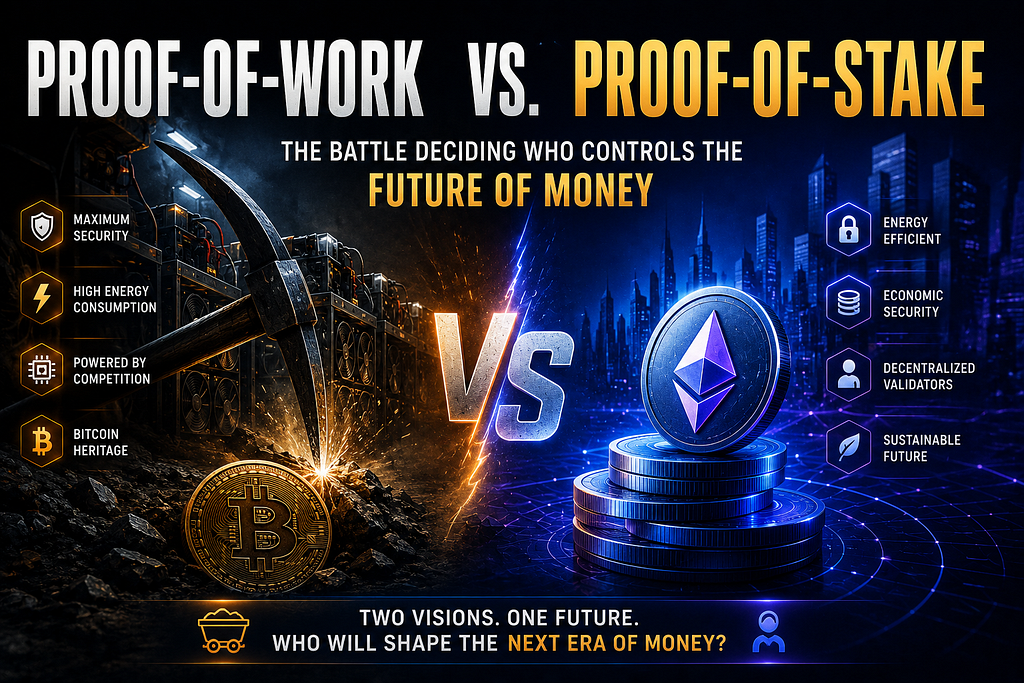
Every financial revolution has a power struggle at its core. This one is playing out in code.
Proof-of-Work vs. Proof-of-Stake — Who Controls the Future of Money?
In 2009, a pseudonymous developer named Satoshi Nakamoto launched Bitcoin and quietly introduced the world to a concept that would eventually threaten the foundations of modern finance: decentralized consensus. The idea was radical — a network of strangers agreeing on financial truth without a bank, government, or trusted intermediary in the room.
The mechanism Satoshi chose to make this possible was called Proof-of-Work (PoW). It worked. Beautifully. And for over a decade, it was the unquestioned backbone of the entire cryptocurrency ecosystem.
Then Ethereum flipped the switch.
In September 2022, Ethereum completed “The Merge” — one of the most ambitious software upgrades in the history of the internet — transitioning its entire $200 billion+ network from Proof-of-Work to Proof-of-Stake (PoS). The crypto world split into two camps almost overnight: those who called it a triumph of sustainable engineering, and those who called it a catastrophic betrayal of everything blockchain was supposed to stand for.
That debate isn’t just technical. It’s philosophical, political, and financial. The outcome will determine who gets to participate in the next monetary system, who profits from it, and who gets left behind.
This is that story.
What Is Proof-of-Work? (And Why It Matters More Than You Think)
At its core, Proof-of-Work is a competition. To add a new block of transactions to the Bitcoin blockchain, miners around the world race to solve an extraordinarily difficult mathematical puzzle. The first one to solve it wins the right to write the next page of the ledger — and earns a reward in Bitcoin for doing so.
The “work” is intentional. Solving these puzzles requires massive computational power, which requires massive amounts of electricity. This energy expenditure is the entire point. It creates what cryptographers call economic finality: reversing a transaction would require an attacker to redo all the computational work of every block since that transaction, an effort so expensive it becomes practically impossible.
Bitcoin’s Proof-of-Work has now secured over $1 trillion in value for 15+ years without a single successful hack of the base protocol. That track record is not an accident — it is the direct product of the thermodynamic cost baked into every block.
The key properties of Proof-of-Work:
Security through physics: Attacking the network requires real-world resources — hardware, electricity, time. You can’t fake the work.Permissionless participation: Anyone with the right hardware can mine. Geographic distribution is a feature, not a bug.Censorship resistance: No single entity controls which transactions get included. Miners compete independently.Battle-tested: Bitcoin’s PoW has operated continuously since January 2009, weathering market crashes, regulatory crackdowns, and nation-state bans.
But PoW has a problem — and it’s a big one. According to the Cambridge Centre for Alternative Finance, Bitcoin’s annual energy consumption rivals that of entire countries. As climate change moves from background concern to front-page crisis, the environmental cost of securing decentralized money became impossible to ignore.
Enter the challenger.
What Is Proof-of-Stake? (And Why Ethereum Bet Everything on It)
Proof-of-Stake replaces energy with capital. Instead of miners competing with computational power, validators lock up — or “stake” — cryptocurrency as collateral. The protocol randomly selects validators to propose and confirm new blocks, weighted by how much they’ve staked. Behave honestly, earn rewards. Attempt fraud, lose your stake — a penalty called slashing.
The logic is elegant: rather than wasting energy to prove commitment, you prove commitment by putting real money at risk. The network becomes self-policing because dishonesty is financially catastrophic for the validator.
Ethereum’s transition delivered what its developers promised. Post-Merge energy consumption dropped by approximately 99.95% overnight. The same network that once consumed electricity comparable to a mid-sized European country now runs on a fraction of the power of a typical office building.
The key properties of Proof-of-Stake:
Energy efficiency: Orders of magnitude less electricity consumed than PoW.Higher transaction throughput: Faster block times enable more scalable networks.Yield generation: Validators earn staking rewards, creating a native yield instrument within the protocol itself.Lower barrier to participate (in theory): No specialized mining hardware required — just tokens.
Ethereum’s bet paid off technically. Its network has processed billions of dollars in transactions, NFTs, DeFi trades, and smart contract interactions without missing a beat since The Merge. Staking yields have attracted institutional capital at a pace that would have been unthinkable under PoW.
But critics argue the tradeoffs are deeper than the energy headlines suggest.
The Real Debate: Security, Decentralization, and Who Holds the Power
Proof-of-Work vs. Proof-of-Stake — Who Holds The Power?
Here’s where the conversation gets uncomfortable.
Proof-of-Work’s critics are right that it consumes enormous energy. But Proof-of-Stake’s critics raise a more fundamental question: does replacing energy with capital make blockchains more secure, or just more like the financial system they were designed to replace?
The Centralization Problem
Under Proof-of-Work, mining is brutally competitive and geographically distributed. The market rewards efficiency — cheaper electricity, better chips, smarter operations. While mining pools have grown large, the underlying hardware is physically distributed across dozens of countries, and any miner can leave one pool and join another within minutes.
Under Proof-of-Stake, influence is proportional to holdings. Those with the most tokens have the most say in validating transactions and, in governance-enabled systems, the most say in protocol changes. Ethereum’s staking landscape is already showing concerning concentration: a handful of liquid staking providers, led by Lido Finance, control a disproportionate share of staked ETH. At its peak, Lido alone controlled over 30% of all staked Ether — dangerously close to the threshold at which a single entity could theoretically influence the network.
Bitcoin maximalists have a pointed name for this dynamic: plutocracy. The rich get richer, literally. Staking rewards flow proportionally to those who already hold the most tokens. There’s no analog to the small miner in rural Iceland running solar-powered rigs to earn Bitcoin — PoS systematically rewards capital over ingenuity.
The “Nothing-at-Stake” Problem (and Its Solutions)
Early Proof-of-Stake designs suffered from a theoretical vulnerability: validators had nothing to lose by voting on multiple competing blockchain forks simultaneously. In PoW, you can only spend your hashrate once. In naive PoS, you could bet on every outcome at no cost.
Modern PoS implementations have addressed this through slashing conditions — automated penalties that destroy a portion of a validator’s stake if they sign contradictory blocks. Ethereum’s slashing mechanism has executed penalties on validators who violated protocol rules, demonstrating that the deterrent has real teeth.
But slashing also introduces a new risk: validator mistakes, bugs, or even coordinated attacks on client software could trigger mass slashing events, punishing honest participants for technical failures rather than malicious behavior. The game theory is more complex than PoW’s elegant thermodynamic simplicity.
The Long-Range Attack Question
Proof-of-Stake networks face an attack vector that doesn’t exist in PoW: long-range attacks. Because past staking keys can be compromised or sold, an attacker who acquires enough historical private keys could theoretically rewrite blockchain history from an early point — something computationally impossible in PoW, where rewriting history requires redoing every single block’s energy-intensive computation.
PoS networks address this through mechanisms like weak subjectivity — requiring new nodes to trust a recent checkpoint — and key deletion incentives. But these solutions reintroduce a degree of social trust that PoW eliminates entirely through physics.
Proof-of-Work vs. Proof-of-Stake: Head-to-Head Comparison
Proof-of-Work vs. Proof-of-Stake
The Regulatory Wild Card Nobody Is Talking About Enough
Here’s a dimension of this debate that doesn’t get nearly enough attention: regulatory exposure.
Proof-of-Work mining is a physical activity. Miners buy hardware, consume power, and produce a commodity — cryptocurrency — through a process that regulators can loosely analogize to gold mining. It’s energy-intensive and dirty, but it’s hard to argue that a miner who solves a puzzle and earns a block reward is doing anything that structurally resembles issuing a security.
Proof-of-Stake, on the other hand, looks uncomfortably like a yield-bearing investment. You stake tokens, and the protocol pays you a return based on your stake. The SEC’s ongoing scrutiny of staking programs — including its 2023 action against Kraken’s staking service, which resulted in a $30 million settlement and a shutdown of the program for U.S. customers — suggests that regulators are actively probing whether staking rewards constitute securities under U.S. law.
This isn’t a fringe concern. If major jurisdictions determine that staked tokens are securities, it would reshape who can offer staking services, how validators must be registered, and potentially whether retail investors can participate at all. The very feature that makes PoS attractive to institutional investors — its predictable yield — may be its greatest regulatory liability.
What Institutional Investors Are Actually Doing
Whatever the philosophical arguments, capital has its own opinion.
Institutional investors have poured into Ethereum staking in earnest since The Merge. Coinbase, Kraken, Binance, and dozens of specialized staking providers now offer institutional-grade staking infrastructure. ETF products built around staked Ethereum have emerged in multiple jurisdictions. The annualized staking yield on Ethereum has ranged between 3–6%, making it one of the few crypto instruments that offers a traditional yield profile familiar to fixed-income investors.
At the same time, Bitcoin’s institutional adoption has followed a different path — one built around its PoW credentials. The narrative around Bitcoin as “digital gold” leans explicitly on the energy argument: just as gold requires physical extraction and cannot be conjured from thin air, Bitcoin cannot be created without real-world thermodynamic cost. BlackRock, Fidelity, and other asset managers have embraced this framing in their Bitcoin ETF filings.
The result is a fascinating bifurcation in the institutional crypto market. Bitcoin is being positioned as a store of value — a monetary asset secured by physics. Ethereum and its PoS peers are being positioned as productive assets — yield-generating infrastructure for the decentralized internet.
These are not competing products so much as competing monetary philosophies. And both are attracting serious capital.
The Emerging Middle Ground: Hybrid Consensus and What Comes Next
The binary framing of PoW vs. PoS obscures a more complex reality taking shape at the frontier of blockchain development.
Several projects are experimenting with hybrid consensus mechanisms that attempt to capture the security properties of PoW while achieving the throughput and efficiency of PoS. Others are exploring Proof-of-Spacetime (Chia, Filecoin) — replacing energy expenditure with storage capacity as the scarce resource underpinning consensus.
Layer 2 networks built on top of both Bitcoin and Ethereum are decoupling the security layer from the execution layer, potentially rendering some aspects of the base-layer consensus debate moot for everyday users. Bitcoin’s Lightning Network enables millions of near-instant transactions secured ultimately by PoW. Ethereum’s rollup ecosystem processes transactions cheaply and quickly, settling their security back to the PoS base layer.
The honest answer is that neither Proof-of-Work nor Proof-of-Stake has achieved the scalability, decentralization, and security simultaneously — the so-called blockchain trilemma — that would be required for truly global monetary infrastructure. Both represent serious engineering attempts at an unsolved problem.
The Verdict: What Should You Actually Believe?
After fifteen years of Proof-of-Work and two years of post-Merge Ethereum, here is what the evidence actually supports:
Proof-of-Work is battle-hardened: Bitcoin’s security record is extraordinary. No protocol-level compromise. No successful 51% attack on the main chain. No rewritten history. The thermodynamic cost is real and it works. The environmental concern is legitimate and unsolved.
Proof-of-Stake is efficient and promising: Ethereum’s transition was a technical achievement of the highest order. It dramatically reduced environmental impact, enabled new economic models, and attracted institutional capital. Its long-term security assumptions remain less battle-tested than Bitcoin’s.
Both face centralization pressures: Mining pools concentrate PoW. Liquid staking protocols concentrate PoS. Decentralization is a constant fight in both ecosystems, not a guaranteed property of either.
The regulatory story is unwritten: How governments ultimately classify staking rewards — yield or mining income, security or commodity — will profoundly shape which consensus model dominates institutional adoption over the next decade.
The battle between Proof-of-Work and Proof-of-Stake is not a battle between the old and the new. It is a battle between two different answers to the most important question in monetary design: what should it cost to be trusted?
Bitcoin’s answer: real-world energy. Irreversible, physical, thermodynamic commitment.
Ethereum’s answer: real-world capital. Skin in the game, algorithmically enforced.
Both answers are serious. Both have costs. And neither side is going away.
The future of money may well be built on both — not because we cannot choose, but because different monetary needs may demand different security assumptions. What matters most is that you understand what you own, what secures it, and what you’re betting on when you hold either.
Because in this particular battle, every wallet is a vote.
If this breakdown helped clarify the PoW vs. PoS debate, consider following for more deep-dives into blockchain technology, cryptocurrency investing, and the infrastructure of the decentralized financial system. Claps and shares help this analysis reach readers who are navigating the same questions — and that conversation is worth having at scale.
Proof-of-Work vs. Proof-of-Stake: Who Controls the Future of Money? was originally published in Coinmonks on Medium, where people are continuing the conversation by highlighting and responding to this story.