
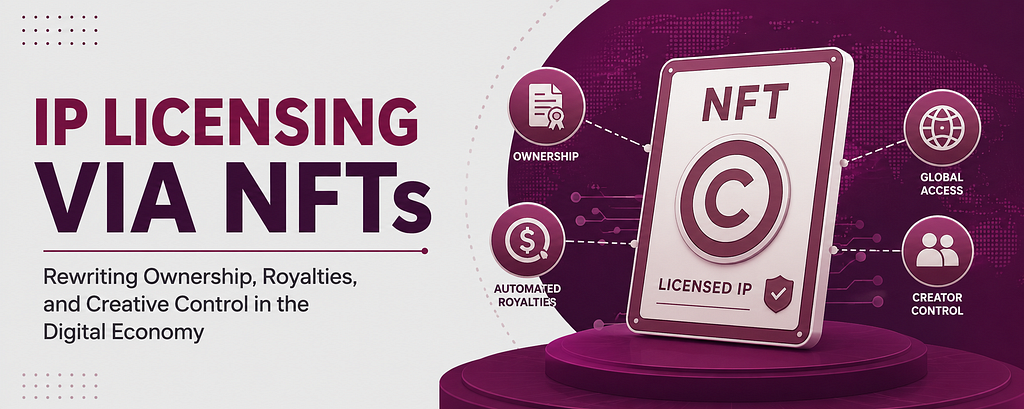
How tokenized intellectual property is transforming licensing into a programmable, transparent, and global system for creators and businesses
For decades, intellectual property licensing has been a slow, fragmented, and often opaque system. Whether it is music rights, digital art, film distribution, patents, or brand usage, the process of licensing intellectual property (IP) has relied heavily on intermediaries, manual contracts, regional restrictions, and delayed royalty settlements.
ChatGPT Generated Image
But a new infrastructure layer is emerging that challenges all of this: NFTs, or non-fungible tokens, not as collectibles, but as programmable licenses for intellectual property.
This shift is not just about digital art or speculation. It is about fundamentally redesigning how IP is owned, licensed, tracked, and monetized across global markets.
From Static Contracts to Programmable Ownership
Traditional IP licensing is built on static legal contracts. These agreements define who can use a piece of content, under what conditions, for how long, and at what cost. However, once signed, enforcement and tracking depend on legal systems, audits, and trust in intermediaries.
NFT-based IP licensing replaces parts of this structure with programmable logic stored on blockchain systems.
At its core, an NFT used for IP licensing can function as:
A digital certificate of ownership or usage rightsA programmable licensing agreement embedded with smart contract rulesA transparent ledger of transfers and royalty flowsA verifiable proof of authenticity and provenance
Instead of relying purely on legal interpretation, usage rights can now be encoded directly into digital assets.
This transforms IP from a static legal document into a dynamic digital instrument.
How NFT-Based IP Licensing Actually Works
To understand the shift, it is important to break down the mechanics.
In a typical NFT licensing model:
A creator mints an NFT representing a specific IP asset (music track, design, character, software module, etc.)The NFT contains metadata defining usage rights (commercial, non-commercial, geographic restrictions, duration, exclusivity)Smart contracts automate royalty distribution whenever the NFT is sold or sub-licensedThe blockchain maintains an immutable record of ownership and transfers
This structure introduces a level of transparency and automation that traditional licensing systems struggle to achieve.
For example, a digital illustrator can mint an NFT representing a character design. That NFT can specify:
Personal use allowed for free holdersCommercial use requires automatic payment of a licensing fee10% royalty on any secondary resaleRestrictions on modification or derivative works
All of this is enforced programmatically rather than manually.
Why Traditional Licensing Systems Are Under Pressure
The conventional IP licensing ecosystem has several persistent inefficiencies:
High dependency on intermediaries like agents, publishers, and legal firmsSlow negotiation cycles that can take monthsLack of real-time visibility into how IP is being usedCross-border enforcement challengesDelayed royalty payments and reconciliation errors
These issues are especially painful for independent creators and small businesses, who often lack access to legal infrastructure.
NFT-based licensing introduces an alternative model where enforcement and tracking are embedded in the asset itself.
Instead of chasing royalties after usage, creators can receive payments automatically when usage occurs through smart contract triggers.
Key Advantages of IP Licensing via NFTs
The shift to NFT-based licensing introduces several structural benefits that are difficult to replicate in traditional systems:
Transparency: Every transaction is recorded on-chain and publicly verifiableAutomation: Royalties can be distributed instantly via smart contractsGlobal reach: Licensing becomes borderless, reducing jurisdictional frictionFractional ownership: IP rights can be split among multiple stakeholdersReduced intermediaries: Direct creator-to-licensee relationships become possibleProgrammable constraints: Usage rules are embedded into the asset itself
This is not just an incremental improvement. It is a redesign of how value flows through creative economies.
Use Cases Emerging Across Industries
NFT-based IP licensing is not limited to digital art. It is already being explored across multiple sectors:
1. Music and Audio Rights
Artists can tokenize tracks and license streaming, remixing, or commercial use directly.
2. Gaming Assets
Game developers can license characters, skins, and environments with built-in royalty systems for secondary markets.
3. Film and Entertainment
Studios can tokenize distribution rights or character IP for global licensing deals.
4. Fashion and Digital Wearables
Designs can be licensed for both physical manufacturing and metaverse usage.
5. Software Components
Developers can license reusable code modules with automated usage tracking.
In each case, NFTs serve as a bridge between legal ownership and programmable access.
The Role of Smart Contracts in IP Enforcement
Smart contracts are the backbone of NFT-based licensing systems. They define and enforce conditions such as:
Payment thresholds before access is grantedAutomatic royalty splits among stakeholdersTime-bound licensing expirationTransfer restrictions or sublicensing permissionsDynamic pricing based on usage demand
This reduces reliance on post-facto legal enforcement.
For instance, if a brand wants to use a licensed NFT-based logo in a marketing campaign, the smart contract can automatically:
Validate license typeCharge usage feesRecord the transactionDistribute royalties instantly
This creates a near real-time licensing economy.
Challenges That Still Need Solving
Despite its promise, NFT-based IP licensing is not without significant challenges.
Some of the key issues include:
Legal recognition gaps: Many jurisdictions do not yet fully recognize NFT-based rights as enforceable contractsMetadata dependency: If licensing terms are stored off-chain, they can be altered or lostEnforcement beyond blockchain: Real-world misuse still requires legal interventionStandardization issues: No universal framework for IP licensing NFTs exists yetUser complexity: Wallets, gas fees, and blockchain UX remain barriers for mainstream adoption
These limitations mean that NFT licensing is currently more of a hybrid system than a full replacement.
The Hybrid Future: Legal + Blockchain Integration
The most likely evolution is not a complete replacement of traditional licensing, but a convergence model.
In this hybrid system:
Legal contracts define high-level rights and dispute resolution mechanismsNFTs handle execution, tracking, and automationCourts and arbitration bodies recognize blockchain records as supporting evidenceEnterprises integrate NFT licensing into existing IP management systems
This creates a layered infrastructure where blockchain handles speed and transparency, while legal systems handle enforcement and interpretation.
Why This Matters for Creators and Businesses
The shift toward NFT-based IP licensing changes the power dynamics of the creative economy.
For creators, it means:
Direct monetization without gatekeepersReal-time royalties instead of delayed payoutsGreater control over how their work is usedAbility to scale licensing globally without legal bottlenecks
For businesses, it means:
Faster licensing procurementLower administrative overheadClear provenance of IP assetsMore flexible licensing models (subscription, pay-per-use, fractional access)
This alignment of incentives is what makes the model particularly powerful.
Looking Ahead: IP as a Living Digital Asset
The most important conceptual shift is this: intellectual property is no longer just a static asset protected by law. It is becoming a living digital object that can be programmed, traded, fractionalized, and automated.
NFTs are not just a new asset class. They are a new coordination layer for creative rights.
As infrastructure matures, we are likely to see:
IP marketplaces operating like financial exchangesAutomated licensing APIs embedded into platformsReal-time royalty dashboards for creatorsAI-generated content licensed and tracked at scale
In this world, ownership is no longer a document stored in a drawer. It is a programmable state embedded into the digital economy itself.
Conclusion: The Beginning of Programmable IP Economies
IP licensing via NFTs represents a structural evolution in how value is assigned and exchanged in creative industries. While still early and facing legal and technical hurdles, the direction is clear: licensing is becoming automated, transparent, and global by design.
The transition will not happen overnight, but the foundation is already being laid. As creators, businesses, and legal systems begin to align with programmable ownership models, intellectual property will move from being a static legal construct to a dynamic economic system.
And that shift may ultimately redefine what it means to own an idea in the digital age.
IP Licensing via NFTs: Rewriting Ownership, Royalties, and Creative Control in the Digital Economy was originally published in Coinmonks on Medium, where people are continuing the conversation by highlighting and responding to this story.