
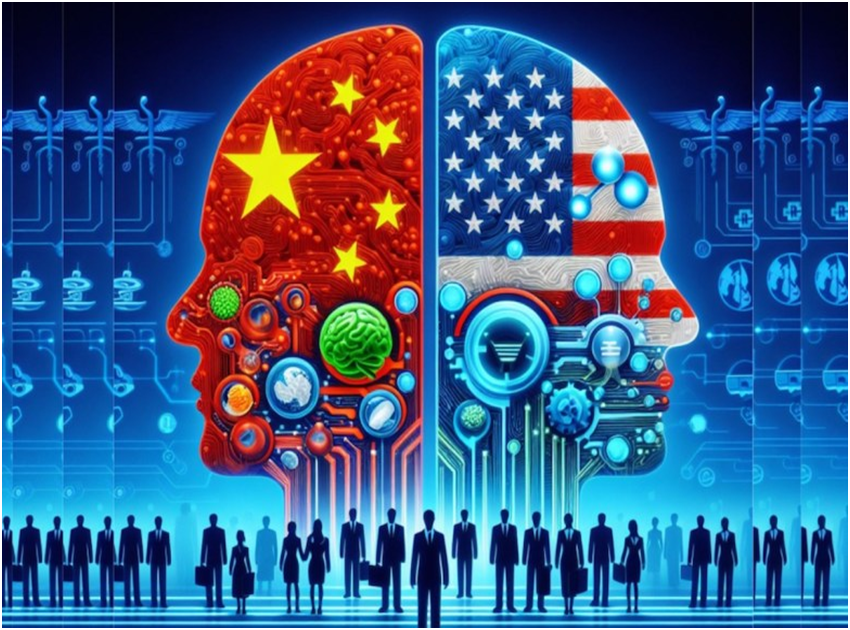
Anthropic’s Latest Paper Warns of a US-China AI Race. But its Own Logic Points to a Deeper Problem the West Is Ignoring
Copyright © 2025. iStock / @PageOfDesigns.
New here? Start with: Start Here: Exe Protocol in 5 Minutes
The Reality Behind the AI Race
The AI Race Is Real —But The Real Question Is Who Benefits
Anthropic’s latest paper, “2028: Two Scenarios for Global AI Leadership,” lays out a clear warning: The US-China AI race is real, and the ecosystem that turns model capability into deployed economic power first will shape the next era.
Exe Protocol agrees — and draws the line where the paper stops short:
The winner of the AI race will be the company, country, or ecosystem that makes users the first economic beneficiaries of the systems they power.
That reframes the race from state advantage or corporate moat-building to user economic alignment.
But the paper leaves the most important question underdeveloped:
What converts AI capability into broad economic benefit?
The Geoeconomic Reality
Anthropic frames the race as a binary between democracies that protect freedom and authoritarian regimes that enable automated repression. It flags real risks: Export-control loopholes, distillation attacks, offshore compute access, military acceleration, cyber offense, and the prospect of frontier models powering repression at scale.
These are serious dynamics, but the deeper insight in its own analysis points beyond the geopolitical framing.
The binary worldview masks a more important geoeconomic reality:
AI leadership will be decided by who turns intelligence into useful, governed action for the people and systems generating the value.
The Alignment Race
Exe operates on a different premise —viewed correctly, the future is not “Western AI against Chinese AI.” It’s aligned AI infrastructure that expands economic agency for every user — regardless of flag, ideology, or border — against non-aligned AI that doesn’t.
That is the only true binary in the AI race.
The serious question is who builds that layer first — and whether it serves users, or merely the institutions competing to control them.
Anthropic’s paper accurately outlines a four-front competition between the US and China: Model intelligence, domestic adoption, global distribution, and resilience. It arrives at the same conclusion our work points toward:
Intelligence alone is not enough.
The winner of the AI race doesn’t need the best frontier model if it integrates near-frontier AI faster into its economy, state apparatus, and global distribution channels.
What should worry Western AI companies is that — on the philosophical and developmental level — China already is.
Integrating near-frontier systems faster, cheaper, and more systematically into the real economy is something its AI+ Initiative is designed to advance.
It’s an inconvenient reality the West needs to wake up to — and fast.
Or Western AI companies risk competing on cost, integration, and deployment — only after someone else has already set the terms.
That future still spooks Western AI companies and jittery markets: DeepSeek was the preview.
What DeepSeek Actually Proved
DeepSeek mattered because it showed that AI leadership is not secured by frontier capability alone. A cheaper, near-frontier model was enough to shake the market’s confidence in the Western AI infrastructure trade.
That does not mean China has already won. It means the next phase of competition will be decided by deployment, cost, integration, and economic usefulness.
Anthropic’s own framework points to the same conclusion: Intelligence matters, but intelligence only becomes power when it is adopted, distributed, and made resilient in the real economy.
That is execution access. And execution access is alignment.
Yet neither side has calculated alignment into their plans for global market dominance.
Neither side has calculated the reaction time, track conditions or wind resistance to decisively win this race: A sprint not a marathon.
That is a strategic mistake.
A big one.
One the winner will not make — and maybe already hasn’t.
AI Alignment Is the Adoption Layer: How the Race will be Won
Why Alignment Matters
AI alignment is not yet seen by either side as the core adoption driver for AI, or its key competitive and commercial edge.
Alignment is still treated too narrowly: As a safety discipline, a governance problem, or a technical field concerned with model behavior. Those questions matter. But they do not go far enough.
Relegating the subject to debates on system objectives, decisions, and behaviors that match human intentions and values is a tactical oversight — potentially fatal in commercial terms. It’s born of a skewed view that the other race participants are behind when they are quickly edging ahead.
As the key technical field dedicated to making AI systems safe, ethical, and reliable — so they reliably do what humans actually want them to do — alignment is the key.
Make no mistake — alignment is not a side issue:
It is the adoption layer that will win (or lose) the AI race.
The commercial logic is clear. If an AI does not improve the user’s real position — economically, practically, and repeatedly — it will not earn durable adoption, no matter how capable the model becomes. And the race for that particular AI model is over before it has begun.
Who would want a subscription for it? Users don’t adopt ideology. They adopt tools that make their lives easier, cheaper, faster, or more valuable.
Exe’s thesis is that the decisive alignment question is economic:
Does AI return value to the users whose activity powers it?
That begets the question no AI company is asking (or can yet answer):
At what foundational level do users first need AI to align?
Winning the Alignment Race
The execution layer is where alignment stops being rhetoric. If user activity creates signal, and that signal funds lower-friction execution for the user, then AI begins to serve the user economically instead of merely extracting from them.
Anthropic is right that intelligence alone is not enough. But the deeper question is:
Who benefits when intelligence becomes action?
Exe’s execution access layer is where alignment becomes real. Models can reason. Agents can plan. But only policy-governed execution rails decide whether AI creates economic empowerment for every user or simply concentrates power under a different flag — for the winning side’s commercial and ideological ends.
The commercial logic is simple:
AI that expands user agency earns adoption
AI that merely concentrates power meets resistance
Empowerment begins by giving users and agents governed autonomy at the execution layer. That AI wins because it gives users what they want:
Economic relief, control, and participation at the point of action.
The outcome is clear:
Whoever wins the AI race will do so by making alignment practical for users first.
That isn’t theory. It’s not ideology. It’s architecture.
That is the architecture Exe is building.
Why Execution Access Wins
The User Is the Missing Stakeholder
Anthropic warns about authoritarian AI and the dangers of a neck-and-neck race. Fair concerns. But its analysis raises an even more uncomfortable truth — one the paper’s own framing quietly sidesteps:
The AI debate would not need to collapse into “authoritarian versus Western” if the user were treated as the central economic stakeholder.
A properly designed AI economy should not depend on which superpower wins the narrative war. It should be structurally aligned toward expanding human economic agency for every user. Full stop.
Exe’s model does not ask agents to serve state power, corporate moats, or closed platforms by default, and consequently renders most of today’s binary fear-mongering secondary.
Instead, Exe is designed so verified activity creates execution capacity, and that capacity can return value to the users, apps, agents, wallets, and systems generating it.
What Execution Access Actually Means
Exe’s execution layer ties execution access to verified economic signal — not nationality, political alignment, or jurisdictional preference.
AI produces signal constantly: User intent, workflow activity, agent decisions, transaction patterns. Today, much of that signal is treated as exhaust: Siloed, ignored, or monetized elsewhere. Exe flips that paradigm. When users, apps, or agents generate permissioned signal, Exe converts that signal into non-tradable, policy-governed execution credit.
That credit is not a speculative asset; it gates redemption under policy against eligible execution costs. Networks and routes still get paid. Users get lower-friction execution.
This is the difference between subsidy and infrastructure. Most “gasless” or “AI payments” models simply move costs from the user to a treasury, account, card, or platform balance.
Exe creates a self-reinforcing loop:
Verified activity → execution credit → policy redemption → lower landed cost → more completed activity
Activity becomes execution capacity. Execution capacity funds more activity. That’s how AI agents move from cost centers to economic participants.
That’s how alignment becomes more than a policy slogan.
It becomes foundational infrastructure tied to user economic outcomes.
Defusing The Economic Time Bomb
Few Western commentators like to discuss the economic side of AI alignment, because it cuts too close to home. The US economy has effectively placed an enormous bet on an AI industry that still has no fully proven path to profitability at scale. Compute is expensive. Inference is expensive. Scaling is expensive.
The numbers are not yet closed: Compute, inference, and scaling costs still need a self-sustaining economic loop.
The prevailing assumption is that if intelligence becomes powerful enough, the economics will eventually solve themselves.
Scale has to be converted into economics.
The only way out is to stop treating AI activity as a pure cost center. In the next AI economy Exe is building the rails for, activity becomes the basis of execution capacity.
Signal paying for signal. Activity settling activity.
That is the missing loop Anthropic’s scenarios point toward but do not name.
Exe is building that layer.
It’s called the execution access layer.
Conclusion: The Real AI Leadership Question
The real question is not whether AI serves the West or China. The real question is whether AI serves the people whose activity gives it value in the first place.
Anthropic is right that model intelligence matters. Compute matters. The political system around AI matters.
But the real leadership test is now practical:
Who gives agents the governed rails to act economically — and makes users the first beneficiaries of that activity?
Not just the best model.
Not just the biggest data center.
Not just the cheapest inference.
But the best rails for agents to act, spend, route, settle, and complete economic workflows under policy.
That is where AI capability becomes economic power. That is where alignment becomes real. That is where any ecosystem — Western, Chinese, or otherwise — either serves users economically or watches a better execution layer win adoption.
The race is not only about who builds the smartest model. It is about who ships the system that makes intelligence economically self-sustaining for everyone.
Exe is building the execution layer for that system.
The question is who recognizes that user-aligned execution access is not a feature.
It is the next competitive frontier.
Next Steps
Want to see this in production? Follow for launch updates, pilot announcements, and KPI snapshots as we stress-test Exeswap and expand to partner integrations. We’ll share what’s working, what isn’t, and the metrics behind it.
Together, we’re building infrastructure that scales without subsidies.
Connect with Us
Email: tonyexeswap@proton.me
Telegram: [Link]
Telegram Ann: [Link]
X (Twitter): [Link]
Bluesky: [Link]
Anthropic Is Right About AI Leadership — But the Real Battle Is Execution Access was originally published in Coinmonks on Medium, where people are continuing the conversation by highlighting and responding to this story.