
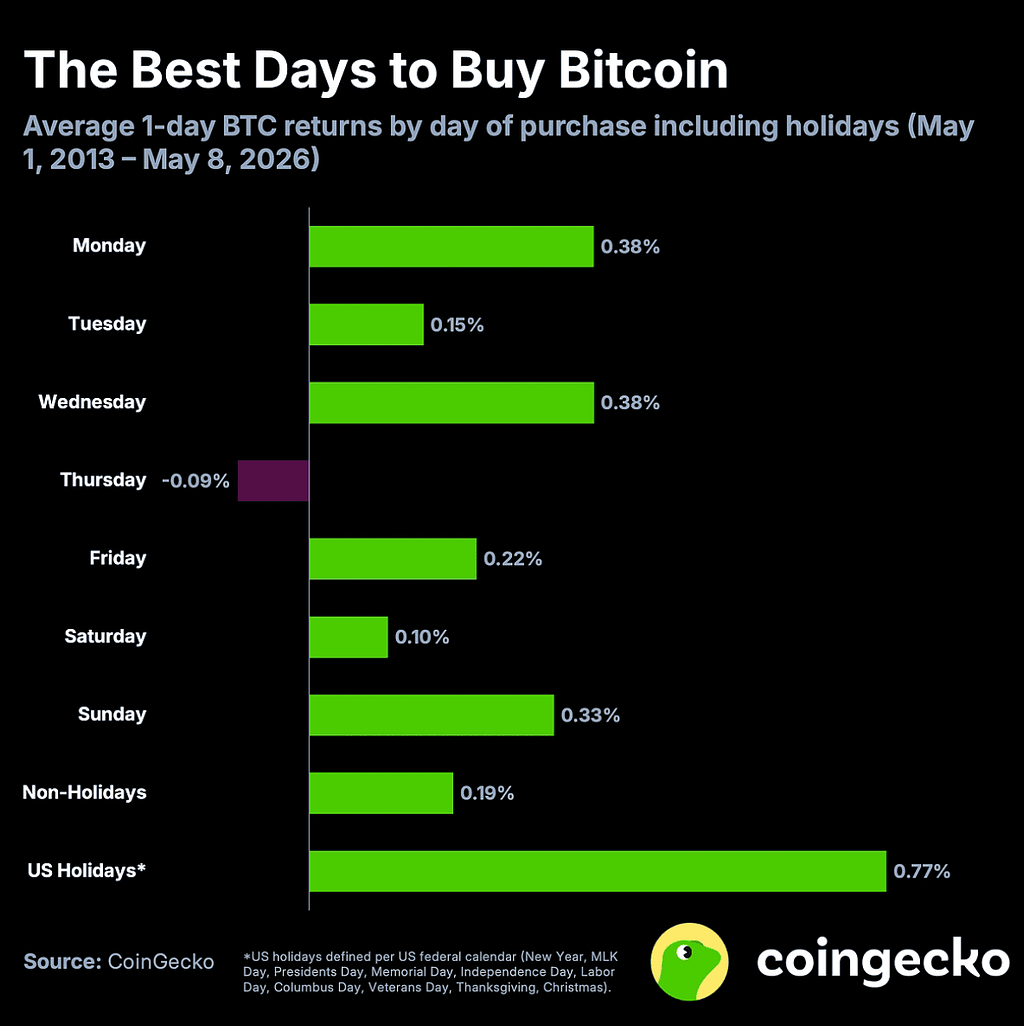
From 2013 to 2026, analysts at CoinGecko examined thousands of Bitcoin trading days to answer a deceptively simple question: does the day you buy BTC affect your returns?
At first glance, the answer looks surprising.
US federal holidays showed almost 4× higher average next-day returns than regular days. Buying Bitcoin on a holiday delivered an average +0.77% the following day versus +0.19% on ordinary days.
The standout? New Year’s Day — with an average +2.01% next-day gain and profitable outcomes in ~85% of observed cases. Other strong performers included Columbus Day, Christmas, and Labor Day. Meanwhile, Martin Luther King Jr. Day and Independence Day slightly underperformed.
It’s tempting to read this as a hidden timing edge. But zoom out — and the story changes completely.
Short-Term Patterns vs. Long-Term Reality
When the data is extended beyond a single day, the “holiday effect” quickly fades. Holding Bitcoin for a year after purchase — regardless of the entry day — produced nearly identical outcomes. Annualized returns clustered in a tight band around 142–145% across all weekdays and weekends.
Even the classic market myth of weekday vs. weekend performance didn’t hold up. Returns were almost identical:
Weekdays: 0.21%Weekends: 0.22%
Monday and Wednesday showed a mild edge. Thursday was slightly negative. But statistically, the differences are negligible in the context of Bitcoin’s volatility.
Why? Because unlike traditional markets, Bitcoin trades 24/7. There is no “weekend gap,” no opening bell, no closing session. Most legacy timing patterns simply don’t apply.
The “January Effect” and Tax Psychology
CoinGecko links New Year’s outperformance to the well-known January Effect from traditional finance. After December tax-loss harvesting and portfolio rebalancing, investors rotate back into risk assets in early January.
That behavior appears to spill into crypto as well. But again — this explains a short-term drift, not a repeatable edge you can reliably trade for long-term outperformance.
What Actually Determines Your Results
This is where the real takeaway lies. It’s not whether you bought on January 1st, Christmas, or a random Tuesday. What truly defines whether you win or lose in Bitcoin is:
Risk managementPosition sizingDiversificationEmotional disciplinePortfolio strategy
An investor who buys “on the perfect day” but overallocates, panics in drawdowns, or chases hype will underperform someone who buys on an average day with a structured plan.
Trying to optimize entry timing by calendar date is a distraction from the factors that actually move the needle.
Timing the Market vs. Managing the Portfolio
Many traders obsess over entry points measured in hours or days. Professionals think in cycles, allocation, and survivability. Bitcoin’s history shows that time in the market has overwhelmingly mattered more than timing the market.
The data from CoinGecko doesn’t give us a magic date to buy BTC. It gives us something more valuable:
A reminder that micro-patterns exist, but macro-discipline wins.
Yes — historically, US holidays showed better next-day returns. No — this should not change how you invest.
Always do your own research, invest responsibly, and never chase short-term hype.
CoinGecko Reveals the “Best” Days to Buy Bitcoin And Why It Barely Matters was originally published in Coinmonks on Medium, where people are continuing the conversation by highlighting and responding to this story.