
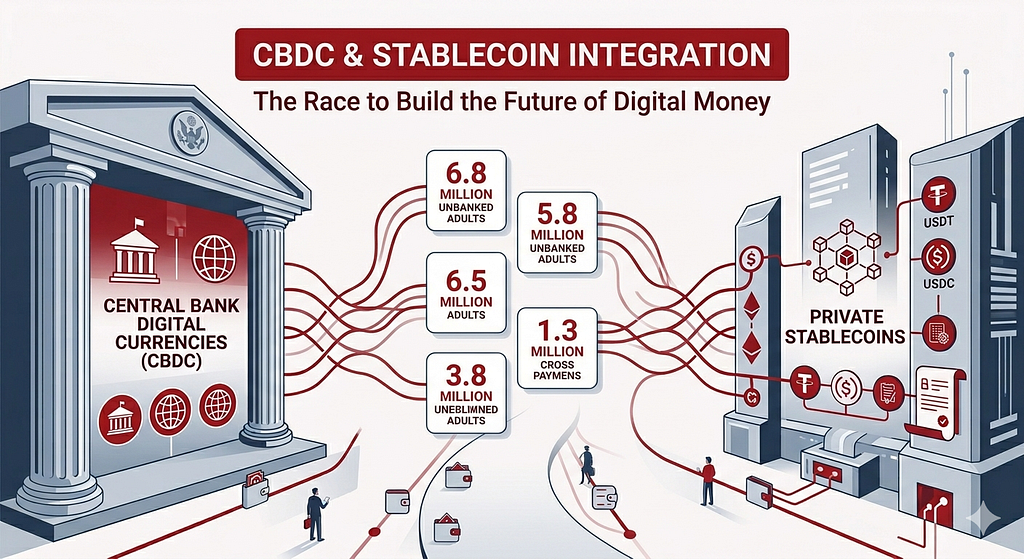
The Race to Build the Future of Digital Money
The financial industry is rapidly moving toward a future where digital currencies will become part of everyday transactions. Governments, banks, fintech start-ups, and blockchain companies are all competing to shape this new financial era. At the center of this transformation are two powerful innovations: Central Bank Digital Currencies, commonly known as CBDCs, and stablecoins.
Gemini Ai Generated Image
For years, the conversation focused on which model would dominate global finance. Governments viewed stablecoins as a challenge to monetary control, while crypto communities often criticized CBDCs for being too centralized. But the debate is now shifting from competition to integration.
Financial leaders are beginning to realize that the future may not belong to one system alone. Instead, the next stage of digital finance could be built on cooperation between CBDCs and stablecoins.
This integration could redefine payments, banking, cross-border transfers, compliance, financial inclusion, and even the global balance of economic power.
Understanding CBDCs and Stablecoins
Before discussing integration, it is important to understand the difference between these two digital assets.
What Are CBDCs?
CBDCs are digital versions of national currencies issued and controlled by central banks. They are designed to function as legal tender and are backed directly by governments.
Examples include:
Digital Yuan in ChinaDigital Rupee in IndiaDigital Euro under exploration in EuropeDigital Pound initiatives in the United Kingdom
CBDCs aim to modernize financial systems by improving payment efficiency, reducing cash dependency, and strengthening monetary control.
Key features of CBDCs include:
Government-backed valueCentralized oversightRegulatory complianceNational monetary integrationPotential offline payment capabilities
What Are Stablecoins?
Stablecoins are privately issued digital currencies pegged to stable assets such as the US Dollar, Euro, or gold. They operate primarily on blockchain networks and are designed to reduce the volatility commonly associated with cryptocurrencies.
Popular stablecoins include:
USDTUSDCDAIPYUSD
Stablecoins are widely used for:
Crypto tradingCross-border paymentsDecentralized finance applicationsMerchant settlementsDigital remittances
Unlike CBDCs, stablecoins are generally issued by private companies or decentralized protocols.
Why Integration Is Becoming Necessary
The financial ecosystem is becoming increasingly interconnected. Consumers expect instant payments, businesses want cheaper settlements, and governments need secure digital infrastructure.
Both CBDCs and stablecoins solve different parts of the same problem.
CBDCs provide trust, regulation, and sovereign backing.
Stablecoins provide innovation, flexibility, and global blockchain accessibility.
Instead of replacing one another, these technologies may complement each other in the future.
Several factors are driving this possibility.
1. Demand for Faster Global Payments
Traditional cross-border payments remain slow and expensive. International bank transfers can take several days and involve multiple intermediaries.
Stablecoins already offer near-instant transfers on blockchain networks. CBDCs could integrate with these systems to create government-approved digital settlement layers.
This combination could dramatically reduce:
Transaction costsSettlement delaysCurrency conversion inefficienciesBanking intermediaries
For global commerce, this would represent a major breakthrough.
2. Regulatory Pressure on Stablecoins
Governments are increasingly regulating stablecoin issuers due to concerns about financial stability, anti-money laundering compliance, and consumer protection.
Integration with CBDC infrastructure may provide stablecoin issuers with:
Stronger legal frameworksEnhanced credibilityCentral bank settlement accessImproved compliance standards
Rather than banning stablecoins, regulators may choose supervised coexistence.
3. Financial Inclusion Goals
Millions of people worldwide still lack access to traditional banking.
CBDCs can help governments distribute digital financial services directly to citizens. Stablecoins, meanwhile, can operate through smartphones and decentralized applications without requiring full banking infrastructure.
Together, they could expand digital finance into underserved regions more effectively than either system alone.
The Core Differences Still Matter
Even with integration discussions increasing, CBDCs and stablecoins remain fundamentally different.
Control and Governance
CBDCs are controlled by central banks and governments.
Stablecoins are controlled by private companies or decentralized communities.
This difference affects:
Monetary policyData privacyTransaction censorshipGovernance structuresFinancial surveillance
Many crypto supporters worry that CBDCs could lead to excessive financial monitoring, while regulators remain cautious about the influence of private stablecoin issuers.
Innovation Speed
Stablecoin ecosystems evolve rapidly because private companies can experiment faster than governments.
CBDCs move more slowly due to:
Regulatory requirementsNational security concernsMonetary policy implicationsPublic infrastructure testing
This creates a natural partnership opportunity.
Governments can focus on security and stability, while private innovators build user-friendly applications on top of compliant financial rails.
Cross-Border Compatibility
Stablecoins are already global by design.
A user in one country can send stablecoins to another country within minutes using blockchain infrastructure.
CBDCs, however, are mostly designed around national financial systems.
For CBDCs to achieve international scale, interoperability will become essential.
Stablecoin networks may help solve this challenge.
How CBDC and Stablecoin Integration Could Work
The future of integration could take several forms.
Stablecoins Backed by CBDC Reserves
One potential model involves stablecoin issuers holding CBDC reserves instead of traditional bank deposits.
This approach could provide:
Greater transparencyReduced counterparty riskFaster settlementsDirect central bank liquidity access
It would also increase confidence in stablecoin stability.
Hybrid Payment Networks
Governments could allow regulated stablecoins to operate alongside CBDC infrastructure.
In this system:
CBDCs handle sovereign settlementStablecoins enable innovation and programmabilityBanks provide compliance layersFintech companies create user experiences
This model may become attractive for countries seeking both innovation and regulatory control.
Cross-Chain Financial Infrastructure
Blockchain interoperability protocols may connect CBDCs and stablecoins across multiple networks.
This could allow:
Seamless currency exchangeAutomated compliance checksSmart contract settlementsMulti-currency digital commerce
Such infrastructure would move global finance closer to real-time programmable money.
The Role of Banks and Fintech Companies
Banks are unlikely to disappear during this transformation.
Instead, they may evolve into digital asset infrastructure providers.
Banks could manage:
Digital identity verificationCustody servicesCompliance systemsCBDC walletsStablecoin liquidity management
Meanwhile, fintech companies may focus on:
Payment innovationUser experience designEmbedded finance solutionsMerchant integrationsCross-border transaction tools
The companies that adapt quickly will likely dominate the next generation of financial services.
Risks That Cannot Be Ignored
Despite the opportunities, integration also introduces serious risks.
Privacy Concerns
CBDCs could provide governments with unprecedented visibility into financial transactions.
If combined with advanced monitoring systems, this could raise concerns about:
Financial freedomTransaction trackingData misuseSurveillance overreach
Balancing compliance with privacy will become one of the biggest challenges in digital finance.
Cybersecurity Threats
A fully digital monetary system increases exposure to cyberattacks.
Potential risks include:
Wallet breachesBlockchain exploitsInfrastructure outagesSmart contract vulnerabilitiesNation-state cyber warfare
Strong cybersecurity frameworks will be critical for both CBDCs and stablecoins.
Market Fragmentation
If countries build incompatible CBDC systems while private companies launch competing stablecoins, the result could be a fragmented global financial ecosystem.
Without interoperability standards, digital payments could become more complex instead of more efficient.
Which System Will Win?
The answer may surprise many people.
Neither CBDCs nor stablecoins are likely to eliminate the other.
Instead, the financial system may evolve into a layered structure where:
CBDCs provide sovereign trustStablecoins provide programmable flexibilityBanks provide regulatory infrastructureBlockchain networks provide global connectivity
This model mirrors how the internet evolved.
Governments control core infrastructure, while private companies build innovative applications on top of it.
The same pattern may emerge in digital finance.
The Bigger Picture
The integration of CBDCs and stablecoins is not just about payments.
It represents a larger battle over the future of money itself.
Questions now being debated include:
Who controls digital value?How much privacy should users have?What role should governments play in decentralized finance?Can innovation exist alongside regulation?Will global finance become more open or more controlled?
The answers to these questions will shape economies for decades.
Countries that successfully balance innovation, compliance, security, and accessibility could become leaders in the next financial era.
At the same time, companies building infrastructure around CBDC and stablecoin interoperability may unlock enormous opportunities.
Final Thoughts
CBDCs and stablecoins began as rivals competing for the future of digital money. Today, they are increasingly moving toward coexistence.
Governments need innovation.
Private blockchain ecosystems need regulatory legitimacy.
Consumers want faster, cheaper, and more accessible financial services.
Integration offers a path where all three goals can align.
The road ahead will not be simple. Regulatory battles, technological challenges, and geopolitical tensions will continue shaping the market. But one thing is becoming increasingly clear.
The future of finance will likely combine the trust of government-backed digital currencies with the efficiency and programmability of blockchain-based stablecoins.
The institutions, fintech companies, and infrastructure providers that understand this shift early may define the next generation of global finance.
CBDC vs Stablecoin Integration was originally published in Coinmonks on Medium, where people are continuing the conversation by highlighting and responding to this story.