
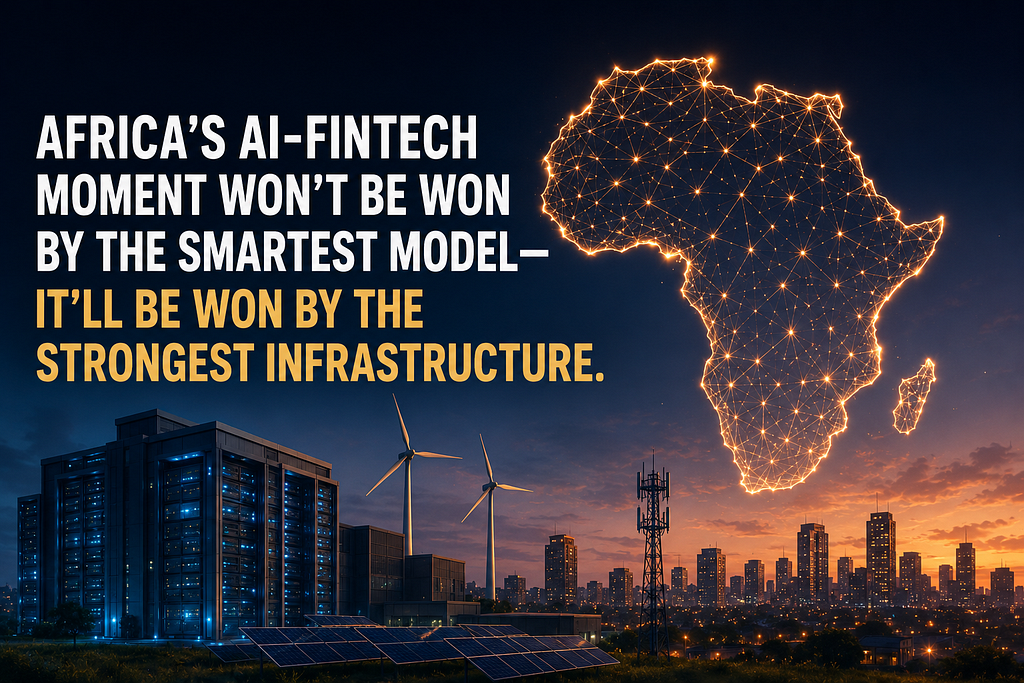
It will be won by whoever builds the strongest infrastructure
Power grids, data centers, payment rails, and governance frameworks will ultimately decide whether intelligence can actually run at scale across the continent.
Image is generated by AI
The Infrastructure Imperative
African Tech and Finance
Everyone loves the idea. AI powered lending that takes seconds. Payments that know where your money needs to go before you do. Digital commerce seamlessly woven into everyday life across Lagos, Nairobi, Accra, and Cairo.
The vision is compelling and largely correct. Artificial intelligence will transform financial services across Africa. The question that is rarely asked is simpler and more urgent: what does that AI actually run on?
The Core Argument
The Plumbing Problem Nobody Wants to Talk About
Across the global technology industry, attention gravitates toward the spectacular: model benchmarks, product launches, and startup valuations.
Infrastructure is unglamorous. It does not trend. You cannot demo a data center or photograph a payment orchestration layer. But in Africa’s fintech context, infrastructure is not background noise. It is the entire story.
The uncomfortable truth is that the most sophisticated AI agent in the world becomes an expensive demo when:
Electricity is unreliableThe data center is thousands of kilometers awayLast mile connectivity is throttledPolicy does not allow cross border money movement at scale
Intelligence without infrastructure is theater.
AI agents can only be as useful as the rails they run on. If the rails are unreliable, the product becomes a demo. If the rails are strong, the product becomes a market.
The Infrastructure Imperative
The excitement around embedded finance and agentic AI in Africa often focuses on applications. But the real winners may be invisible.
Not consumer apps. Not flashy interfaces.
But companies building:
Payment orchestration middlewareIdentity verification systemsFraud control networksLocal cloud storageEnergy efficient compute infrastructure
The Numbers
Scale of Opportunity and the Gap
57 percent
of sub Saharan Africans remain unbanked or underbanked
3 trillion plus dollars
projected size of Africa’s digital economy by 2030
Less than 1 percent
of global data center capacity is in Africa
600 million plus
people still lack reliable electricity access
These numbers reveal coexisting abundance and scarcity. Demand is massive. Mobile penetration is widespread. M Pesa and MTN Mobile Money proved adoption is real.
But supply side infrastructure remains constrained.
The Leapfrog Myth
You can skip legacy systems. You cannot skip physics.
Africa has successfully leapfrogged certain systems:
Branch heavy banking modelsCopper telephone networksPhysical software distribution
But leapfrogging does not mean skipping fundamentals.
You cannot skip:
ElectricityData infrastructureCompute resourcesGovernance systems for cross border money movement
Embedded Finance Opportunity
AI powered embedded finance, including lending at checkout, insurance in ride sharing, and agricultural credit scoring, is real.
But it depends on infrastructure:
Identity verification must workPayment settlement must be reliableRegulation must allow product design
Mobile money succeeded because mobile networks created a new infrastructure layer. M Pesa was not a software miracle. It was infrastructure plus regulation plus human networks.
The Stack
What Africa’s AI Fintech Operating System Needs
Layer 1: Power and Connectivity
Reliable electricity and broadband are foundational. Without them, transactions fail, fraud detection breaks, and AI systems cannot operate continuously.
Layer 2: Local Cloud and Compute
Most African financial data is processed outside the continent. This creates latency, cost, and sovereignty risks. Local data centers and edge compute are essential.
Layer 3: Identity and Trust
Fragmented identity systems prevent scalable AI lending. Unified identity frameworks are essential for credit and compliance systems.
Layer 4: Payment Rails
Cross border payments remain fragmented. AI driven commerce requires fast, cheap, and reliable settlement infrastructure.
Layer 5: Regulatory Framework
Policy is infrastructure. Data protection laws, AI governance rules, and licensing systems determine what is possible.
Layer 6: AI Application Layer
Only after all foundational layers exist can AI agents and embedded finance systems operate at full potential.
The Strategic Question
Building value locally vs importing intelligence
Most AI models are built and hosted outside Africa. This raises a critical question:
Who captures the value created in African financial systems?
If infrastructure remains external:
Data is generated locallyApplications are built locallyProfits flow externally
The only defense is building local infrastructure for compute, storage, and model adaptation.
The real question is not whether AI will transform African finance. It will. The question is whether Africa builds enough infrastructure fast enough to capture the value.
The Machine Money Transition
Africa’s fintech evolution has three phases:
Phase 1: Traditional banking
Branch based, slow, exclusionary
Phase 2: Mobile money
Financial access through mobile networks
Phase 3: Machine money
AI mediated financial decision making embedded in commerce
Machine money requires:
Reliable powerLocal computeData governanceFraud systemsRegulatory maturity
Who Is Building What
Payment infrastructure
Companies like Flutterwave, Paystack, and Peach Payments are building orchestration layers across fragmented systems.
Identity and fraud systems
Companies like Smile Identity and Youverify are enabling trust for digital finance.
Compute and connectivity
Data center expansions in major cities and submarine cables are slowly building digital capacity.
Regulation
The African Union digital strategy and national regulatory sandboxes are enabling controlled experimentation.
The Unglamorous Winners
The most valuable companies may not be consumer facing.
They may solve problems like:
Cross market payment settlementFraud detection under low connectivityIdentity verification without formal documentationEfficient AI inference on edge devices
These are hard infrastructure problems, not consumer apps.
The Path Forward
Governments
Treat energy as digital infrastructureHarmonize cross border regulations
Private capital
Invest in infrastructure layers, not just appsFund payment systems, data centers, identity platforms
Development finance
De risk long term infrastructure investments
AI and tech companies
Deploy local computeRespect data sovereigntyBuild for infrastructure constrained environments
Final Word
The future of African fintech will not be defined by who builds the best AI agent.
It will be defined by who can:
Keep the lights onKeep data movingKeep trust intact
Africa’s transition from mobile money to machine money is already underway. The intelligence is arriving. What remains uncertain is whether the infrastructure will arrive fast enough to capture the value it creates.
Africa’s AI Fintech Moment Won’t Be Won by the Smartest Model was originally published in Coinmonks on Medium, where people are continuing the conversation by highlighting and responding to this story.