
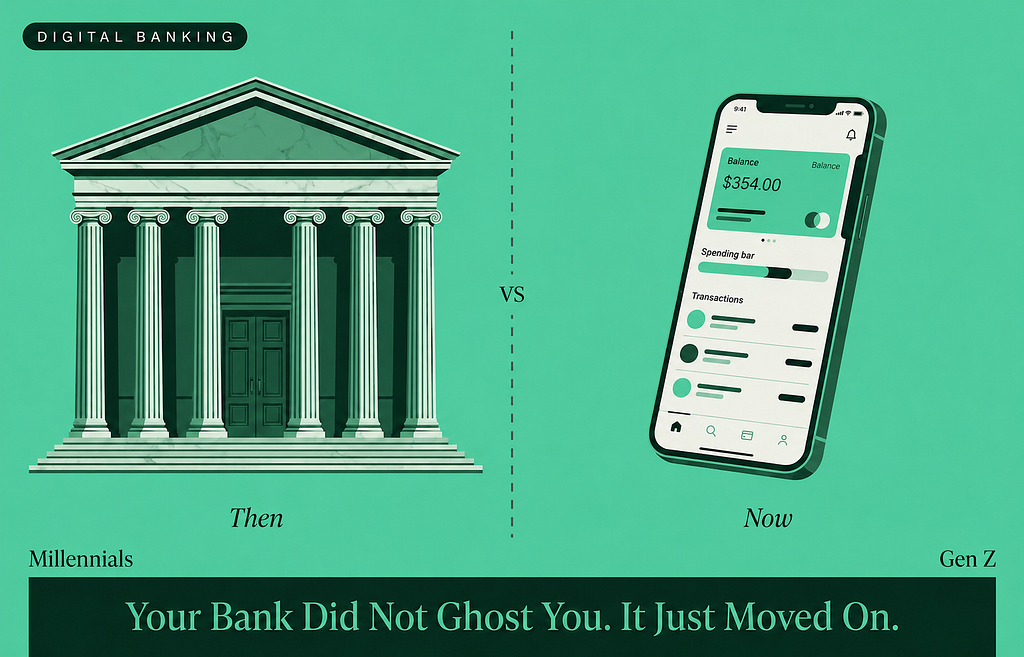
How digital banking changed the way we think about money. Why the people who grew up online feel it the most.
There is a kind of frustration that comes from waiting in line at the bank on a Tuesday afternoon. You are holding a number watching the ticker. It has not moved in eleven minutes. You took half a day off work just to update your address. Not to get a loan or a mortgage just to update your address. If you have ever been in that situation you already know why digital banking became so popular. It did not just arrive it happened suddenly.
Image Generated by Gemini AI
Here is the thing that people do not talk about enough. Digital banking is not one thing. It is not something that changed overnight and affected everyone in the way. The way a 26-year-old who has never had a checkbook thinks about money is different from the way a 38-year- who used to balance a ledger thinks about it.. Both of those are different from the way a 52-year-old who still keeps a savings book thinks about it. What changed is not the technology it is the way people think about their money.. Depending on which generation you are from that change either feels like freedom or feels like the ground is moving under your feet.
The World Before the App
To understand what digital banking replaced you have to think about what it was like to go to the bank
For people who were young in the 1990s and early 2000s going to the bank was something you did in person. You went to the branch you talked to a teller you got a statement in the mail a month. That statement was often the way you knew how much money you had. If you wanted to check your balance you had to call a number and listen to a robot voice. There were no alerts if someone stole your card. If your card was stolen you often did not find out until weeks later.
Getting a loan was also a mystery. You had to sit down with someone who looked at a paper file and made a decision. It could take days to find out if you got the loan. If you did not get it you got a letter in the mail. There was no way to find out instantly if you qualified for a loan. The whole system was based on the idea that the bank had all the power.
For the younger generation that is not how it was. The oldest of them were teenagers when banking apps started to appear. By the time they opened their bank accounts they expected to be able to do everything online. They did not experience the change as a revolution. To them digital banking is just what banking is. The idea of going to a bank to deposit a check seems as fashioned as rewinding a VHS tape.
What. Why It Affected Different Generations
The changes that happened on the surface are easy to see. Apps replaced branches alerts replaced statements tapping to pay replaced signing receipts.. Beneath those changes there were deeper shifts that changed the way each generation thinks about money.
For one thing it became normal to be able to see your money in time.
For people who were adults when digital banking started, being able to see their exact balance watching transactions happen in real time getting a breakdown of where their money went was a big deal. It felt liberating. It was not a feature it was a way to balance out the power between the bank and the customer.
For the generation that was just how it was. They expected to be able to see their money all the time. What surprises them is when they cannot see it. The idea that a bank might take a days to process a transfer seems like a design flaw to them. They are used to a world where things happen instantly.
Trust also changed.
Older generations trusted banks because of the way they looked. The big buildings, the tellers, the certificates on the wall all of those things said that the bank was safe and reliable.. Digital banking changed that. Now trust comes from design from being able to get help when you need it from reviews and ratings. For some people that shift was hard to get used to. They still feel a little uneasy when they use a bank that does not have a branch.. For the younger generation a good app with transparent fees and fast support is more trustworthy than a branch they would never visit.
The way people think about spending also changed.
Budgeting apps, savings features, spending breakdowns all of those things turned managing money into something like a wellness practice. For people who were adults during the 2008 recession those tools were a way to take control of their finances. Being able to see where their money was going was not always comfortable. It was helpful.
For the generation those tools are not just helpful they are necessary. They are growing up during a time of uncertainty and they need to be able to track their money and automate their savings. It is not a nice thing to have it is a way to feel in control.
The New Landscape: What Digital Banking Looks Like Now
The term “ banking” covers a lot of things from traditional banks with good apps to online-only banks with no physical presence. Understanding the difference matters because it affects how people use their money.
Traditional banks have tried to modernize their interfaces. They still have old systems underneath. Transfers still take time international payments still have hidden fees customer service still uses systems. The app looks modern. The underlying structure is still the same.
Online- banks on the other hand were built from scratch with digital banking in mind. They do not have branches to maintain they do not have systems to integrate. They can move faster charge fees and build products that feel more natural to younger users. They offer features like paycheck access, split payments and international transfers at good rates.
Online-only banks are still figuring out how to be viable in the long term. Some have struggled with customer support others have faced problems. Not having branches can be a problem when something goes wrong and you need help.
The Trust Equation That Nobody Talks About
Digital banking has also created risks that did not exist before. Phishing attempts, account takeovers scams that pretend to be bank notifications all of those things are real and growing. Just because someone is good with technology does not mean they are immune to those risks. If anything, being comfortable with interfaces can make you feel safer than you really are.
The difference that matters is not what generation you are from it is how well the bank is built. A good digital bank invests in security and education not just design. The ones that do not take security seriously create problems for everyone.
At the time digital banking has introduced tools that make it easier to spot fraud. Instant alerts, the ability to freeze your card from an app all of those things make it safer than the way of banking. Long as the platform is built with security in mind digital banking is safer, than what came before.
Where This Is All Going
The future of banking is heading in a few directions that are already visible.
Money and banking are changing fast. Young people are using apps and websites to manage their money without thinking about it as banking. They can buy things now. Pay for them later get money before they get paid and even get insurance when they buy something. All of these things are like banking. They are not done through a bank.
Artificial intelligence is being used more and more in finance. This means that computers can help people manage their money by predicting how much money they will have automatically saving money and even giving them advice on how to spend their money. These tools are getting better and better. Soon they will be a normal part of managing money. The question is, which companies will use these tools to help people and not just to collect information about them.
There is also something called banking, which lets people share their financial information with other apps and websites. This can be good because it gives people options for managing their money but it also raises questions about who owns that information and who gets to control it. Young people who are used to sharing things will have to learn more about what it means to share their financial information.
What Remains Constant Through All of It
Even though things are changing fast some things about money stay the same. When people are stressed they tend to make decisions about money.. When they are calm and have good information they make better decisions. Whether people use an app or go to a bank they still need to spend less than they earn save money and be careful about debt. These are the basics of managing money. They do not change just because we are using a screen instead of a bank.
Using apps and websites to manage money can be really helpful because it makes it easier to see how much money we have to save money automatically and to fix problems quickly.. It is not enough just to have a nice app with a lot of information. People also need to know what to do with that information. The problem is that the technology has moved faster, than peoples understanding of money many people do not know how to use the information they have.
A Final Thought Worth Sitting With
Some people think that digital banking is a good thing that makes everything better.. That is not the whole story. Digital banking has made it easier for people to access their money and manage it. It has also created new problems. It has lowered costs in some ways. It has also created new costs. It has given people information but it has also made them more anxious. The truth is that digital banking is a bag and it has both helped and hurt people.
For people who grew up before banking it is a complicated thing. It has solved some problems. It has also created new ones. For people who have never known anything else the challenge is different. They are growing up in a world where money and banking are still changing. They have to figure out how to navigate it. The old bank branches are not gone they are just hidden.. When they work well it is great.. When they do not it is a problem. Both old and young people are still learning what it means to manage money in a world that is moving fast.
Your bank did not just disappear on you. It moved on without telling you. was originally published in Coinmonks on Medium, where people are continuing the conversation by highlighting and responding to this story.