
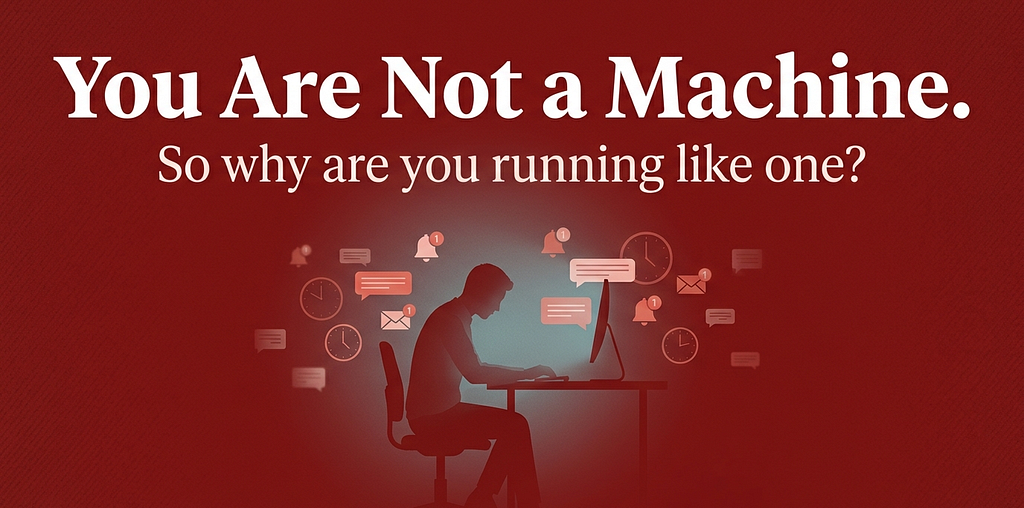
The silent toll of being on. And why your availability might be costing you more than you think.
There is a kind of exhaustion that does not show up on any chart. It does not register as a fever or a broken bone. You feel it when you’re always on never truly stopped. Not in the middle of the week not on weekends not on holidays.
You probably know someone like this. Perhaps you are someone like this.
The idea of being available all the time has been sold to us as a virtue. A sign of dedication.. Somewhere along the way the line between being reliable and being relentless got erased.
Image Generated by Gemini AI
The World That Made “Always On” Feel Normal
Not ago being unreachable was a fact of life. You left the office. The office stayed behind. You went to bed. The world continued without your input.
Then technology changed everything. Emails arrived at midnight. Messages came with read receipts and response timers. Collaboration tools became surveillance systems. The smartphone gave us a leash.. We held the other end convinced it was a lifeline.
The pandemic accelerated all of this. When home and office collapsed into the room boundaries disappeared.. When those boundaries dissolved so did the basic human right to be unreachable.
What emerged was a culture where response speed became a proxy for dedication. A delay in replying to a message was read as indifference. The pressure to perform availability became indistinguishable from the work itself.
What Constant Availability Does to You
Research shows that chronic hyperavailability activates the same stress pathways as physical danger. Your nervous system does not distinguish between a lion in the savanna and a notification demanding your attention at night. Both register as a threat.
Over time this state of sustained alertness wears down the body and mind. Sleep becomes lighter. Creativity narrows. Decision-making quality declines. Emotional regulation becomes harder. Empathy erodes.
There is also something subtler happening. When you are always available you are never fully present. The person sitting across from you at dinner can feel that a part of you is elsewhere. Your children know when your attention is half on them.
This is the cost that never shows up on any invoice. It is paid in attention in relationships in the narrowing of who you are outside of your professional role.
The Myth of the Indispensable Person
One of the stories we tell ourselves to justify availability is the story of indispensability. The belief that if we step away something important will collapse.
In most cases this story is not entirely true. Organizations and teams that depend on any persons constant availability are operating with a structural fragility. The solution is not for that person to be more available. The solution is to build systems, delegate and create ownership.
When you protect your availability as though it were an act of service you may be preventing growth and resilience. Availability in excess can become a form of control.
Reclaiming Time as an Human Resource
Some of the productive and creative people protect stretches of uninterrupted unavailable time. Not as a luxury. Not as laziness. As a necessity.
Deep thinking requires depth. Problems untangle during a walk a shower, an evening with a book. The brains default mode network is where consolidation, creativity and meaning-making happen.
Setting boundaries around availability is not a rejection of your work or the people you work with. It is a recognition that your best contributions require conditions that constant availability destroys.
This looks different for everyone. For some it means declaring certain hours off-limits. For others it means building rituals of transition between work and rest.
The Ripple Effects That Nobody Talks About
The cost of always being available radiates outward.
Teams develop “telepresence” anxiety. The low-grade stress of knowing that you should be reachable even when you are off the clock.
Leaders who model availability set a standard that their teams feel obligated to match.
Families absorb the overflow. Children who grow up watching a parent permanently attached to a device learn something about what matters.
The professional and the personal are not as separate as we have tried to make them. The habits we carry into our working lives shape the people we become.
A Different Way to Think About Responsiveness
Being responsive does not require being immediate. Being committed does not require being perpetually reachable.
Responsiveness is about quality of attention and follow-through. It is about doing what you say you will do communicating clearly and being genuinely present.
The professional cultures that are beginning to reckon with burnout, retention and long-term performance are the ones that have started asking harder questions about what availability norms are actually optimizing for.
What if the professional thing you could do was to protect your capacity to think well? What if the generous thing you could offer the people who depend on you was to arrive rested, focused and genuinely present. Even if that meant sometimes being unavailable?
Finding Your Way Back
The path, out of availability begins with a small and honest admission: that the current pace is not sustainable and that the costs are real.
It continues with the choice to treat your time and attention as finite resources that require stewardship. To communicate your availability clearly. To hold those boundaries with professionalism. To build recovery into your schedule as a non-negotiable.
It also involves a quieter internal shift: the gradual relearning of what it feels like to simply be somewhere without always checking what’s next. This is harder than it sounds for people who have spent years on alert. The silence can feel weird at first a bit suspicious.. On the other side of that discomfort is something worth recovering. The experience of being fully in your own life rather than just being next to it.
You were not made to be available all the time. Just because technology makes it possible doesn’t mean it’s an idea and just because everyone expects it doesn’t mean it’s healthy. You are a being with a limited nervous system, a life that goes beyond your job and a depth of contribution that needs conditions that technology can’t create. Only you can.
The important thing you might do this week is do nothing. Not the kind of nothing that gets things done. The real kind. The kind that lets your mind wander without a goal lets your body remember what stillness feels like and lets the part of you that’s not your job remember that it still exists.
That too is work It may be the most valuable kind you do.
A Note to the Reader
If this piece made you think. Made you recognize something feel uncomfortable or ask a question you’ve been avoiding. I would love to hear about it in the comments. The conversation around being available resting and what we owe ourselves and each other is one that needs honest talk than it usually gets.
If you found value here consider following this publication for writing that looks at work, life and being human with care and depth. Share this piece with someone who needs to read it.. If you have your own perspective. Your own experience of dealing with this tension. Consider sharing your voice. The best thinking, on these questions comes not from one writer. From a community of people willing to talk openly together.
Applaud if it resonated. Comment if you disagree. Both are welcome.
You Are Not a Machine. So Why Are You Running Like One? was originally published in Coinmonks on Medium, where people are continuing the conversation by highlighting and responding to this story.