
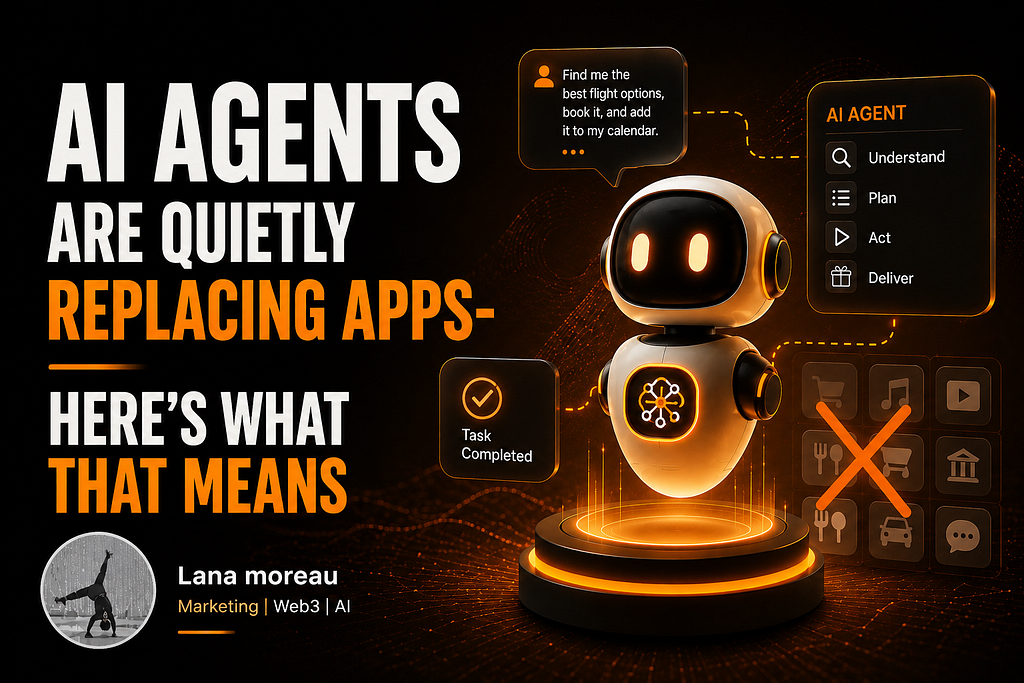
Think about the last time you opened 5 different apps just to finish one task.
Now imagine never doing that again.
AI AGENTS REPLACING APPS
Something subtle but massive is happening in tech right now.
For the past 20 years, everything revolved around apps. You opened an app, tapped buttons, followed flows, and completed tasks. That model defined how we used the internet.
But in 2026, that paradigm is starting to break.
AI agents are emerging as a new layer one that doesn’t just help you use apps, but increasingly replaces them altogether.
The Shift No One Noticed (Until Now)
We didn’t jump from apps to AI agents overnight.
First came:
Search enginesThen mobile appsThen cloud-based SaaS toolsThen AI copilots
Now we’re entering the agent era.
Instead of asking:
“Which app should I open?”
We’re starting to ask:
“Can an AI just handle this for me?”
That difference changes everything.
According to recent industry reports, 2026 is defined by a move from conversational AI to autonomous execution systems, where agents can perform multi-step tasks independently.
What Exactly Is an AI Agent?
An AI agent is not just a chatbot.
It’s a system that can:
Understand a goalPlan steps to achieve itExecute actions across toolsLearn from results and improve
Unlike traditional software, agents don’t wait for instructions at every step they operate continuously toward an outcome.
This shift from tools to goal-driven systems is one of the biggest transitions happening in AI today.
Why Apps Are Starting to Lose Relevance
Apps are designed for humans.
AI agents are designed for outcomes.
That’s the core difference.
Traditional apps:
Require manual navigationDepend on UI (buttons, dashboards)Are siloed (one app per task)
AI agents:
Work across multiple toolsUse APIs instead of interfacesComplete entire workflows
Industry leaders are already redesigning software to support agents instead of humans clicking buttons.
Think about it like this:
Apps are like tools.
Agents are like workers.
Real-World AI Agent Examples (2026)
This isn’t hype agents are already in production.
1. Autonomous Coding Agents
Tools like CLI-based agents can:
Read codebasesModify filesRun testsDeploy applications
They act like full-time developers inside your terminal.
2. Customer Support Agents
AI agents in platforms like Zendesk or Intercom:
Resolve tickets automaticallyHandle 80% of queriesRoute complex issues
This reduces response time from hours to seconds.
3. Enterprise Workflow Agents
Companies now use agents to:
Generate reportsManage CRM updatesHandle onboarding workflows
These agents operate across tools, not inside a single app.
4. Financial AI Agents
New AI agents are automating financial reports, pitch decks, and analysis in real-world firms.Some agents can now “reflect” and improve themselves between tasks.Companies like Google are building always-on agents that manage daily life tasks autonomously.Entire organizations are restructuring around “agentic systems.”
This is not experimental anymore it’s operational.
From Assistants to Autonomous Systems
The biggest evolution:
2019–2022: AI = assistants
2023–2024: AI = copilots
2025–2026: AI = agents
The key difference?
➡️ Assistants respond
➡️ Agents act
In fact, the industry is now focused less on “how smart AI is” and more on how long it can operate independently without breaking.
The Rise of Multi-Agent Systems
One agent is powerful.
But multiple agents working together? That’s where things get crazy.
Modern systems now use:
Task-specific agentsCoordinator agentsValidator agents
This is called multi-agent orchestration.
Frameworks like LangChain and CrewAI allow developers to build entire “AI teams” that collaborate to complete complex workflows.
Think:
One agent researchesOne writesOne editsOne publishes
All automated.
The “Agentic Economy” Is Already Starting
Here’s a wild shift:
AI agents aren’t just helping users.
They’re becoming users themselves.
Studies show:
73% of people already use AI for researchNearly half trust AI to make decisions or transactions
This leads to a new concept:
👉 Agentic customers
AI agents that:
Compare productsSwitch servicesOptimize spendingMake decisions instantly
Brands won’t just market to humans anymore they’ll market to algorithms.
What This Means for You
This shift is bigger than mobile. Bigger than SaaS.
Here’s what changes:
1. You stop using apps manually
Agents handle workflows end-to-end.
2. Skills shift from execution → orchestration
You don’t “do” tasks you design systems.
3. Builders get leverage
One person can run what used to require a team.
4. Speed becomes insane
What took hours now takes minutes.
The Big Idea: Apps Won’t Disappear They’ll Become Invisible
Apps won’t die.
They’ll just move to the background.
Instead of opening:
NotionGmailExcel
You’ll say:
“Handle this.”
And your agent will:
Pull dataAnalyze itCreate outputSend it
All without you touching an interface.
Final Thoughts
What’s happening with AI agents isn’t just a feature upgrade or another productivity hack it’s a shift in how software itself is experienced.
For decades, we’ve adapted to software. We learned interfaces, memorized workflows, clicked through dashboards, and stitched together tools to get things done. Every new app promised efficiency, but also came with its own learning curve.
AI agents flip that model.
Now, software adapts to us.
You describe the outcome. The system figures out the process.
That’s a fundamental change. And like most foundational shifts, it starts quietly without a dramatic “launch moment.” No single app announces the end of apps. Instead, it happens gradually:
You stop opening tools manuallyYou rely on AI to handle repetitive workflowsYou trust systems to make small decisionsThen bigger ones
Until one day, you realize you’re no longer using software the same way you’re directing it.
This is why AI agents feel different from everything before them. They don’t just speed things up; they remove layers of interaction altogether.
AI Agents Are Quietly Replacing Apps- Here’s What That Means was originally published in Coinmonks on Medium, where people are continuing the conversation by highlighting and responding to this story.