
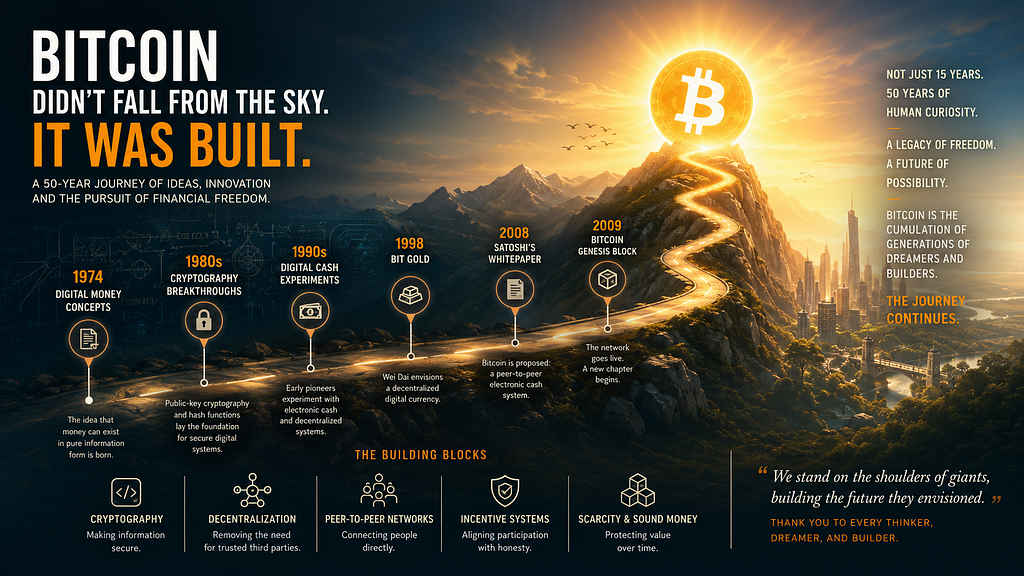
The 50-year adventure story that nobody tells you about
Imagine you were handed a 500-piece jigsaw puzzle with no picture on the box. Once you finished, would you call the person who clicked in the final piece the “inventor” of the whole thing? Probably not. You would want to know who drew the image, who cut the pieces, who spent years figuring out which shapes fit where. Bitcoin is that puzzle. And Satoshi Nakamoto clicked in the final piece.
What follows is the story of the people who built every other piece, decade by decade, long before most of us knew we needed them. No equations. No code. Just a genuinely wild adventure through the ideas that quietly assembled one of the most significant inventions in human history.
Five Decades of Building Blocks — The Road to Bitcoin
First, Someone Had to Build the Roads
Chapter One · 1974
Before anyone could dream up digital money, the world needed digital plumbing. And in 1974, it got it.
Two American researchers named Vint Cerf and Bob Kahn published a set of rules that allowed any computer on the planet to talk to any other computer. Those rules are called TCP/IP. [1] That acronym may sound alarming, but here is all you need to know: every email you have ever sent, every video you have ever watched, every Bitcoin transaction ever processed, all of it has travelled along the foundation these two people laid.
Think of it like a highway system. You can build the most extraordinary vehicle in history, but without roads, it goes nowhere. Bitcoin needed a global, open, nobody-owns-it network to live on. Cerf and Kahn built the roads. Everything else came later.
Analogy check: TCP/IP is like the postal system of the internet. It does not care what is in the parcel or who sent it. It just makes sure parcels can travel between any two addresses in the world. Bitcoin parcels, like everything else, use this same system.
The Math That Changed Everything
Chapter Two · 1976 to 1985
Over the following decade, mathematicians began solving problems that at the time looked purely theoretical. Looking back now, they were unwittingly writing the instruction manual for Bitcoin. Nobody told them that. They were just solving the puzzles in front of them.
The Padlock Trick 1976
Two researchers named Whitfield Diffie and Martin Hellman tackled what sounded genuinely impossible: how can two total strangers communicate privately without first sharing a secret password? If you have to share the password to get started, you have already lost.
Their answer was so elegant it almost feels obvious in hindsight. Imagine you hand out open padlocks to anyone who wants one. Anyone can lock something up with your padlock and send it to you. But only you hold the key that can open it. Your padlock is public knowledge. Your key stays private. [2]
That is public-key cryptography in plain terms. And every Bitcoin wallet you will ever own works exactly this way. Your wallet address, the string of letters and numbers you share with people so they can send you Bitcoin, is the open padlock. Your private key is the one thing in the universe that can unlock it and spend the coins inside. Lose the key, and the coins are gone. That is not a bug. That is precisely the point.
Later refinements made this more practical. RSA encryption arrived in 1978, and elliptic curve cryptography followed in 1985. Bitcoin uses the elliptic curve version every time a transaction is signed. Without Diffie and Hellman’s original insight, none of this would exist.
The Fingerprint Tree 1980
A Stanford researcher named Ralph Merkle solved a different problem: how do you prove a massive pile of data has not been quietly altered, without checking every single item in the pile?
His solution: give every piece of data its own unique fingerprint. Then pair up fingerprints and create a new fingerprint for each pair. Pair those, and create larger fingerprints. Keep condensing until one single master fingerprint represents the entire pile. Change anything at the bottom, and the master fingerprint at the top changes too, instantly and unmistakably. [3]
Bitcoin uses this structure, called a Merkle tree, to organise transactions inside every block. It is how your phone can confirm a payment without storing the full history of every Bitcoin transaction ever made. It just checks the master fingerprint. Without Merkle’s work, running Bitcoin software would require a hard drive of considerable size.
The Rebels Who Wanted to Reinvent Money
Chapter Three · Late 1980s to Mid 1990s
While the mathematicians were busy in their labs, a very different crowd was paying close attention and asking a much bigger question. What if ordinary people could use this cryptography to protect themselves from the people who had always had all the power?
This crowd called themselves the Cypherpunks. The name came from a writer and hacker named Jude Milhon, who went by the handle St. Jude. She fused “cipher” with “punk,” borrowing from the rebellious cyberpunk science fiction of the era, and the label stuck. [4] A member named Eric Hughes captured their whole philosophy in three words: “Cypherpunks write code.” They were not just talking about changing the world. They were building it.
The first serious attempt at digital cash came from inside this world. In 1990, a cryptographer named David Chaum founded a company called DigiCash. [5] The idea was elegant: digital tokens that worked like physical cash, anonymous and untraceable, but usable online. A handful of banks got involved. Then something went wrong. Consumer interest failed to show up, credit cards ate up the online payments market, and Chaum reportedly turned down several deals that might have saved the company. DigiCash went bankrupt in 1998.
The lesson was unmistakable: if one company controls the money, killing that company kills the money. Whatever came next would need to have no company in the middle at all.
When Pirates Accidentally Invented the Blueprint
Chapter Four · 2001
Let us take a brief detour into the world of internet piracy. Stay with me, because this part matters more than it sounds.
In 2001, a programmer named Bram Cohen released a piece of software called BitTorrent. It let users share files directly with each other, with no central server sitting in the middle. [6] Movies, music, software, all of it could flow between millions of computers without passing through any single point that someone could switch off.
Hollywood noticed. The recording industry noticed. Governments got involved. They sent lawyers, filed lawsuits, pressured internet providers, and raided servers. BitTorrent kept running anyway, because there was no single server to confiscate, no headquarters to raid, no throat to choke. The system lived inside the collective network of its users, and you cannot arrest a network.
For the people still working on digital money, watching this unfold was genuinely revelatory. If a peer-to-peer file-sharing network could survive the combined legal firepower of the world’s largest entertainment companies, what could a peer-to-peer money network survive? That question planted a seed that nobody could unplant.
Four People You Have Probably Never Heard Of
Chapter Five · 1997 to 2004
Now we meet the four figures whose work shows up most directly in the code Satoshi would eventually write. Each one came agonisingly close to finishing what would become Bitcoin. Each one was missing one final piece.
What is extraordinary about these four is that they were working in public. Their proposals were posted on mailing lists, available to anyone who wanted to read them. They were not locked away in secret corporate labs or government facilities. They were open ideas waiting for someone to assemble them.
A note on Hal Finney: He later developed ALS and gradually lost the use of his hands. He continued contributing to Bitcoin using assistive technology from his hospital bed, and died in 2014. His Bitcoin node kept running. If you read one thing from any person mentioned in this article, make it his short forum post “Bitcoin and Me” from 2013. It is free, it is short, and it is quietly one of the most moving documents in Bitcoin’s whole story. [7]
Satoshi Assembles the Puzzle
Chapter Six · October 31, 2008
On Halloween night 2008, right in the middle of the worst financial crisis in decades, Satoshi Nakamoto posted a nine-page document to a cryptography mailing list. It was called “Bitcoin: A Peer-to-Peer Electronic Cash System.” [8] The timing was almost certainly not random.
When Satoshi mined the very first Bitcoin block in January 2009, a small text message was embedded inside it: “The Times 03/Jan/2009 Chancellor on brink of second bailout for banks.” That was a real headline from that morning’s newspaper. Satoshi wanted it on the record, permanently and unalterably, that this was not an accident of timing.
What Satoshi Actually Assembled:
The One New Idea: Longest Chain Wins
2008 — Satoshi NakamotoOne rule solved the problem nobody before had cracked: how do you stop people spending the same coin twice, without a referee? You make the network the referee, and you make cheating mathematically more expensive than playing honestly. Every piece above, plus this rule, equals Bitcoin.
Satoshi did not invent the components above. They already existed in academic papers and mailing list archives. What Satoshi did was find the configuration that finally made them work together without a central point of failure. That contribution was genuine, important, and brilliant. But it sat squarely on top of fifty years of other people’s work.
The Next Time Someone Calls It Magic Internet Money
Chapter Seven · Why Any of This Matters
You now have the full picture. The ideas inside Bitcoin are public, peer-reviewed, and some of them are older than the people currently using Bitcoin. This is not a knock on Bitcoin. If anything, it makes the story more extraordinary, not less.
Every attempt at digital money before Bitcoin died the same way: one company, one server, one point of failure. Governments found the company, sent a letter, and the money disappeared overnight. Decentralisation is not a buzzword someone invented for a marketing deck. It is the hard-won lesson of every failed experiment from DigiCash to E-gold to Liberty Reserve, written in the wreckage of each one.
BitTorrent proved that a peer-to-peer network could survive sustained attack from the most powerful legal machinery in the entertainment world. Bitcoin took that proof of concept and applied it to something the stakes of which were considerably higher.
Satoshi was a synthesiser. A genuinely brilliant one, who solved a problem that had stumped everyone else for decades. But the raw materials being synthesised had been shaped, tested, and often abandoned by other brilliant minds over half a century. Standing on the shoulders of giants, as the saying goes, does not make you shorter than the giants. It just means you had good taste in whose shoulders you chose.
Bitcoin is not a 17-year-old invention. It is the final chapter of a 50-year book written by cryptographers, mathematicians, and stubborn idealists who refused to stop asking the same question. The last one just happened to find the answer.
And the really wonderful part? That entire history is sitting in old mailing list archives and forum posts, free for anyone curious enough to go looking. The story was never locked away in a vault. It was hiding in plain sight the whole time.
Sources
Cerf, V. & Kahn, R. — “A Protocol for Packet Network Intercommunication” (1974) — cs.princeton.eduDiffie, W. & Hellman, M. — “New Directions in Cryptography” (1976) — ee.stanford.eduMerkle, R. — “Protocols for Public Key Cryptosystems” (1980) — merkle.comHughes, E. — “A Cypherpunk’s Manifesto” (1993) — activism.netChaum, D. — DigiCash and the history of digital cash — chaum.comCohen, B. — “Incentives Build Robustness in BitTorrent” (2003) — bittorrent.orgFinney, H. — “Bitcoin and Me” (2013) — bitcointalk.orgNakamoto, S. — “Bitcoin: A Peer-to-Peer Electronic Cash System” (2008) — bitcoin.orgInspiration: Katie Mestre — “Bitcoin Didn’t Come from Nowhere” (2026) — bitcoinkatie.substack.com
Disclaimer: This article is intended for informational and educational purposes only and does not constitute financial or investment advice. The author is not a licensed financial advisor. Nothing written here should be interpreted as a recommendation to buy, sell, or hold any asset. All investment decisions carry risk, and readers are encouraged to conduct their own research and consult a qualified financial professional before making any financial decisions. Never invest more than you are prepared to lose.
Bitcoin Didn’t Fall from the Sky was originally published in Coinmonks on Medium, where people are continuing the conversation by highlighting and responding to this story.