
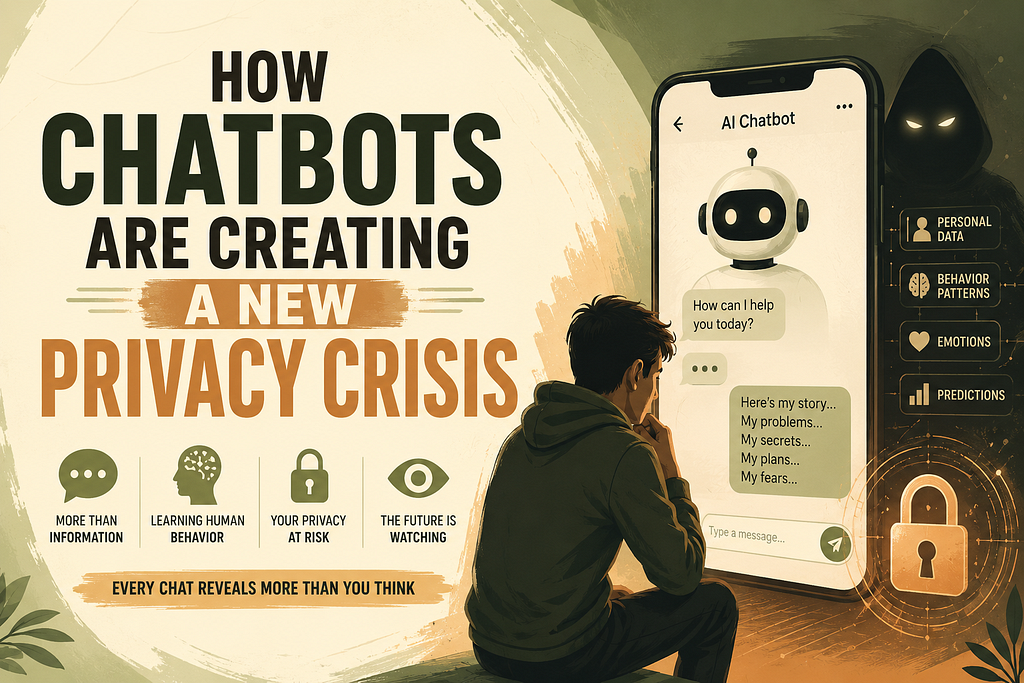
Chatbots are collecting more than information — they are learning human behavior
We used to search the internet.
Now we talk to it.
That small shift may become one of the privacy problems of this decade.
Every day millions of people are typing personal thoughts into AI chatbots.
Not just questions like “What’s the weather today?”
Things like:
* “Help me write a breakup message.”
* “How do I deal with anxiety?”
* “Can you review my business contract?”
* “Here’s my resume.”
* “Here’s my medical report.”
People are no longer treating chatbots like tools.
They are treating them like trusted friends.
That changes everything.
Image generated by ChatGPT
The Dangerous Thing About Chatbots Is How Comfortable They Feel
* Social media platforms collect data.
* Search engines track what we do.
* Apps monitor where we are.
Chatbots are different.
They invite us to share secrets.
A chatbot doesn’t interrupt us.
It doesn’t judge us.
It responds away.
It feels patient.
Sometimes it even feels like it understands our emotions.
That makes us trust it faster than any app we’ve used before.
When humans trust something they reveal more than they should.
This is where the new privacy crisis begins.
We Are Feeding AI Systems Extremely Sensitive Information
Most users don’t realize how private information they casually share with AI systems every day.
People upload:
* Legal agreements
* reports
* Password hints
* Therapy-like conversations
* journals
* Work documents
* Medical details
* Business strategies
* Relationship problems
In cases users share information they would never post publicly online.
Why?
Because chatting feels private.
But “feeling private” and “being private” are two different things.
The Illusion of a Private Conversation
When you talk to a friend in a room the conversation disappears into memory.
When you talk to an AI chatbot your words may become data.
That data can be:
* stored
* analyzed
* reviewed for safety
* used for system improvement
* or processed by third-party infrastructure
Many platforms mention this in their policies.
Almost nobody reads privacy policies anymore.
We click “Agree” the way we close popups.
Without thinking.
Without understanding the trade-off.
Ai companies know this.
Convenience Always Wins First
History repeats itself in technology.
People said yes to:
* free social media
* free cloud storage
* free navigation apps
* free photo backups
The hidden price was always data.
Now AI is following the path.
The useful chatbots become the more personal information people will share with them.
Convenience lowers caution.
That is why privacy problems often grow silently before society notices them.
AI Knows More Than a Search Engine Ever Did
A search engine sees fragments.
A chatbot sees context.
That difference matters.
Search history may show:
* “ laptops”
* “symptoms of stress”
* “cheap flights”
But chatbot conversations can reveal:
* emotions
* fears
* financial situations
* career goals
* mental health struggles
* communication style
* personality patterns
Over time AI systems may understand users on a much deeper level than traditional platforms ever could.
That creates power.
Enormous risk.
The Next Data Breaches Could Be Far More Personal
Imagine a data breach today.
Maybe your email leaks.
Maybe your password leaks.
Now imagine a chatbot conversation leaking.
Not just account information.
Your:
* private thoughts
* confidential business ideas
* emotional breakdowns
* health concerns
* personal conflicts
* unfinished plans
The emotional damage could be far greater.
Because chatbot conversations often contain the unfiltered version of ourselves.
That is the part.
Children and Teenagers May Be the Vulnerable
Young users are growing up talking to AI systems naturally.
For teenagers chatting with AI already feels normal.
Some use chatbots for:
* emotional support
* homework help
* relationship advice
* life guidance
But younger users often do not fully understand:
* data collection
* digital footprints
* long-term privacy risks
An entire generation may grow up oversharing with machines before they understand the consequences.
That could permanently redefine what privacy means.
Companies Are Moving Faster Than Regulations
Technology evolves faster than laws.
Always.
Governments around the world are still trying to understand:
* AI accountability
* data ownership
* model training ethics
* privacy
* AI-generated profiling
Meanwhile chatbot adoption is exploding globally.
Businesses are racing to release AI products because the market rewards speed.
Not caution.
This creates a gap between innovation and regulation.
History shows that when regulation arrives late users usually pay the price first.
GDPR Was the Beginning
When GDPR arrived in Europe it forced companies to take privacy more seriously.
Least publicly.
Ai introduces challenges GDPR was not fully designed for.
Because now the issue is not
* “What data is collected?”
The bigger question is:
* “What can AI infer from your conversations?”
That changes the game completely.
AI does not just store information.
It can detect patterns predict behavior and generate insights from interaction itself.
That creates a new category of privacy risk.
The Future May Divide People Into Two Groups
In the future privacy itself may become a privilege.
Some people will carefully protect their data.
Others will trade privacy for convenience without hesitation.
The gap between those groups may grow dramatically.
Because the companies with the conversational data may eventually understand human behavior better than humans understand themselves.
That level of intelligence has value.
Political value.
Advertising value.
Potentially manipulative value.
The Scariest Part? Most People Still Don’t Care
Privacy problems rarely feel urgent until damage becomes visible.
Most users still think:
* “I have nothing to hide.”
Privacy was never only about hiding wrongdoing.
Privacy is about:
* control
* boundaries
* autonomy
* and human dignity
The danger is not just that companies collect data.
The danger is that humans are becoming comfortable surrendering parts of themselves to systems they barely understand.
We are doing it voluntarily.
Final Thoughts
Chatbots may become one of the technological tools ever created.
They can educate, assist, simplify work and unlock creativity at a scale.
They are also quietly changing humanity’s relationship with privacy.
For the time in history millions of people are emotionally interacting with machines every day.
Whenever humans become emotionally comfortable they become vulnerable.
The AI revolution is not about intelligence.
It is also, about trust.
The biggest privacy crisis of the next decade may begin with a simple message typed into a chat box.
How Chatbots Are Creating a New Privacy Crisis was originally published in Coinmonks on Medium, where people are continuing the conversation by highlighting and responding to this story.