
Over $36 billion in tokenized real-world assets existed on-chain as of late 2025.
That number does not include stablecoins.
With stablecoins, the total tokenized market has already crossed $240 billion.
BlackRock, JPMorgan, DAMAC, and Franklin Templeton are all active in this sector.
So it is no surprise that founders, real estate firms, gold custodians, and carbon credit platforms are all investing in this. But how much does it cost to build a tokenization platform?
The blog contains a clear breakdown by asset type.
What Is RWA Tokenization?
RWA tokenization is the process of converting a real-world asset into a digital token on a blockchain.
Real estate, gold bars, government bonds, private credit, carbon credits, and even infrastructure projects can all be tokenized.
Once tokenized, these assets can be traded 24/7 globally.
For example, a $25 million office building tokenized into 2,500,000 tokens at $10 each means any investor can now own a slice starting at $10.
The Factors Affecting the Cost of Tokenization
Asset complexity — The more complex the asset, the more custom smart contract logic is needed.Legal and regulatory — MiCA in Europe, SEC requirements in the U.S., and other jurisdiction-specific frameworks all add to the compliance cost.Custody integration — Physical assets like gold or real estate need verified off-chain custodians.Token standard — ERC-20 for fungible tokens, ERC-721 for unique assets, ERC-1400 or ERC-3643 for security tokens with built-in compliance.
With those in mind, the cost for various tokenization platforms follows.
Digital Asset Tokenization Platform Development Cost
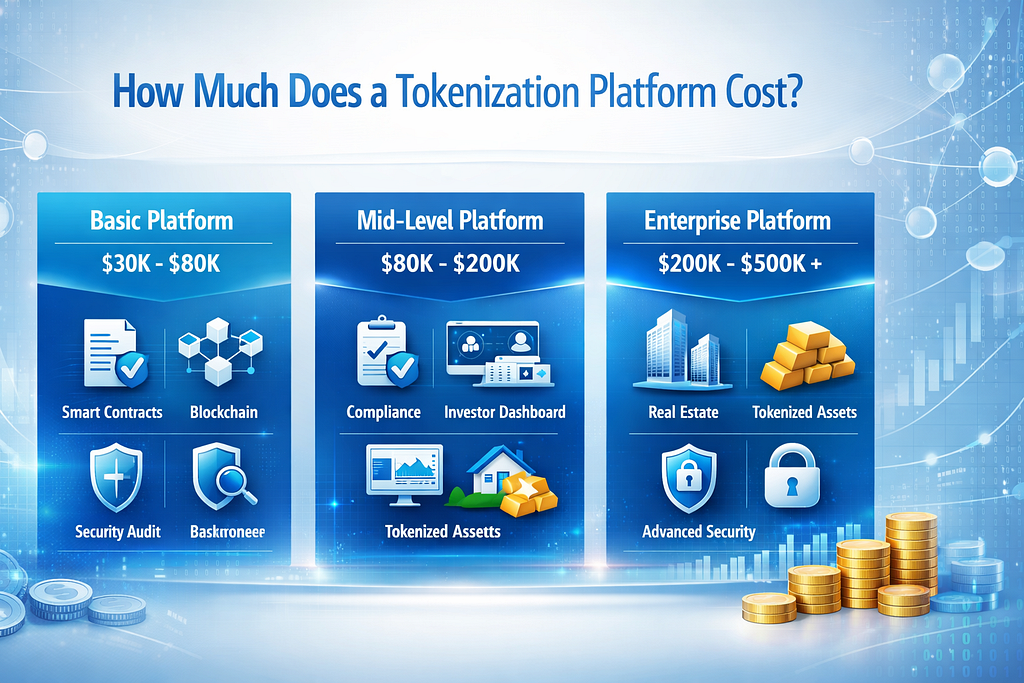
A digital asset tokenization platform development, one that handles token issuance, investor onboarding, smart contract deployment, and a basic admin dashboard, typically costs between $80,000 and $200,000 for an MVP.
Adding a secondary trading marketplace, cross-chain support, and advanced compliance modules pushes the total from $200,000 to $500,000+. It may take a few months to build.
RWA Tokenization Platform Development Cost
A dedicated RWA tokenization platform development targeting institutional-grade assets like private credit, corporate bonds, and structured products sits in the $150,000 to $400,000 range.
If you are building a multi-asset, multi-chain RWA tokenization platform development project with secondary market liquidity and institutional-grade security, budget $400,000 to $700,000+.
Because the market it serves is worth trillions. Even a 0.1% platform fee on $1 billion in assets under tokenization is $1 million in annual revenue.
Real Estate Tokenization Platform Development Cost
A focused real estate tokenization platform development for a single property type, say, residential fractional ownership, runs $100,000 to $250,000.
A full-scale marketplace for multiple property types across jurisdictions, where investors can browse, invest, receive income distributions, and trade positions costs $250,000 to $600,000+.
A real estate tokenization development company that has handled SPV structures and title-level custody before is worth paying a premium for.
Gold Tokenization Platform Development Cost
Gold tokenization is one of the cleaner builds from a technical standpoint. Paxos Gold (PAXG) and Tether Gold (XAUT) have already proven the model.
A basic gold tokenization development company engagement for a single-region platform with one vault partner and ERC-20 token issuance runs $60,000 to $150,000.
A full platform with multi-vault support, self-custody wallet compatibility, secondary market integration, and institutional-grade compliance runs $150,000 to $350,000.
Carbon Credits Tokenization Platform Development Cost
Carbon credits tokenization platform development sits at the intersection of blockchain, ESG regulation, and commodity markets.
A basic carbon credits tokenization platform with registry integration, smart contract issuance, and a compliance dashboard costs $80,000 to $200,000.
A full marketplace where businesses can browse, purchase, and retire verified tokenized carbon credits on-chain, with API integrations for sustainability reporting, runs $200,000 to $450,000.
Choosing the Best Tokenization Development Company
An asset tokenization development company that has shipped production builds across at least two or three of these asset categories before is a wise choice.
As they understand SPVs, ERC-3643, vault attestation processes, and KYC gating.
Ask the partner about the asset type, target jurisdiction, and investor base to make sure you choose the right one.
The market is getting strong, and the institutional appetite is too. Build now before it matures to grab a market share.
How Much Does a Tokenization Platform Cost? was originally published in Coinmonks on Medium, where people are continuing the conversation by highlighting and responding to this story.