
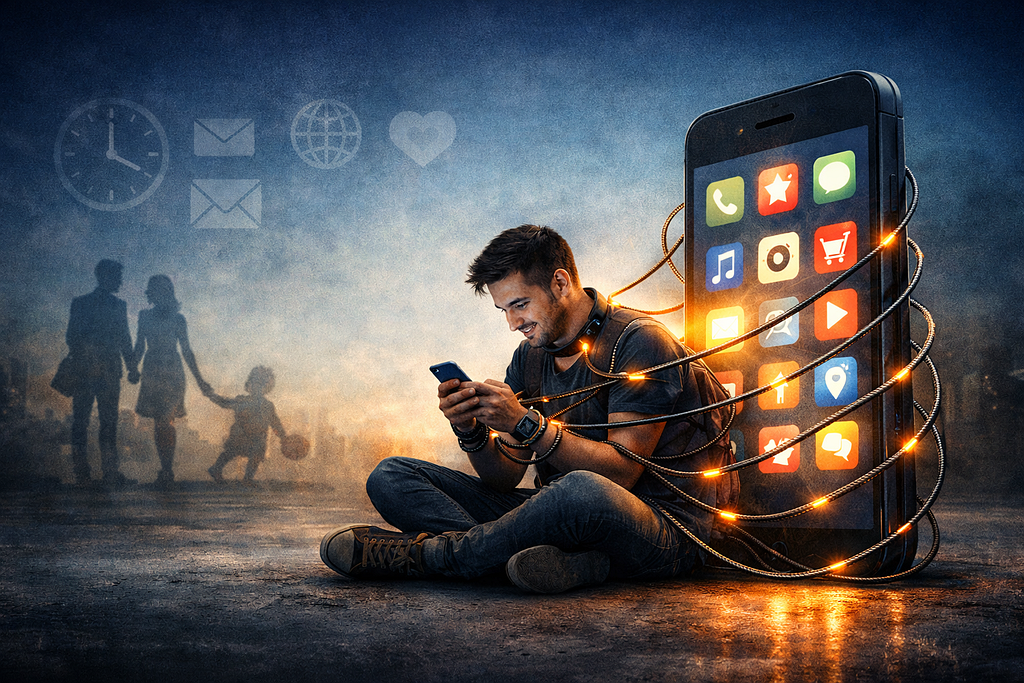
Man Vs Mobile.
— The Invisible Knot of Modern Life
In the 21st century, the first thing people look at when they wake up is their mobile phone, and the last thing they touch before sleeping is also the same device. Sometimes it makes us wonder — Is the mobile phone a tool we use, or have we become tools used by the mobile phone?
Today, a mobile phone is not just a gadget. It has become our memory, companion, calendar, camera, entertainment hub, workspace, contact book, and identity. This naturally raises the question: Is the mobile phone our necessity, or has it turned into a compulsion?
1) Necessity: Why Mobile Phones Became the Foundation of Modern Life
• Communication and Connectivity
The ability to communicate instantly from any corner of the world is one of humanity’s greatest revolutions.
• Work and Productivity
Emails, banking, notes, calendars, online meetings — everything fits in the palm of our hand.
• Knowledge and Information
Google, YouTube, online courses — knowledge is no longer in libraries; it’s in our pockets.
• Entertainment and Creativity
Mobile phones have turned everyone into creators — photos, videos, music, Reels, TikTok…
2) Compulsion: The Invisible Strings That Bind Us
• Fragmented Attention
Notifications and short videos constantly stimulate the brain.
• Digital Dependency
Losing a phone feels like losing oneself.
• Social Distance
People sit in the same room yet remain lost in their screens.
• The Trap of Dopamine (the brain’s “pleasure chemical”)
Fast, repetitive bursts of pleasure from content create addiction-like patterns.
3) What Mobile Phones Replaced — and How They Became the ‘Hero’
(Newly added column, integrated in the right place)
Mobile phones didn’t just arrive as a new technology — they replaced dozens of tools, habits, and social practices. Everything that once required separate devices is now compressed into a single screen, making the mobile phone an indispensable hero of modern life.
• Cameras
Once a separate device, now the phone is the camera, studio, and editor.
• Watches and Alarm Clocks
Timekeeping and waking up — both taken over by the phone.
• Radios and MP3 Players
Music, podcasts, radio — everything is now mobile-based.
• Flashlights
The phone’s flashlight replaced traditional torches.
• Calendars, Diaries, Notebooks
Paper tools have turned digital.
• Maps
Asking for directions is history — Google Maps guides the world.
• Cash and Banking
QR payments, digital wallets, and mobile banking made the phone a financial hub.
• Television
News, shows, sports — everything streams on the phone.
• Many Computer Tasks
Emails, Zoom, Word — 70% of computer tasks are now mobile-friendly.
• Social Interaction
Face‑to‑face conversations have shifted to digital chats.
Why Did the Mobile Become the ‘Hero’?
Because it turned:
10 devices into 1 phone10 habits into 1 screen10 tasks into 1 tap
This is how the mobile phone became the center of modern life.
4) Psychological Perspective: Why Mobile Phones Bind Us
Instant gratificationReward loopsHabit → dependency → compulsionSystems designed to exploit human psychology
Mobile phones have reshaped our minds to work in their favor.
5) Sociological Perspective: How Mobile Phones Changed Society
Family conversations have decreasedRelationships have moved onlineBoundaries between work and personal life have blurredPeople are “present” yet “absent”
Mobile phones modernized society but weakened certain human values.
6) The Solution: Balancing Necessity and Compulsion
Removing mobile phones is not the solution — balance is.
Limit screen timeControl notificationsPractice digital detoxCreate “no‑phone” family timeTreat the phone as a tool, not a master
Conclusion : Mobile Phones — Both Necessity and Compulsion
In the 21st century, mobile phones are neither purely a necessity nor purely a compulsion. They are both — a necessity when under our control, a compulsion when they begin to control us.
The final question remains: Is the mobile phone in your hand, or are you in the mobile phone’s hand ?
📱 Mobile Phones and Humans: Necessity or Compulsion in the 21st Century? was originally published in Coinmonks on Medium, where people are continuing the conversation by highlighting and responding to this story.