
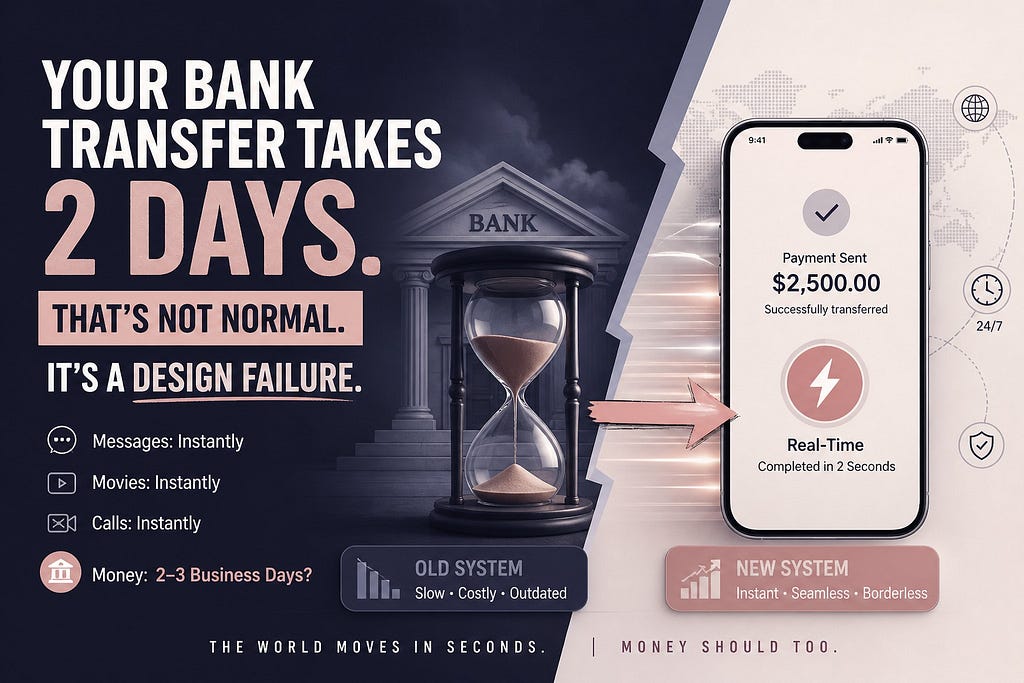
Our bank transfers take two to three business days.
That is not normal.
It is a design failure.
The world moves fast. Except for money.
You can send a message across the world in a second.
You can stream a movie instantly.
You can join a video call with someone on the side of the planet in real time.
Try sending money.
Suddenly you have to wait.
They say it is “processing”.
They say it is “settlement”.
They say it takes “business days”.
Somehow we got used to that.
Image generated by ChatGPT
The Lie We Learned to Live With
For years we were told this was normal.
That money needs time.
That transactions are complicated.
That banking systems are just slow.
But the truth is simple:
Money is not slow.
The banking system is.
The financial system was built decades ago before the internet.
Back then:
* Transactions were recorded by hand
* Communication systems were limited
* Risk management relied on delays
* Trust depended on middlemen
So banks added layers.
More layers.
Then more layers.
Each layer added time, cost and hassle.
What Actually Happens When You Send Money
A bank transfer is not a movement of money.
It is a chain of approvals, messages and settlements.
Here is what happens:
* Your bank checks the request
* Instructions are sent through payment networks
* Intermediary banks process the transaction
* Settlement happens in batches
* Final confirmation arrives hours. Or days. Later
It is not one system.
It is a chain of systems.
Chains are slow.
The Hidden Cost of Waiting
Most people think delayed payments are just annoying.
They are not.
They hurt the economy.
When money moves slowly:
* Businesses delay decisions
* Suppliers wait longer to get paid
* Employees depend on timing cycles
* Cash flow becomes unpredictable
* Opportunities disappear
Liquidity exists.
It is just stuck in motion.
We made communication fast.
We made logistics fast.
We made information flow fast.
Money?
We let it crawl.
Real-Time Money Changes Everything
When you realize this the question changes.
It is no longer:
“Why is money slow?”
It becomes:
“Why are we still using systems that make it slow?”
That is why time financial infrastructure is growing fast.
New payment systems are emerging. Not as upgrades. As complete redesigns.
In these systems:
* Transactions settle in seconds
* Payments work 24/7
* Weekends do not matter
* Middlemen are minimized
* Money moves instantly
Once people experience real-time money there is no going
Waiting two or three business days starts to feel broken.
Because it is.
This Is Bigger Than Payments
This shift is not just about speed.
It is about power.
In the system banks controlled everything and businesses adapted.
In the system infrastructure is open.
Developers, startups and platforms are building experiences into products.
Control is shifting.
When money moves instantly:
* Cash flow becomes predictable
* Global transactions feel local
* Businesses operate in time
* Entire business models change
This is not a small update.
It is a change in how economies work.
The Future of Finance Will Not Look Like Banking
The companies that win in the decade will not just have better apps.
They will understand:
* Infrastructure
* Liquidity
* Compliance
* Real-time settlement systems
Fintech is not about moving money faster.
It is about removing the concept of waiting.
The real problem was not time itself.
The real problem is that we accepted waiting for something that should be instant.
The System Is Already Being Rebuilt
Quietly the financial system is changing.
Not patched.
Not upgraded.
Rebuilt.
The biggest transformation in finance will probably not come from banks.
It will come from:
* Startups
* Infrastructure providers
* Platforms
* Developers embedding finance into products
Because the future of money will not feel like banking.
One day we will look back at “two to three business days” like we look at dial-up internet:
Slow.
Confusing.
Unacceptable.
In a world that moves in time money should too.
Final Thought
Every generation inherits systems it assumes are permanent. Until someone rebuilds them.
For decades we accepted money because we thought there was no alternative.
When technology makes instant movement possible delays stop feeling reasonable.
They start feeling outdated.
The future of finance is not about making systems slightly faster.
It is about building a world where money moves naturally and instantly like information.
When that happens waiting for money will feel as outdated, as waiting for the internet to connect.
Why Does a Bank Transfer Still Take Two Days? was originally published in Coinmonks on Medium, where people are continuing the conversation by highlighting and responding to this story.