
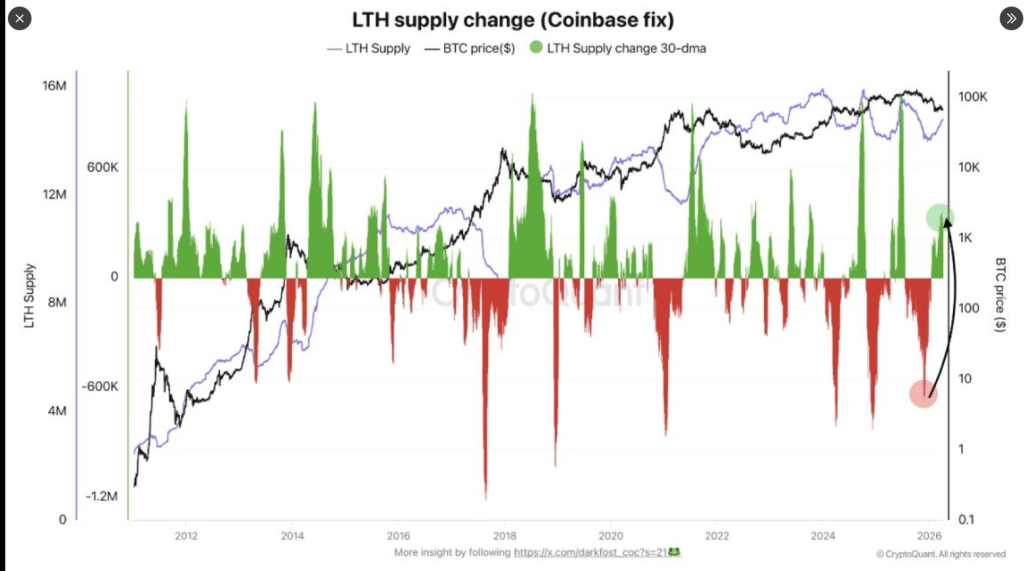
Bitcoin’s long-term holder supply change has moved back into positive territory over the past 30 days, as the coin reclaims the $71,000 level today. The data point is getting attention because only 29% of long-term holder supply is now sitting in loss, still well below the 44% to 53% levels seen at major cycle bottoms in 2015, 2018, and 2022.
Holding Behavior Returns To The Foreground
According to CryptoQuant analyst Darkfost, the latest reading suggests that more Bitcoin is aging into long-term holder status than is being sold. The move is not a clean sign of fresh buying. It mainly reflects coins that were moved six months ago and then left untouched long enough to enter the long-term holder bucket. That matters because it points to a change in behavior, not just a price bounce.
Bitcoin LTH Supply Turns Positive Again
“This represents a positive shift in investor behavior, as it suggests that holding currently dominates over selling, even while Bitcoin continues to trade within its range.” – By @Darkfost_Coc pic.twitter.com/wVOIV8S47P
— CryptoQuant.com (@cryptoquant_com) April 7, 2026
The metric had been deeply negative before. By the end of November 2025, the 30-day moving average had fallen to a little under 674,000 BTC. It has now recovered to just past 308,000 BTC. Darkfost said that in earlier market stretches, similar turns often came before price gains, though he also warned it is still too early to call it a lasting trend.
Bitcoin’s latest price action has not helped the mood. The asset pushed above $70,000 on April 6, but the move did not hold. It was quickly pulled back, and the market has remained under pressure since then. The article ties that weakness to broader geopolitical stress and its effect on risk assets.
Traders Still Watching For Confirmation
The report also points out that weak demand remains part of the picture. Darkfost said the current rise in long-term holder supply does not necessarily mean active accumulation. It can happen when holders simply refuse to sell. That distinction matters, because a higher long-term holder reading alone does not guarantee stronger prices.
Reports also compare the current setup with past cycle lows. Data shows long-term holder supply in loss reached over 50% in 2015, and around 45% and 44% in 2018 and 2022, respectively, before those bottoms formed. The current reading of 29% is still climbing, which suggests there may be room for further downside before a clear floor is established.
Featured image from Unsplash, chart from TradingView