
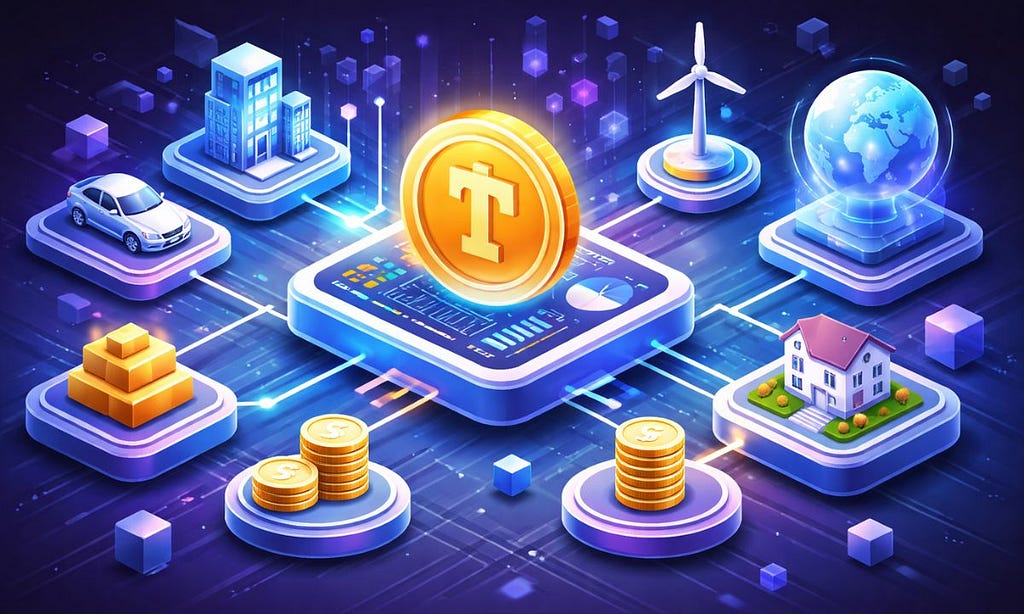
Real World Asset Tokenization has moved far beyond theoretical discussions and experimental pilots. What was once considered a niche use case within blockchain ecosystems has now emerged as a serious financial and technological development, attracting institutional attention, regulatory focus, and enterprise adoption. In 2026, the conversation is no longer about whether tokenization will matter — it is about how it is being applied, scaled, and integrated into existing economic systems.
At its core, Real World Asset Tokenization refers to the process of representing physical or traditional financial assets — such as real estate, commodities, bonds, or intellectual property — as digital tokens on a blockchain. These tokens can then be traded, divided, or managed with greater efficiency compared to traditional systems. However, what makes it unique today is not the concept itself, but the maturity of its execution, the diversity of its use cases, and the increasing alignment between technology, regulation, and market demand.
This article explores what distinguishes Real World Asset Tokenization in the current landscape, focusing on the structural, technological, and economic factors that make it one of the most significant developments in modern finance.
The Evolution From Early Blockchain Experiments
To understand what makes Real World Asset Tokenization unique today, it is essential to look at how it has evolved. Early blockchain applications primarily focused on cryptocurrencies and decentralized finance protocols. These systems operated largely in isolation from traditional financial markets, often lacking regulatory clarity and institutional trust.
Tokenization initially followed a similar path. Early projects attempted to tokenize real estate or art, but they struggled with liquidity, legal enforceability, and user adoption. Many platforms lacked the infrastructure to connect digital tokens with real-world ownership rights in a legally binding manner.
Today, that gap is closing. The uniqueness lies in the transition from isolated digital experiments to integrated financial infrastructure. Enterprises, financial institutions, and even governments are now exploring tokenization as a way to modernize asset management and distribution.
Bridging Traditional Finance and Blockchain Systems
One of the most defining aspects of Real World Asset Tokenization today is its role as a bridge between traditional finance and blockchain-based systems. Unlike earlier blockchain use cases that aimed to replace traditional systems, tokenization is increasingly designed to complement and enhance them.
This integration is visible in several ways. Financial institutions are using blockchain to issue tokenized bonds and funds, while maintaining compliance with existing regulations. Real estate firms are leveraging tokenization to offer fractional ownership without altering the underlying legal frameworks. Commodity markets are exploring tokenized representations of assets like gold or oil to improve transparency and efficiency.
The uniqueness lies in this hybrid approach. Instead of forcing a complete transition to decentralized systems, Real World Asset Tokenization allows for gradual adoption, enabling stakeholders to benefit from blockchain technology without abandoning established practices.
Fractional Ownership at Scale
Fractional ownership is not a new concept, but Real World Asset Tokenization has elevated it to a level that was previously difficult to achieve. By dividing assets into digital tokens, it becomes possible to offer ownership in smaller, more accessible units.
This has profound implications for investment markets. High-value assets such as commercial real estate, fine art, or infrastructure projects can now be accessed by a broader range of investors. Instead of requiring large capital commitments, individuals can participate with significantly lower investment thresholds.
What makes this unique today is the scale and efficiency at which fractional ownership can be implemented. Blockchain-based systems allow for real-time tracking, automated compliance, and seamless transfer of ownership. This reduces administrative overhead and opens up new opportunities for both asset owners and investors.
Enhanced Liquidity for Traditionally Illiquid Assets
Liquidity has always been a major challenge for many real-world assets. Real estate, private equity, and collectibles are often difficult to buy or sell quickly, limiting their appeal to certain types of investors.
Real World Asset Tokenization addresses this issue by enabling these assets to be traded in digital marketplaces. Tokenized assets can be exchanged more easily than their physical counterparts, potentially reducing the time and complexity involved in transactions.
The uniqueness here lies in the ability to create liquidity where it previously did not exist. While liquidity is not guaranteed and depends on market demand, the infrastructure now exists to support more dynamic trading environments. This represents a significant shift in how assets are managed and valued.
Programmability and Smart Contract Integration
Another key factor that sets Real World Asset Tokenization apart today is the use of programmable logic through smart contracts. These digital agreements can automate various aspects of asset management, including ownership transfers, dividend distributions, and compliance checks.
For example, rental income from a tokenized property can be distributed automatically to token holders based on predefined rules. Similarly, compliance requirements such as investor eligibility can be enforced at the protocol level, reducing the risk of regulatory violations.
This level of programmability introduces a new layer of efficiency and reliability. It reduces the need for intermediaries and minimizes the potential for human error. More importantly, it allows for the creation of complex financial instruments that can operate with greater transparency and precision.
Regulatory Progress and Institutional Confidence
One of the most important developments in recent years has been the progress in regulatory frameworks surrounding Real World Asset Tokenization. While challenges remain, there is increasing clarity in many jurisdictions regarding how tokenized assets should be classified and managed.
This has led to greater institutional confidence. Banks, asset managers, and investment firms are now more willing to explore tokenization as part of their operations. Pilot projects are evolving into full-scale implementations, and partnerships between technology providers and financial institutions are becoming more common.
The uniqueness of the current landscape lies in this alignment between innovation and regulation. Unlike earlier phases of blockchain development, where regulatory uncertainty created barriers, today’s environment is more conducive to sustainable growth.
Diverse Asset Classes and Expanding Use Cases
Real World Asset Tokenization is no longer limited to a few asset categories. Its application has expanded across a wide range of sectors, each with its own set of opportunities and challenges.
Some of the most notable asset classes being tokenized today include:
Real estate, including residential, commercial, and industrial propertiesCommodities such as gold, silver, and agricultural productsFinancial instruments like bonds, funds, and invoicesIntellectual property, including music rights and patentsInfrastructure assets such as renewable energy projects
This diversity is a key factor in what makes tokenization unique today. It demonstrates the flexibility of the underlying technology and its ability to adapt to different market needs.
Improved Transparency and Auditability
Transparency has always been a core advantage of blockchain technology, and it plays a crucial role in Real World Asset Tokenization. By recording transactions on a distributed ledger, it becomes easier to track ownership, verify asset history, and ensure data integrity.
This is particularly valuable in markets where trust is a concern. For example, in real estate transactions, blockchain can provide a clear record of ownership and reduce the risk of fraud. In supply chains, tokenization can enhance traceability and accountability.
What makes this unique today is the growing emphasis on auditability. Enterprises are not just using blockchain for transparency — they are leveraging it to meet regulatory requirements, improve reporting, and build trust with stakeholders.
Cost Efficiency and Operational Improvements
Traditional asset management involves multiple intermediaries, including brokers, custodians, and legal advisors. Each of these participants adds complexity and cost to the process.
Real World Asset Tokenization has the potential to streamline these operations by reducing the reliance on intermediaries. Transactions can be executed more directly, and many administrative tasks can be automated through smart contracts.
The result is a more efficient system that can lower costs for both asset issuers and investors. While not all intermediaries can be eliminated, their roles can be optimized, leading to more streamlined workflows.
Real-World Examples and Emerging Case Studies
The uniqueness of Real World Asset Tokenization becomes even more evident when looking at real-world implementations. Across different industries, organizations are experimenting with tokenization to address specific challenges and unlock new opportunities.
In the real estate sector, developers are using tokenization to fund projects by offering fractional ownership to global investors. This not only increases access to capital but also diversifies the investor base.
In the financial sector, tokenized bonds and funds are being issued with improved efficiency and transparency. These instruments can be managed more effectively, with real-time visibility into ownership and performance.
In the energy sector, tokenization is being used to represent ownership in renewable energy projects, allowing investors to participate in sustainable initiatives while earning returns.
These examples highlight the practical applications of tokenization and demonstrate its potential to reshape various industries.
The Role of Technology Providers and Platforms
Behind the growth of Real World Asset Tokenization is a growing ecosystem of technology providers and platforms. These organizations offer the tools and infrastructure needed to create, manage, and trade tokenized assets.
A typical RWA tokenization company provides services such as asset digitization, smart contract development, compliance integration, and platform deployment. These capabilities are essential for enterprises looking to implement tokenization without building everything from scratch.
The presence of specialized RWA tokenization services has made it easier for businesses to adopt this technology. Instead of navigating complex technical and regulatory challenges on their own, they can rely on experienced providers to guide the process.
Challenges That Still Shape the Landscape
While Real World Asset Tokenization has made significant progress, it is not without challenges. Understanding these challenges is essential to appreciating what makes the current phase unique.
One of the primary issues is interoperability. Different blockchain platforms and token standards can create fragmentation, making it difficult to transfer assets across systems. Efforts are underway to address this, but it remains a work in progress.
Another challenge is regulatory variation. While some regions have embraced tokenization, others are still developing their frameworks. This creates uncertainty for global projects and requires careful planning.
Additionally, liquidity is not guaranteed. While tokenization can improve access, it does not automatically create active markets. Building liquidity requires participation, trust, and robust trading infrastructure.
What Truly Makes It Unique Today
Bringing all these factors together, what makes Real World Asset Tokenization unique today is the convergence of multiple developments:
The transition from experimental projects to enterprise-grade solutionsThe integration of blockchain with traditional financial systemsThe expansion across diverse asset classes and industriesThe increasing alignment with regulatory frameworksThe availability of specialized development and service providers
This convergence creates a more stable and scalable environment for tokenization. It is no longer an isolated innovation but a growing part of the broader financial ecosystem.
The Road Ahead: A Gradual but Definite Expansion
Looking forward, Real World Asset Tokenization is expected to continue expanding, driven by both technological advancements and market demand. As infrastructure improves and regulatory clarity increases, more organizations are likely to explore its potential.
The focus will likely shift toward standardization, interoperability, and user experience. These factors will play a crucial role in determining how widely tokenization is adopted and how effectively it can be integrated into existing systems.
At the same time, new use cases will continue to emerge, further demonstrating the versatility of this approach. From supply chain management to intellectual property rights, the possibilities are extensive.
Conclusion
Real World Asset Tokenization stands at a unique point in its development. It has moved beyond early experimentation and is now entering a phase of practical implementation and broader acceptance. What sets it apart today is not just the technology itself, but the ecosystem that supports it — comprising regulatory frameworks, institutional participation, and specialized service providers.
By bridging the gap between traditional assets and digital systems, tokenization offers a new way to manage ownership, improve efficiency, and expand access to investment opportunities. While challenges remain, the progress made so far indicates a strong foundation for future growth.
In 2026, Real World Asset Tokenization is no longer just an emerging trend. It is a developing infrastructure that is gradually reshaping how assets are created, managed, and exchanged across the global economy.
Real World Asset Tokenization: What Makes It Unique Today? was originally published in Coinmonks on Medium, where people are continuing the conversation by highlighting and responding to this story.