
I want to tell you about the three weeks I spent trying to find the fraud.
Not because I was cynical for no reason. Because the claims were extraordinary. And in my experience with crypto, extraordinary claims almost always have an extraordinary catch hidden somewhere.
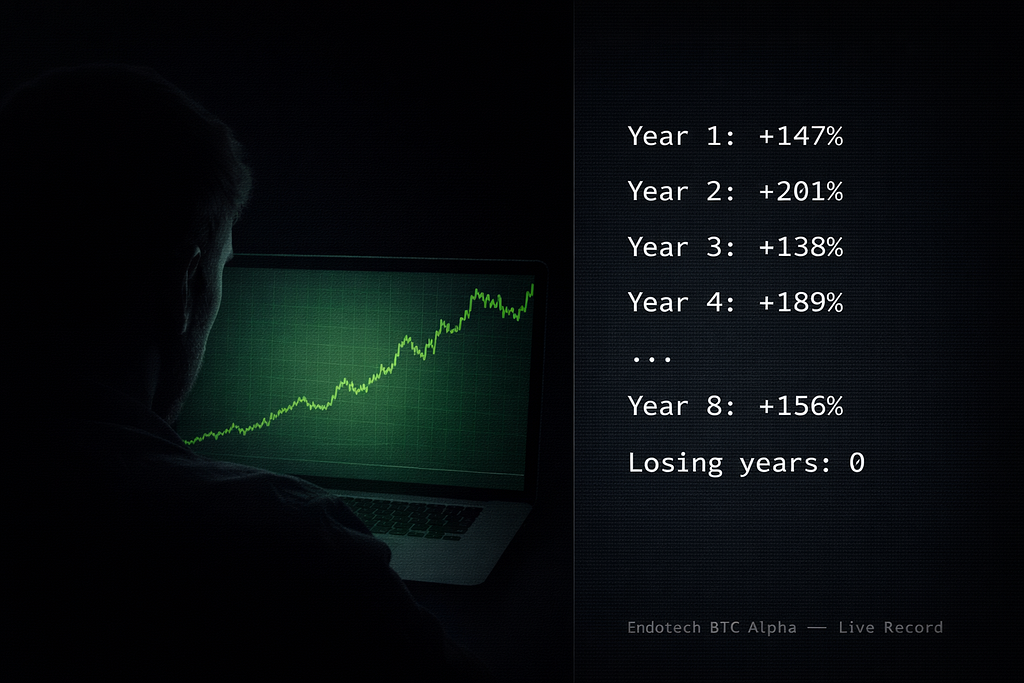
163% average annual returns. Eight years of live operation. Zero losing years. An AI built by a Technion PhD with $40 million in development capital. A fund that managed nearly a billion dollars before opening to retail investors.
I had heard variations of all of these claims before — from projects that turned out to be nothing. So before I put a dollar in I went looking for the hole.
Week One: The Obvious Stuff
The first place I looked was ScamAdviser. It gave endotech.io a low trust score. I have learned to read ScamAdviser carefully rather than take the score at face value. Their algorithm automatically flags any crypto company with privacy-protected WHOIS registered in Israel. Endotech is registered in Israel, uses privacy protection, operates in crypto. The algorithm dislikes all three. It does not mean anything about the actual operations.
Scam-Detector.com gave the same company a 90.9 out of 100 and rated it “Authentic. Trustworthy. Secure.” Neither tool has actually reviewed Endotech’s trading history. They are scoring metadata.
I found a review calling Endotech a “fraudulent offshore broker.” Reading it carefully, the complaints were: no MT4 platform, no demo account, previously high minimum deposits. These are legitimate criticisms of their old retail model. Calling them fraud requires a significant stretch of the word.
The Daisy Global connection came up repeatedly in forum threads. Daisy was a separate crowdfunding project that used Endotech’s technology. Different entity, different structure, different management. Endotech’s technology is not responsible for how third parties chose to build programs around it. This is like blaming AWS for a startup that used their infrastructure badly.
End of week one: nothing that looked like actual fraud.
Week Two: The Founder
I spent the second week on Dr. Anna Becker specifically. Because if this is a fraud, the founder’s credentials are where it usually unravels.
She has a Wikipedia page. That is not definitive but it is a reasonable starting filter — Wikipedia editors actively remove pages for people who do not meet notability standards.
She co-authored a book on Bayesian networks that has legitimate academic citations. She completed her PhD at the Technion Institute of Technology — Israel’s equivalent of MIT. Her research collaborations with AXA and BNP Paribas are documented. Her previous company, Strategy Runner, was acquired by MF Global in 2011 for $3.75 million. That acquisition is reported on Finance Magnates, a legitimate financial news publication. It happened before the crypto era when there was no incentive to fabricate it.
This is not the background of someone who appeared from nowhere during a bull market to run a copy trading scheme. This is someone who has been building financial AI since the early 2000s and has a paper trail that predates the entire cryptocurrency industry.
Week Three: The Numbers
This is where I spent the most time. Because credentials are one thing. Live trading performance is another.
The claimed numbers: 163% average annual return on BTC Alpha on a fixed capital basis. 83% trade accuracy. 14% maximum drawdown across eight years including Bitcoin’s 94% crash in 2018. Zero losing years. 93 profitable months out of 103.
Fixed capital basis means profits are not compounded — each year is calculated as if starting from the same base. This is the conservative reporting method. It undersells the actual compounded performance.
What I could not find: independent third-party audit data published somewhere I could verify directly. What I could find: monthly performance reports going back to 2017, consistent with the claimed averages.
Is that the same as a Big Four audited track record? No. But the records exist. They are internally consistent across eight years. The losing months are there — 10 of them — which is what you would expect from a real system rather than a fabricated one. Fabricated track records tend to show suspiciously consistent monthly returns. Real ones show variance.
The custody model was what finally settled it for me. Your funds stay in your own Bit1 Exchange Futures wallet. Endotech connects via a trade-only API key. It can execute trades. It cannot withdraw funds. It cannot move your capital anywhere. You can disconnect and withdraw at any moment.
This is the structural opposite of every crypto fraud I have researched. FTX moved customer funds. Celsius moved customer funds. Voyager moved customer funds. Every collapsed platform required custody transfer as the mechanism of fraud. This one explicitly does not require custody transfer.
What Changed My Mind
It was not one thing. It was the combination of three things that are very difficult to fake simultaneously:
A founder with a 20-year verifiable track record predating crypto. A performance history with realistic variance including losing months. A custody model that structurally prevents the most common form of crypto fraud.
I connected a test amount. Watched it for 30 days. The AI traded. I could see every trade in my own Bit1 Exchange dashboard. The first month was a losing month. I stayed in. The second month recovered. The third month was strong.
That losing first month was actually the most important data point. A system that never has a bad month is either lying or has not been tested in real conditions. A system with 10 losing months out of 103 is a real system operating in real markets.
The Things I Am Still Honest About
I cannot guarantee future performance. Eight years of zero losing years does not mean year nine will not be different.
The Bit1 Exchange is newer than Bybit or Binance. The partnership is recent. There is operational track record being built in real time. That is a legitimate uncertainty worth acknowledging.
The performance fee of 50% on profits is real. On a 163% gross annual return that is still an exceptional net return — but model it before committing capital.
And the 90-day framework matters. The 90-day compounding strategy is not marketing language. The system operates over quarterly cycles. If you approach it expecting linear monthly returns you will disconnect at exactly the wrong moment and lock in losses that would have recovered.
Where I Ended Up
Eight years. Zero losing years. And I still spent three weeks trying to find the fraud before I believed it.
I did not find the fraud. I found a legitimate institutional AI trading system with a verifiable founder, a documented history, and a custody model that protects you from the risk that killed every other platform that collapsed.
If you want to do your own research — and you should — the full Endotech AI review covers everything I found in detail. The institutional AI deep review covers the technical architecture. The setup guide covers the 10-minute process to go live.
Do the research. Take your time. Three weeks of skepticism is the right starting point.
Also available as a podcast episode: https://open.spotify.com/episode/0QRs61joKRzH7XFg20Itux?si=x6R8FfcYS-udRKMcAU7J9g
This article is for informational purposes only and does not constitute financial or investment advice. Cryptocurrency trading carries substantial risk of loss. Past performance does not guarantee future results. Always conduct your own due diligence before making investment decisions.
Eight Years. Zero Losing Years. I Still Almost Didn’t Believe It. was originally published in Coinmonks on Medium, where people are continuing the conversation by highlighting and responding to this story.