
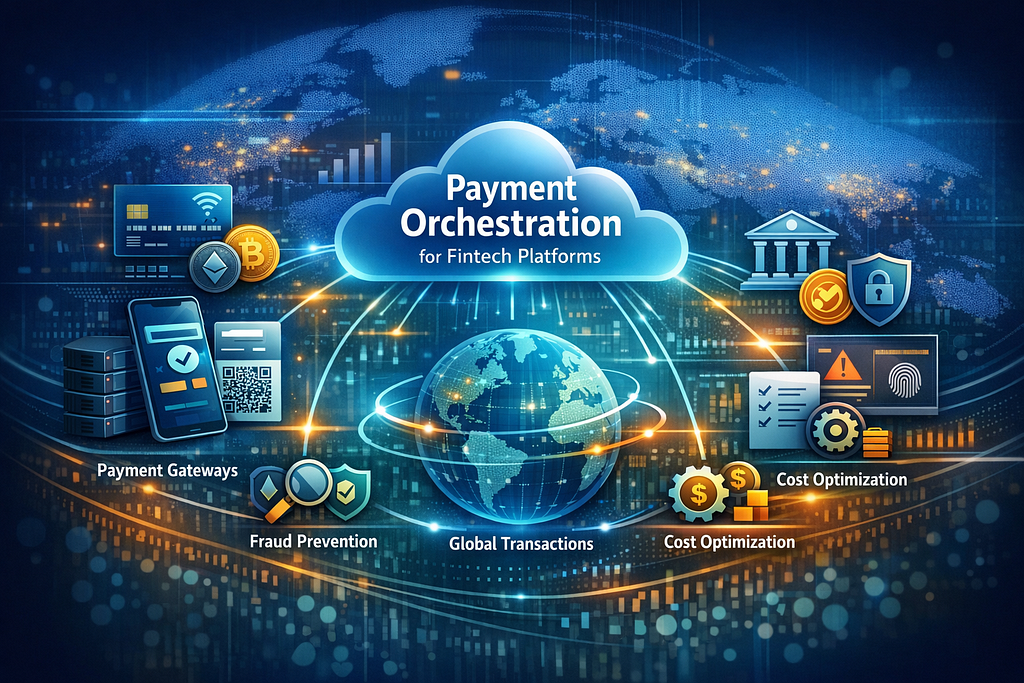
Why Payment Orchestration Is Becoming Critical for Fintech Platforms
Over the past decade, the fintech industry has transformed the way people interact with money. Payments that once required physical cash, cards, or bank visits now happen instantly through mobile applications, online platforms, and digital wallets. Consumers can send money across continents within seconds, businesses can accept payments from customers around the world, and financial services are now embedded into everyday digital experiences.
This image is generated by chatgpt
Behind this seamless user experience, however, lies an increasingly complex payment infrastructure.
Modern fintech platforms are no longer dealing with a single payment processor or a simple card transaction flow. Instead, they operate within a sophisticated ecosystem that includes multiple payment gateways, acquiring banks, card networks, digital wallets, alternative payment methods, fraud detection tools, and regulatory compliance frameworks.
Managing this complexity efficiently has become one of the most critical challenges for fintech companies. As transaction volumes grow and global expansion becomes a priority, the traditional approach of integrating with a single payment provider is no longer sufficient.
This is where payment orchestration is emerging as a fundamental layer of fintech infrastructure.
Payment orchestration allows fintech platforms to connect and manage multiple payment providers through a centralized system that intelligently routes transactions, optimizes performance, and improves operational control. What once seemed like an advanced technical capability is now becoming a strategic necessity for fintech companies operating in a competitive and rapidly evolving payments landscape.
The Evolution of Digital Payment Infrastructure
To understand why payment orchestration has become so important, it is helpful to look at how digital payment systems have evolved.
In the early stages of online commerce, businesses typically relied on a single payment gateway. This gateway connected merchants to acquiring banks and card networks, allowing them to process credit and debit card payments online. For many companies, this setup was simple and sufficient.
However, the payments landscape has changed dramatically.
Today, customers expect to pay using a wide variety of methods. These include traditional card payments, digital wallets such as Apple Pay and Google Pay, real time bank transfers, buy now pay later solutions, and in some cases even cryptocurrency.
Each of these payment methods may involve different providers, technologies, and processing flows. In addition, regional payment preferences vary significantly across the world. A payment method that dominates one market may barely exist in another.
For fintech companies operating across multiple markets, supporting this wide range of payment options often requires integrating with several payment providers simultaneously.
Without a structured system to manage these integrations, payment infrastructure can quickly become fragmented and difficult to maintain.
The Hidden Complexity of Fintech Payment Systems
While the payment process appears simple to users, the backend infrastructure that powers digital payments is highly intricate.
A single online payment may involve several entities working together. These include the payment gateway, the acquiring bank, the card network, the issuing bank, fraud monitoring systems, and compliance checks. Each participant in this chain plays a role in determining whether a transaction is approved or declined.
Fintech platforms must manage these interactions while ensuring that transactions are processed quickly and securely.
As platforms scale and enter new markets, the complexity increases further. Different payment processors may have different performance levels, fee structures, and risk policies. Approval rates can vary depending on the provider, the type of card used, the location of the user, and the nature of the transaction.
A payment processor that performs well in one region may produce lower approval rates in another. A provider that offers competitive pricing for one type of transaction may charge significantly higher fees for another.
Without a system to manage these variables effectively, fintech companies may face unnecessary payment failures, increased operational costs, and limited flexibility in adapting to market changes.
Payment orchestration addresses these challenges by creating a unified infrastructure layer that brings structure and intelligence to payment operations.
What Payment Orchestration Actually Does
At its core, payment orchestration acts as a central control layer that sits between a fintech platform and multiple payment providers.
Instead of integrating individually with each gateway, acquirer, or payment service provider, the fintech platform connects to the orchestration system. This system then manages all interactions with external payment providers.
The orchestration layer determines how transactions are processed, which provider should handle a particular payment, and how the system should respond if a transaction fails.
This approach creates a flexible architecture where payment providers can be added, removed, or modified without disrupting the entire payment system.
For fintech platforms, this flexibility is extremely valuable because it allows them to optimize payment performance and adapt to changes in the payments ecosystem without constantly rebuilding their infrastructure.
Improving Payment Approval Rates
One of the most significant benefits of payment orchestration is its ability to improve transaction approval rates.
Payment failures are surprisingly common in digital commerce. Transactions can be declined for many reasons, including technical outages, risk assessment decisions, network connectivity issues, or inconsistencies in how different banks evaluate transactions.
When a platform relies on a single payment processor, a failed transaction often means the payment simply does not go through. This leads to lost revenue and a frustrating experience for users.
Payment orchestration introduces intelligent transaction routing.
If a transaction fails with one provider, the system can automatically attempt the payment through another provider or acquiring bank. This process can occur in real time without requiring any action from the user.
Over time, orchestration systems can also analyze historical transaction data to determine which providers perform best for certain payment types, regions, or customer segments.
By routing payments through the most reliable and efficient providers, fintech platforms can significantly increase their approval rates and reduce unnecessary transaction failures.
Reducing Operational Risk
Dependence on a single payment provider creates a major operational risk for fintech platforms.
If a gateway experiences downtime, implements new restrictions, or changes its pricing structure, the entire payment operation of the fintech platform may be affected. In extreme cases, payment disruptions can lead to revenue loss, reputational damage, and customer dissatisfaction.
Payment orchestration reduces this risk by allowing platforms to work with multiple providers simultaneously.
If one provider encounters technical issues, the orchestration system can automatically redirect traffic to another provider. This redundancy ensures that payment processing continues even during unexpected disruptions.
In addition, fintech platforms gain greater negotiating power when they are not tied to a single provider. They can choose providers based on performance, pricing, and regional capabilities rather than being locked into long term dependencies.
Enabling Global Payment Acceptance
For fintech companies expanding internationally, payment orchestration is particularly valuable.
Each country has its own payment ecosystem, regulatory environment, and customer preferences. In some regions, card payments dominate. In others, bank transfers or local payment methods are more common.
Successfully entering new markets requires supporting the payment methods that customers trust and prefer.
Integrating each local payment provider individually can be a slow and resource intensive process. Engineering teams may need to develop custom integrations, maintain multiple APIs, and manage different compliance requirements.
Payment orchestration simplifies this process by allowing fintech platforms to connect to multiple regional payment providers through a single integration layer.
This makes it easier for companies to support local payment methods, improve transaction approval rates through local acquiring relationships, and expand into new markets more efficiently.
Controlling and Optimizing Payment Costs
Payment processing involves several types of fees, including gateway fees, interchange fees, currency conversion costs, and cross border transaction charges.
For fintech platforms handling large volumes of transactions, these fees can have a significant impact on profitability.
Payment orchestration allows platforms to route transactions based not only on performance but also on cost efficiency.
For example, domestic transactions may be routed through local acquiring banks to avoid cross border processing fees. Transactions involving specific card networks may be routed through providers that offer more favorable pricing.
By analyzing transaction data and dynamically adjusting routing strategies, fintech companies can reduce payment processing costs while maintaining high performance levels.
Strengthening Fraud Detection and Risk Management
As digital payments grow, so does the sophistication of fraud attempts.
Fintech platforms must continuously monitor transactions for suspicious activity while ensuring that legitimate users can complete payments without unnecessary friction.
Payment orchestration platforms often integrate with multiple fraud detection systems and risk scoring tools. This allows fintech companies to apply layered security strategies that combine different fraud detection methods.
Transactions can be evaluated using several risk signals before being approved or declined. If one fraud detection system identifies a potential threat, additional checks can be triggered automatically.
This multi layer approach strengthens payment security while maintaining a smooth payment experience for genuine users.
Accelerating Innovation in Fintech Payments
The fintech industry is constantly evolving. New payment technologies, regulatory frameworks, and customer expectations continue to reshape the financial services landscape.
Platforms that rely on rigid payment infrastructure often struggle to adapt quickly to these changes.
Payment orchestration provides a modular architecture that supports rapid innovation.
New payment providers, fraud tools, or financial services can be integrated into the orchestration layer without requiring a complete overhaul of the underlying system. This flexibility allows fintech companies to experiment with new payment methods, enter new markets, and adapt to emerging technologies more quickly.
In an industry where speed and adaptability are crucial, this capability becomes a major competitive advantage.
The Strategic Importance of Payment Orchestration
What was once considered a technical optimization is now becoming a strategic component of fintech infrastructure.
Payment orchestration enables fintech platforms to build resilient, flexible, and scalable payment systems that support global growth. It improves approval rates, reduces operational risks, optimizes transaction costs, enhances fraud prevention, and simplifies the integration of new payment technologies.
For fintech companies competing in a rapidly expanding digital economy, payments are not just a background process. They are a critical touchpoint that directly affects revenue, customer experience, and platform reliability.
As digital finance continues to evolve, the fintech platforms that invest in intelligent payment infrastructure will be better positioned to scale globally and deliver seamless financial experiences.
Payment orchestration is no longer simply an operational tool. It is becoming the foundation upon which the next generation of fintech platforms will be built.
Why Payment Orchestration Is Becoming Critical for Fintech Platforms was originally published in Coinmonks on Medium, where people are continuing the conversation by highlighting and responding to this story.