
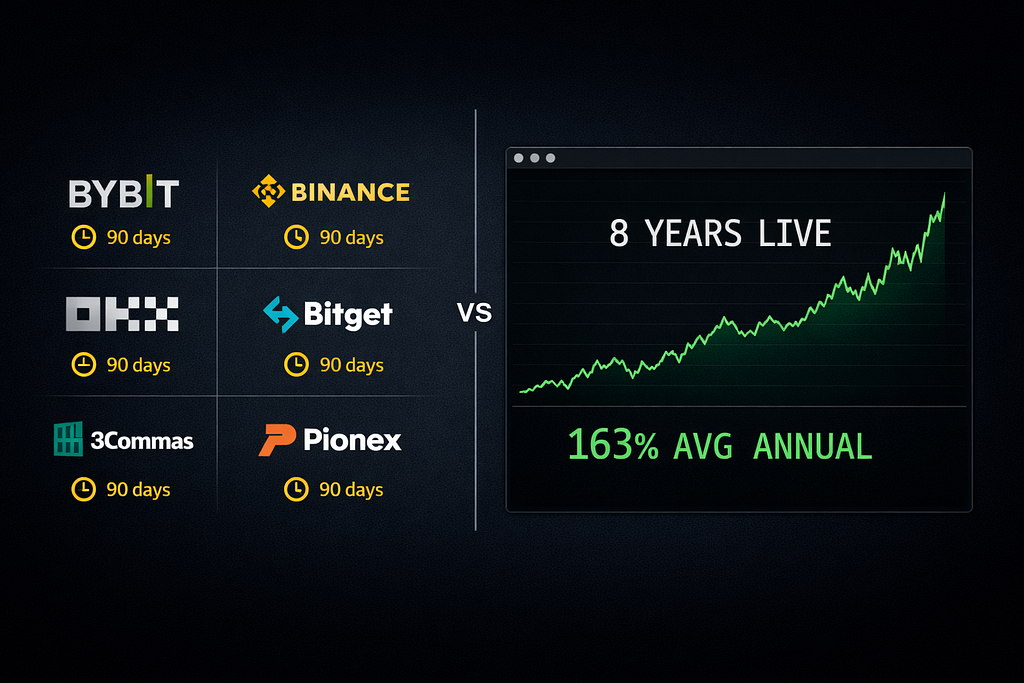
Bybit, Binance, OKX, Bitget, 3Commas, Pionex — and then something completely different.
I spent the last several months testing copy trading across seven platforms. Not paper testing. Real capital, real accounts, real results.
Here is the conclusion I kept arriving at, no matter which platform I was on: the quality of copy trading is entirely determined by the quality of what you are copying. The platforms themselves are largely interchangeable. The strategies you plug into them are not.
The Problem With Every Exchange-Based Copy Trading Platform
Bybit, Binance, OKX, and Bitget all offer copy trading. They have invested heavily in the infrastructure — clean interfaces, transparent stats, one-click following, automatic proportional position sizing.
The problem is consistent across all four: you are copying retail traders who qualified for master trader status by producing positive returns over 30 to 90 days.
Think about what that actually means. Someone had a good quarter. Possibly a great quarter. Their returns attracted followers. Follower capital increased the stakes. The platform promoted them on the leaderboard. More followers came.
What the leaderboard does not show: how many traders started with the same approach and blew up before reaching the threshold. It does not show the leverage ratios. It does not show what happens when the market regime shifts — when the bull run that made their strategy look brilliant reverses and the same approach that worked in trending conditions starts failing in consolidation or a downtrend.
Institutional performance evaluation uses a completely different standard. Three years of live data is considered the minimum meaningful sample. Five years is solid. Eight years across multiple complete market cycles is exceptional.
What I Found When I Looked for an 8-Year Track Record
I started looking specifically for copy trading platforms where the underlying strategy had a multi-year verified track record. Not a leaderboard. Not 90 days. A real institutional-grade performance history.
The answer was Endotech on Bit1 Exchange.
Endotech was founded in 2012 by Dr. Anna Becker — a Technion Institute of Technology PhD in AI, former research collaborator with AXA and BNP Paribas, and founder of Strategy Runner which she sold to MF Global in 2011. She has been building financial AI since before most people knew what a blockchain was.
The live trading record since 2017:
— BTC Alpha: 163% average annual return on fixed capital
— ETH Alpha: 148% average annual return on fixed capital
— Trade accuracy: 83%
— Maximum drawdown: 14% — through Bitcoin’s 94% crash in 2018
— Losing years: zero out of eight
— Losing months: 10 out of 103
These are not backtested projections. They are the live trading record of a system that has been running real money in real market conditions for eight years.
The Custody Question Nobody Asks
After FTX and Celsius I made a rule: I will not put capital into any system where I do not control the withdrawal keys.
This eliminated most options immediately. On Bybit, Binance, OKX, and Bitget, your funds are on their exchange. The copy trading mechanism means the exchange executes trades on your behalf. You are trusting the exchange to remain solvent.
The Endotech and Bit1 model is structurally different. Your USDT stays in your own named Futures wallet on Bit1 Exchange. Endotech connects via a trade-only API key — it can open and close positions but it cannot initiate withdrawals or transfer funds anywhere. You hold the withdrawal keys. You control the account.
If you disconnect today, your funds are immediately accessible. There is no lockup period. There are no penalties. The AI is a service provider, not a custodian.
For a full technical breakdown of how this works, is automated crypto trading safe covers the API permission model in detail.
The Honest Comparison
Here is how the seven platforms stack up on the metrics that actually matter:
Bybit — excellent platform, retail traders, 30–90 day track records. Platform quality solid. Strategy quality poor by institutional standards.
Binance — excellent platform, retail traders, 60+ day track records. Same fundamental limitation as Bybit — the platform is good, the track records are short.
OKX — best analytics dashboard of any exchange copy trading. Better filtering tools including sharpe ratio and drawdown history. Still retail traders with short track records, but the filtering is the best attempt in this category.
Bitget — strong copy trading volume, 6-month badge system is the most honest attempt at track record verification among retail exchanges. Still far short of institutional standards.
3Commas — technically a signal marketplace rather than copy trading. Monthly subscription of $29-$99 regardless of performance. You still supply or choose the strategy logic. Full breakdown in the Endotech vs 3Commas breakdown.
Pionex — grid bot strategy marketplace. You copy bot configurations rather than live decisions. Solid for ranging markets, poor for strong directional moves.
Endotech on Bit1 Exchange — institutional AI, 8-year live track record, full custody, performance fee only. No comparable competitor in the retail space on track record depth alone.
The full side-by-side with scoring on all dimensions is in the full 7-platform copy trading comparison.
The Honest Caveats
I am not going to pretend Endotech is risk-free. It is not.
Losing months happen. Ten out of 103 months were losing months historically. If you connect and the first month is a losing month, that does not mean the system is broken. The single most common mistake new participants make is disconnecting during a losing month — they lock in the loss and miss the recovery. The 90-day copy trading strategy covers how to approach the first quarter correctly.
The Bit1 Exchange is also newer than Bybit or Binance. Its infrastructure is built on ChainUp — the same backend that powers OKX and Bybit — but as a newer exchange it is building its operational track record. This is a legitimate consideration worth weighing.
And the performance fees are real. The VIP Retail tier charges 50% of profits with zero subscription cost. On a 163% annual gross return that is still exceptional net performance — but understand the fee structure before connecting.
Getting Started
The setup takes under 10 minutes. The step-by-step setup guide walks through the full process — registration, Bit1 account sync, USDT deposit, Futures wallet transfer, and copy trading activation.
The most commonly missed step: you must transfer your USDT from your Spot wallet to your Futures wallet before activating copy trading. The AI draws from the Futures wallet only.
For everything else — the full 8-year performance data, the technical architecture, and the complete fee breakdown — the full Endotech AI review has it all.
Do your own research. Read the negative reviews. Check the track record yourself. That is exactly what I did — and it is why I am still here.
This article is for informational purposes only and does not constitute financial advice. Cryptocurrency trading carries substantial risk of loss. Past performance does not guarantee future results. Always conduct your own due diligence before investing.
I Tested 7 Crypto Copy Trading Platforms in 2026. Only One Has an 8-Year Track Record. was originally published in Coinmonks on Medium, where people are continuing the conversation by highlighting and responding to this story.