
Sixty-eight pages. Most coverage landed on paragraph one — specifically, on the list of sixteen.
Bitcoin, Ether, Solana, XRP. Digital commodities, not securities. The headline wrote itself, and most pieces were done by paragraph three.
The part worth paying attention to is buried much further in.
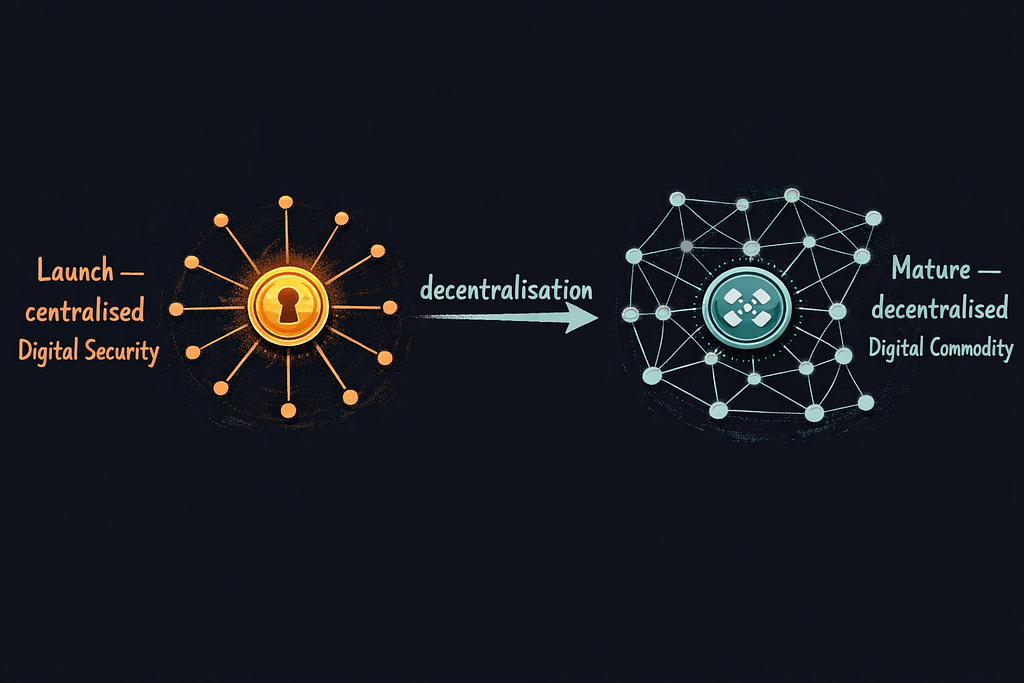
Under the joint SEC/CFTC interpretive release issued on March 17, the framework formally addresses how a token may become subject to investment contract rules — and, crucially, how it may cease to be subject to them. A token launched during an initial offering — when the network is centralised, when a small group controls it — can qualify as a digital security at that stage. That same token can transition to a digital commodity as the network decentralises and control disperses.
Classification travels with the project’s development, not against it. This is not a footnote. It is the framework’s central design choice.
For the first time in US regulatory history, decentralisation is formally defined as a legal destination — one that changes your status when you arrive. The taxonomy the two agencies created covers five categories: digital commodities, digital collectibles, digital tools, stablecoins, and digital securities. Movement between them is now a structured process rather than a legal grey zone.
The precedent is not entirely new. In 2018, then-Director of Corporation Finance William Hinman delivered a speech suggesting that Ether, arguably centralised at launch, had become sufficiently decentralised to fall outside securities law. At the time, that was one official’s opinion. Now it is written policy, jointly signed by both agencies.
The release also clarifies how staking, mining, and airdrops work under federal law — activities that existed in case-by-case limbo for years, subject to conflicting interpretations and enforcement actions. That limbo ends here.
The practical implication is significant for any project sitting in the digital securities category: there is now a documented path out of it. Build toward decentralisation credibly enough — distributed validators, broad token ownership, no controlling group — demonstrate it consistently, and the classification can change. Somewhat inconveniently for the people who spent the last decade arguing the path was permanently closed.
It is worth noting that this remains an interpretation, not permanent legislation. The CLARITY Act must still pass Congress for the framework to be fully codified. The ground can shift.
But the sixteen named assets get coverage every time someone publishes a list. The mechanism that determines whether tomorrow’s project earns a place on a future version of that list barely got a paragraph.
That seems like the more useful thing to understand.
It Started as a Security. It Doesn’t Have to Stay One. was originally published in Coinmonks on Medium, where people are continuing the conversation by highlighting and responding to this story.