
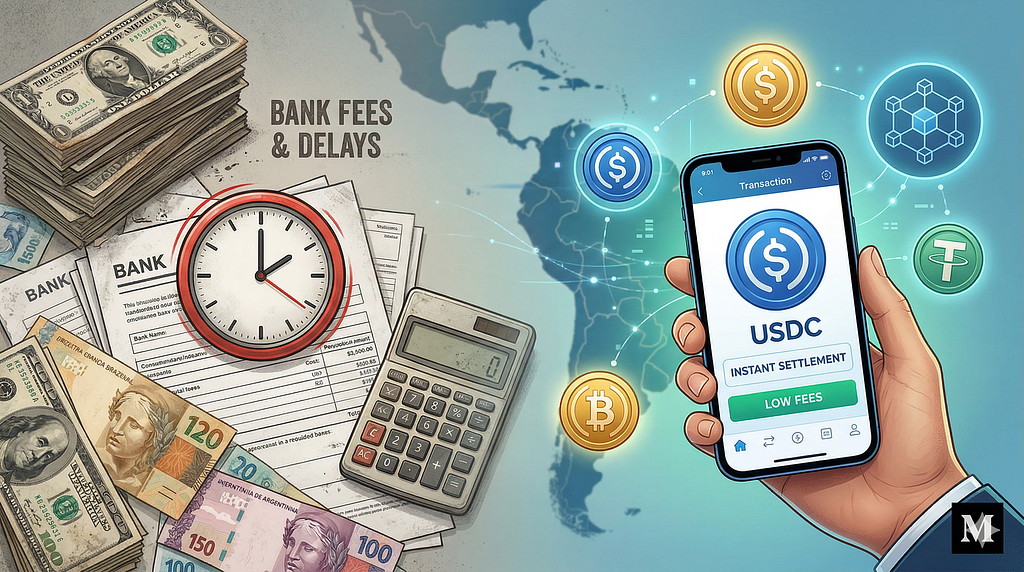
The 12 Percent Tax: Why LATAM’s Remote Workers are Leaving Traditional Banking Solutions for Stablecoins
Remote workers across Latin America are facing a brutal reality. While the global economy has gone digital, the banking infrastructure supporting it is stuck in the past. For a developer in São Paulo or a designer in Buenos Aires, receiving a paycheck is not a simple transaction. It is a costly gauntlet of fees, poor exchange rates, and systemic delays that can consume over 12 percent of their monthly income.
When we talk about the future of work, we often focus on tools and productivity. But for millions in LATAM, the real hurdle is the hidden banking crisis that turns a 2,000 dollar invoice into significantly less by the time it hits a local account.
The Hidden Drain on Global Talent
The numbers tell a story of institutional friction. Wire transfer fees alone often range from 25 to 50 dollars per transaction. On top of that, banks impose foreign exchange spreads that sit 3 to 5 percent below the actual market rate.
In Brazil, an international wire can take five business days to clear, all while facing strict compliance hurdles. In Argentina, capital controls and inflation make every day of delay a direct loss in purchasing power. I have seen developers on Reddit and fintech forums describe losing 180 dollars a month just to move their own money. That is not just a fee. It is a tax on talent.
The traditional correspondent banking system was designed for massive corporate transfers, not for a freelancer in Colombia trying to pay their rent. Because the money passes through multiple intermediary banks, each one takes a cut. Most workers only find out what the final damage is once the funds actually land.
Why the Old System is Failing
The fundamental architecture of cross-border payments has several points of failure for the modern workforce. According to the Bank for International Settlements, traditional cross-border B2B payments take 3 to 5 business days on average via correspondent banking. In high-inflation markets, waiting a week to access your salary is a major financial risk.
Banks also treat a 1,000 dollar salary payment with the same level of manual scrutiny as a multi-million dollar corporate move, creating unnecessary bottlenecks. By the time a bank finishes its conversion, the local currency may have shifted, or the bank may have applied a spread that eats another 4 percent of the total.
The Stablecoin Alternative
Stablecoin-based payouts are fundamentally reimagining this flow. By using USD-pegged assets like USDC, companies can bypass the correspondent banking maze entirely. The change is transformative for both the employer and the worker. In fact, a report from FXC Intelligence notes that 48 percent of businesses cite speed as the main benefit of stablecoin-based payments.
The cost savings are equally significant. The same FXC Intelligence report suggests that stablecoin transaction fees are typically under 1 percent, compared to 3 to 5 percent for traditional cross-border rails.
The Real-World Math: A 2,000 Dollar Payout
To see the impact, look at how a standard 2,000 dollar monthly payment compares across both systems:
Traditional Wire Transfer: You start with 2,000 dollars. After a 35 dollar wire fee, an 80 dollar FX spread, and 20 dollars in intermediary fees, you receive roughly 1,865 dollars. That is a 6.75% loss.Stablecoin Payout: You start with 2,000 dollars. After a flat processing fee of roughly 15 dollars and zero FX spread, you receive 1,985 dollars.
The difference is 120 dollars every single month. Over a year, that is nearly 1,500 dollars. That is essentially an extra month of salary returned to the worker.
How Companies are Making the Switch
We are seeing a massive shift in how Employer-of-Record (EOR) firms and freelance marketplaces handle LATAM payroll. These platforms are increasingly adopting infrastructure that allows them to collect fiat from a client in the US or Europe and deliver stablecoins directly to the worker.
Modern platforms like Tazapay handle the heavy lifting of compliance and technical integration. This allows a company to offer the speed of digital assets without needing to hold cryptocurrency on their own balance sheet.
A Roadmap for Implementation
If your team is ready to move away from legacy banking, the transition usually looks like this:
Choose the Right Partner: Look for providers with institutional-grade licenses, such as those registered with MAS in Singapore or FINTRAC in Canada.Technical Setup: Use a provider that handles the fiat-to-stablecoin conversion so your finance team does not have to manage wallets manually.Worker Education: Help your team understand how to set up secure wallets and how to use local exchanges to convert their stablecoins into local currency.
The era of losing 12 percent of your paycheck to a correspondent bank is coming to an end. For remote workers in Latin America, stablecoins are not just a trend. They are a tool for financial survival and a way to finally receive the full value of their work.
The 12 Percent Tax: Why LATAM’s Remote Workers are Leaving Traditional Banking for Stablecoins was originally published in Coinmonks on Medium, where people are continuing the conversation by highlighting and responding to this story.