
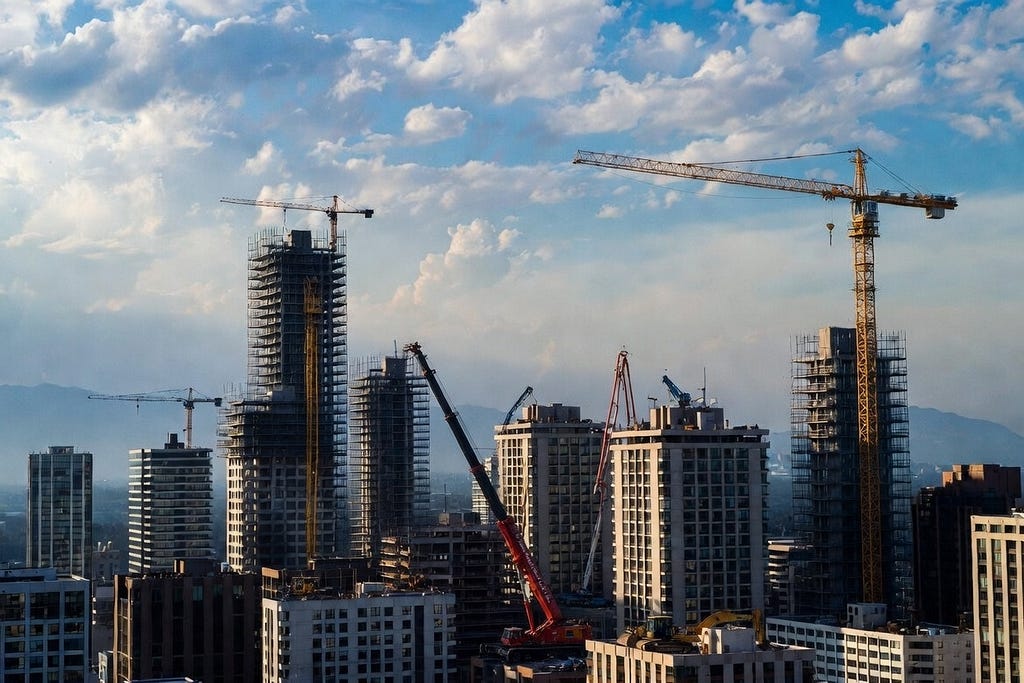
Over the years, Upland has experimented with many layers of gameplay: digital property ownership, collections, commerce, vehicles, ornaments, competition systems, manufacturing, and seasonal events. But in 2026, the platform seems to be sending a much clearer message: the future of the game is not only about competition, but about building cities, activating neighborhoods, and creating real utility inside a shared map based on real-world addresses. That vision did not begin this year, but it has become much more visible with the consolidation of systems like Uppies, the continued release of Service Structures, the redesign of the store to support building, and most importantly, the official launch of the Construction Hub on March 5, 2026.
From Competitive Intensity to Purposeful Building
In previous stages, Upland leaned more heavily into intense, competition-driven dynamics. A clear example was $SPARKLET Warz, introduced in January 2025 as a strategic faction-based event involving ornaments, attacks, territorial defense, and rewards tied to both collective and individual performance.
It was an exciting and ambitious idea. But it also represented a style of gameplay that demanded more coordination, more time, and a higher level of competitive pressure.
My reading as a player is that, while those kinds of experiences can generate excitement, they do not necessarily define the best long-term path for most of the community. What we are seeing this year feels more organic: less pressure to “win a war,” and more attention on what your area needs, what makes sense to build, how to attract activity, and how to better integrate into the game’s economic flow. That difference in vibe is not minor. It changes the conversation inside the metaverse.
Uppies Changed the Way Players Look at the Map
The arrival of Uppies has been one of the biggest reasons for that shift. It is no longer enough to simply own properties or have beautiful buildings: now it matters whether a neighborhood offers services, connectivity, and a functional mix of structures that make it attractive for residents. Upland’s own guide explains that Uppies respond to more complete neighborhoods, where factors such as essential services, entertainment, transportation, employment, and multi-purpose structures all play a role.
In other words, the map has stopped feeling like a board for holding assets and has started behaving more like a city that needs urban logic.
That completely changes the player mindset. Many players are now paying closer attention to their immediate surroundings: what is missing on their street, in their node, or in their community; what kind of structure could add value; what combination of buildings could make an area more attractive. It is no longer just about buying and waiting. It is about planning, developing, and sustaining digital urban life.
Special and Service Structures Gave the Game Direction
Another important change in 2026 has been the consistency with which Upland has pushed its Service Structures. During Frost Season, for example, new weekly structure volumes continued to introduce buildings designed to expand resident life: shops, public services, fitness, food, entertainment, and other functions that make each neighborhood feel more alive and more distinctive. Upland has also made it clear that these rotations are part of an ongoing construction loop, not just a temporary feature.
That detail matters a lot. In the past, players often chased whatever event was live at the moment. Now, however, the game is pushing toward a more persistent logic: acquire blueprints, build, specialize, and think long term. Even the redesign of the Upland Store in February 2026 was presented as an update meant to support “the future of building,” with permanent categories and stronger support for blueprints and building-related options throughout the year.
The Construction Hub Officialized the Builder Economy
If there was one piece that truly confirmed this shift, it was the launch of the Construction Hub. Upland had first introduced the idea in 2025 as a way to unlock a real builder economy, and it finally went live on March 5, 2026.
This system allows property owners to publish construction contracts, while other players, if they own the right blueprint, can accept the job and build on their behalf. That turns construction into a real in-game service — one based on collaboration, mobility, specialization, and market demand.
This is where Upland begins to feel less like a collection of separate features and more like an interconnected ecosystem. The player who owns land needs the player who owns the blueprint. The player with the blueprint needs to demand. The player who knows how to build can monetize that position. And the player who understands the neighborhood can make better decisions about what to build and where.
That relationship between property, infrastructure, and service is exactly what strengthens the feeling of a real estate and urban development simulator.
Upland Is Differentiating Itself From the Competition
What makes this even more interesting is that this path is not the same one other metaverse projects have taken. In its own official positioning, Upland describes itself as a “forever city-builder game” where everyone plays on a shared map based on the real world.
By contrast, The Sandbox centers its model around LAND parcels used to create and monetize experiences, while Decentraland emphasizes 3D virtual spaces where users can create, host, buy, and rent digital land within its own ecosystem.
It is not that one model cancels out the other, but they clearly reflect different philosophies. Upland is leaning harder into the idea of a persistent city connected to the real-world map and sustained by a neighborhood-level economy, while other metaverses have tended to highlight parcel-based experiences and activations.
And that difference is becoming more visible. In Upland, building is no longer just about decorating or putting up a structure to display it. Building is starting to mean serving a need, increasing attractiveness, activating a zone, attracting Uppies, facilitating contracts, and participating in an economy where value comes from use and location inside a living city.
A New Energy for the Community
That is why I feel that in 2026, the vibe of the game has changed. Today, many players are more focused on their communities, their nodes, their blueprints, their contracts, and their neighborhoods. There is more conversation about development, about construction opportunities, about how to prepare areas for residents, and about how to benefit from a more fluid economy.
That kind of conversation feels healthier for the long term, because it creates permanence. And in a metaverse, permanence is worth more than a temporary burst of excitement.
Upland has not abandoned competition; there are still challenges, leaderboards, and events. But the center of gravity seems to have shifted. The priority now is not simply to outperform someone else. The priority is to build a city.
2026: The Year Upland Went Back to Building Cities was originally published in Coinmonks on Medium, where people are continuing the conversation by highlighting and responding to this story.