
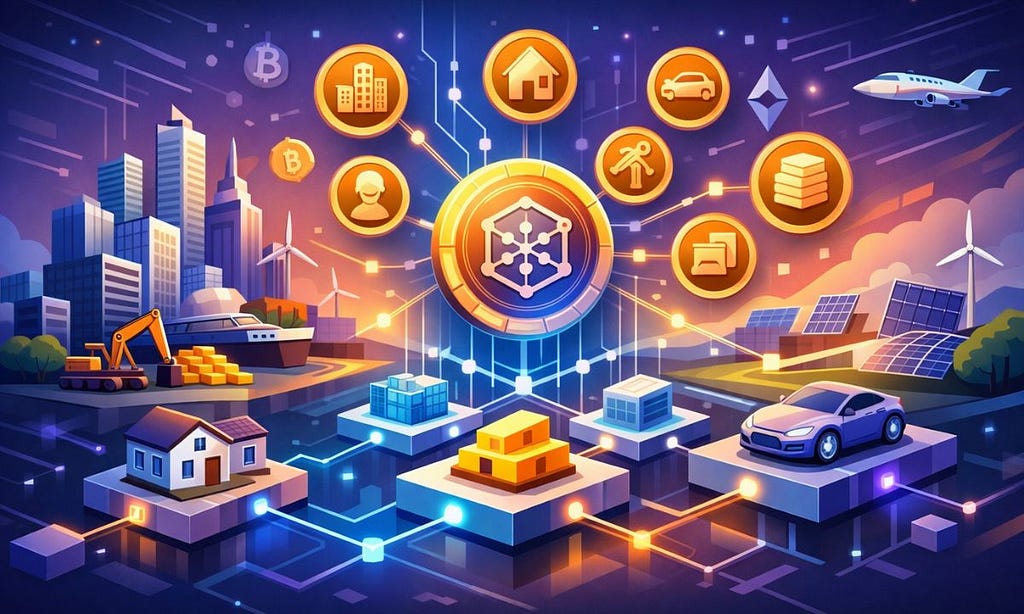
Financial markets are undergoing a quiet structural shift. One of the most discussed developments behind this shift is real-world asset tokenization. The idea is simple on the surface: representing ownership of physical or traditional financial assets through blockchain-based digital tokens. Yet the implications reach far beyond the technical layer. Tokenization changes how assets are issued, distributed, traded, and managed across financial systems.
By 2026, tokenized real-world assets will no longer be experimental. Asset managers, banks, fintech companies, and regulators have moved from theoretical discussions to practical implementation. Government bonds, private credit instruments, funds, commodities, and even segments of real estate now exist in tokenized formats. Market data platforms tracking these assets show billions of dollars already represented on blockchain networks.
Large financial institutions entered the field in the last few years. Tokenized money market funds from major asset managers, tokenized treasury products offered through digital asset platforms, and tokenized private credit vehicles demonstrate that the concept has crossed into institutional finance. These developments signal that tokenization is gradually being incorporated into financial market infrastructure rather than remaining a niche crypto experiment.
At the same time, the sector is still early in its development. Technical limitations, legal uncertainty, fragmented infrastructure, and liquidity constraints continue to slow wider adoption. The progress seen in 2026, therefore, represents an intermediate stage rather than a final outcome. Understanding how the system works, and how it might evolve over the next decade, requires examining both its structure and its practical implementation.
This article examines real-world asset tokenization in depth. It explains how tokenization works, why financial institutions are adopting it, which asset classes are leading the market, and how regulatory frameworks are responding. It also looks ahead to the possible direction of tokenized markets and the structural changes that could emerge in global finance.
Understanding Real-World Asset Tokenization
Real-world asset tokenization refers to the representation of ownership rights to physical or traditional financial assets using blockchain-based tokens. The token acts as a digital certificate of ownership or entitlement that can be transferred, stored, and verified on a distributed ledger.
The asset itself does not move onto the blockchain. Instead, the blockchain records ownership claims connected to the underlying asset. This relationship is usually structured through legal agreements, custody arrangements, or special-purpose entities that hold the asset while tokens represent ownership stakes.
Tokenization can apply to many asset classes, including:
Government bonds and treasury securitiesCorporate bonds and private creditReal estate propertiesCommodities such as gold or oilInvestment fundsInfrastructure assetsFine art and collectibles
Traditional financial markets rely on multiple intermediaries such as custodians, clearinghouses, brokers, and registrars to maintain records of ownership and settlement. Tokenization attempts to record those ownership claims on a blockchain ledger, which can reduce reconciliation requirements between institutions.
Another important characteristic is fractional ownership. A large asset, such as a building or a fund share, can be divided into many smaller token units. This structure allows investors to participate with smaller capital commitments while still holding proportional ownership rights.
Programmable features are also significant. Smart contracts can automatically distribute income, process redemption requests, or enforce transfer restrictions. This automation reduces manual administrative processes that often slow traditional financial transactions.
However, tokenization does not remove regulation or legal frameworks. Tokenized securities still fall under existing financial laws. The digital representation simply changes how ownership records and settlement processes are handled.
Why Financial Institutions Are Paying Attention
Large financial institutions rarely adopt new technology unless it addresses specific operational problems. Tokenization has gained attention because it touches several areas where traditional markets still rely on complex infrastructure.
One of these areas is settlement. In many markets, asset transactions settle two days after the trade occurs. This delay creates counterparty risk and requires collateral management systems. Blockchain settlement mechanisms allow transactions to finalize more quickly when both asset tokens and payment tokens are available on the same network.
Another reason involves distribution channels. Asset managers constantly search for new investor groups. Tokenized investment products can be distributed through digital asset platforms that reach investors who may not normally access traditional brokerage networks.
Operational efficiency also plays a role. Large investment funds involve administrative work related to subscriptions, redemptions, reporting, and compliance checks. Digital tokens combined with smart contract logic can automate some of these steps.
Liquidity is another consideration. Illiquid assets, such as private credit or real estate, are difficult to trade in secondary markets. Tokenization may support fractional trading that attracts smaller investors and increases transaction activity.
Financial institutions are therefore studying tokenization as a potential infrastructure improvement rather than simply a new investment theme.
Major Asset Classes Entering Tokenized Markets
Tokenized Government Bonds and Money Market Instruments
Short-term government bonds and treasury-based products have become the most visible examples of tokenized real-world assets. These instruments provide predictable yields and relatively low credit risk, which makes them suitable for early experimentation.
Several asset managers introduced tokenized money market funds that hold U.S. Treasury securities and other government debt instruments. Investors receive digital tokens representing shares in the fund while the underlying securities remain in traditional custody.
These products gained attention because they combine two features. First, they provide exposure to traditional fixed-income assets. Second, they operate within blockchain ecosystems where digital asset investors already hold capital.
For investors active in digital asset markets, tokenized treasury funds offer a way to earn yield without leaving blockchain infrastructure.
Tokenized Private Credit
Private credit has also emerged as a large tokenization category. Private credit funds provide loans to companies outside public bond markets. These loans are typically illiquid and accessible mainly to institutional investors.
Tokenization introduces fractional exposure to these instruments. Investors can purchase tokens representing portions of loan portfolios rather than committing large amounts of capital to traditional fund structures.
The model does not change the underlying credit analysis or loan agreements. Instead, it changes how investors access the investment vehicle.
Tokenized Commodities
Commodity tokenization usually involves storing physical assets in vaults while issuing digital tokens representing ownership claims.
Gold tokenization is the most common example. Each token represents a specific quantity of gold stored in secure facilities. Investors can trade these tokens on digital asset platforms without physically moving the metal.
Commodity tokens, therefore, function as digital certificates of ownership tied to real inventory.
Tokenized Real Estate
Real estate tokenization has received significant attention because property investments are traditionally illiquid and expensive. Tokenization divides ownership of properties into smaller units represented by blockchain tokens.
Investors can buy fractional shares in properties rather than purchasing entire buildings. Rental income can be distributed automatically through smart contracts according to each investor’s ownership percentage.
Despite its potential, real estate tokenization remains smaller than other segments. Legal complexity, property regulations, and local jurisdiction rules create challenges for global distribution.
Methods Used in Real-World Asset Tokenization
Tokenization requires both technical and legal structures. The process involves multiple stages that connect the physical or financial asset with blockchain-based tokens.
1. Asset Selection and Legal Structuring
The first stage involves identifying the asset and determining how it will be represented legally.
Possible structures include:
Direct ownership representation through tokenized sharesSpecial-purpose vehicles hold the asset, while tokens represent ownership interests.Tokenized fund units that correspond to shares in investment funds
Legal documentation defines investor rights, voting privileges, and redemption mechanisms.
2. Custody and Asset Verification
The underlying asset must be stored or managed by a custodian or trustee. Verification ensures that the token supply accurately reflects the real asset value.
Key steps include:
Independent asset valuationCustodial storage arrangementsAudit procedures confirming asset backing
These safeguards help maintain investor confidence that the token represents genuine ownership rights.
3. Token Issuance
After legal and custody arrangements are completed, digital tokens are created on a blockchain network.
Issuance involves:
Creating smart contracts that define token propertiesDetermining total token supplySetting transfer rules and investor eligibility conditions
The token then functions as a digital certificate representing ownership rights.
4. Compliance and Investor Verification
Most tokenized assets operate under regulatory frameworks that require identity verification.
Compliance procedures usually include:
Know-your-customer verificationAnti-money laundering screeningInvestor accreditation checks
Wallet addresses may be whitelisted before investors can hold or transfer tokens.
5. Distribution and Trading
Tokens are distributed to investors through issuance platforms, digital asset marketplaces, or institutional trading networks.
Secondary trading may occur on specialized platforms that support tokenized securities. Transfer restrictions can still apply depending on jurisdiction and regulatory requirements.
6. Asset Servicing and Reporting
After issuance, tokenized assets require ongoing servicing similar to traditional financial products.
This includes:
Income distributionRedemption processingFinancial reportingCompliance monitoring
Smart contracts may automate certain functions, but administrative oversight remains necessary.
Regulatory Developments Influencing Tokenization
Regulatory policy plays a central role in determining whether tokenized markets can grow. Financial authorities across multiple jurisdictions have begun addressing tokenized securities and digital asset infrastructure.
Europe
The European Union introduced a distributed ledger pilot regime allowing financial institutions to experiment with blockchain-based trading and settlement systems. The program permits certain exemptions from traditional infrastructure rules while regulators study how distributed ledgers function in regulated markets.
Singapore
Singapore has taken a research-oriented approach through initiatives involving banks and financial institutions working on tokenized assets and digital payment infrastructure. These projects test how tokenized funds, foreign exchange transactions, and liquidity pools could operate in regulated environments.
Hong Kong
Hong Kong authorities issued tokenized government bonds to test blockchain settlement for sovereign debt. These experiments show how governments might use distributed ledger technology for debt issuance and investor distribution.
United States
In the United States, tokenized securities remain subject to existing securities laws. Regulators emphasize that blockchain representation does not change the legal classification of financial instruments. As a result, issuers must comply with disclosure, registration, and investor protection rules.
These regulatory responses suggest that tokenization will likely evolve within existing financial frameworks rather than replacing them.
Infrastructure Challenges in Tokenized Markets
Despite significant progress, several obstacles continue to limit adoption.
Liquidity remains one of the largest challenges. Many tokenized assets still trade in small markets with limited participants. Without active secondary trading, investors may treat tokens similarly to traditional private investments.
Interoperability is another issue. Different blockchain networks host different tokenized assets. Moving assets or liquidity between these networks requires bridging systems or separate infrastructure layers.
Legal clarity also varies between jurisdictions. Tokenization structures must adapt to local securities laws, which complicates global distribution.
Operational risk cannot be ignored. Smart contract vulnerabilities, cybersecurity threats, and key management failures could create new categories of financial risk.
These limitations mean that tokenization must continue evolving before it becomes a mainstream financial infrastructure layer.
Future Outlook for Real-World Asset Tokenization
Market forecasts vary widely, but several research institutions expect tokenized assets to grow significantly during the next decade. Estimates suggest that trillions of dollars in assets could eventually be represented through blockchain-based systems.
Growth will likely occur in stages rather than through sudden expansion.
The first stage focuses on assets already familiar to institutional investors. Government bonds, money market funds, and credit instruments fall into this category.
The second stage may involve more complex assets such as private equity, infrastructure projects, and large real estate portfolios.
The third stage could involve integrated financial ecosystems where tokenized assets interact directly with tokenized payment systems, digital identity frameworks, and automated compliance tools.
If those layers develop together, tokenization could gradually influence how capital markets operate.
Conclusion
Real-world asset tokenization in 2026 stands at an interesting point between experimentation and institutional adoption. Financial institutions, technology firms, and regulators are all participating in the development of this new infrastructure layer.
The technology does not replace existing financial systems overnight. Instead, it introduces alternative mechanisms for recording ownership, distributing investment products, and settling transactions.
Tokenization has already demonstrated practical applications in treasury products, investment funds, commodities, and private credit. At the same time, challenges related to liquidity, regulation, and interoperability remain significant.
The future of tokenized assets will depend less on technological enthusiasm and more on practical implementation. Market participants will need reliable legal structures, secure custody arrangements, and regulatory clarity before tokenized markets can operate on a large scale.
If those conditions develop, tokenization may gradually become another layer of financial infrastructure rather than a separate industry. In that scenario, investors may interact with tokenized assets without necessarily noticing the underlying technology that records their ownership.
Real-World Asset Tokenization in 2026: What the Future Holds was originally published in Coinmonks on Medium, where people are continuing the conversation by highlighting and responding to this story.