
In 2020, thousands of businesses “went digital.”
They built websites.
They launched apps.
They started running ads.
They adopted cloud tools.
But five years later, many of them are still struggling.
Why?
Because digital business is not about presence.
It’s about structure.
And most startups confuse digitization with transformation.
If you’re building today, understanding this difference could determine whether you scale — or stall.
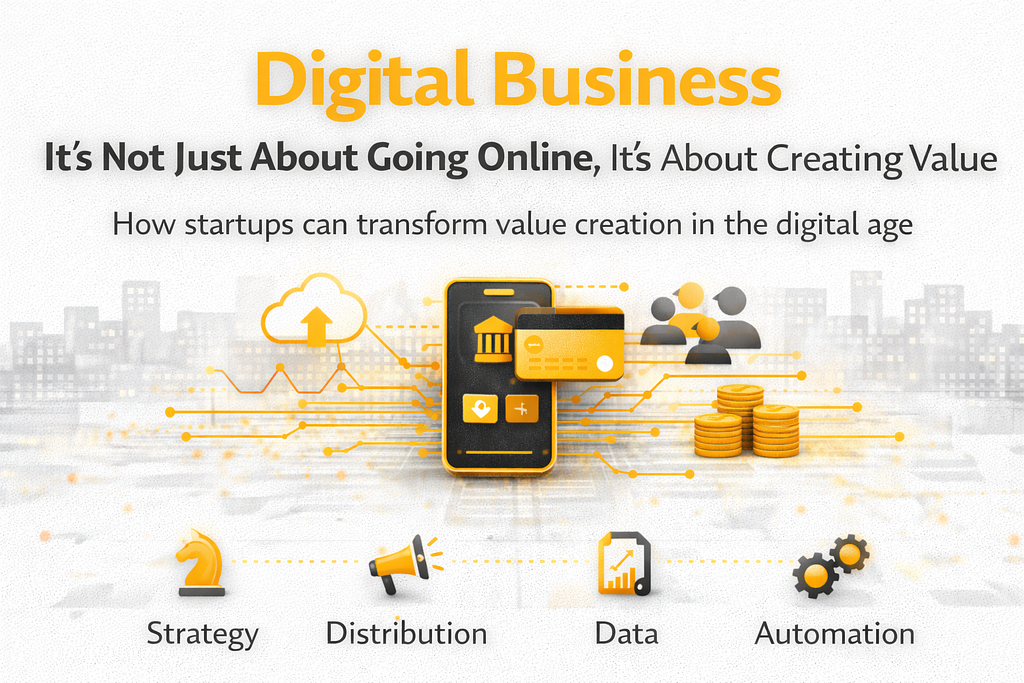
Image is created by ChatGPT
The First Mistake: Thinking Digital Means Technology
Many founders assume digital business is about:
Building an appCreating an e-commerce storeAutomating workflowsRunning paid marketing
But technology is just the surface layer.
A real digital business changes:
How value is createdHow customers are acquiredHow operations scaleHow data drives decisionsHow revenue compounds
Technology enables this shift.
But it does not define it.
Traditional Business vs Digital Business
Traditional businesses scale linearly.
More customers require:
More staffMore physical spaceMore inventoryMore capital
Digital businesses scale differently.
They rely on:
Software leverageAutomationNetwork effectsPlatform distributionData optimization
A single digital product can serve:
10 customers
1,000 customers
1 million customers
Without proportional cost increases.
That asymmetry is the real advantage.
The Digital Leverage Framework
Every digital business is built on some combination of five leverage points:
1. Software
Code replaces manual processes.
Automation replaces repetition.
Scalability increases.
2. Distribution
Digital channels reduce geographic limits.
Social platforms, search engines, marketplaces, and APIs become growth engines.
Distribution is often more important than the product itself.
3. Data
Digital systems generate insights.
Customer behavior becomes measurable.
Optimization becomes continuous.
Data-driven businesses compound faster.
4. Recurring Revenue
Subscriptions, SaaS models, and usage-based billing create predictable cash flow.
Predictability reduces risk.
Investors reward predictability.
5. Network Effects
Platforms become more valuable as more users join.
Marketplaces.
Communities.
Ecosystems.
Network effects create defensibility.
The strongest digital startups combine multiple leverage layers.
The Real Opportunity: Asset-Light, Value-Heavy
Digital businesses shift focus from physical assets to intellectual assets.
Instead of owning factories, they own:
CodeBrandDataCommunityAlgorithmsProcesses
These assets are:
ScalableTransferableCompounding
The marginal cost of serving one more customer often approaches zero.
That changes the math of entrepreneurship.
But Digital Business Is More Competitive
Lower barriers to entry create intense competition.
Anyone can:
Launch a Shopify storeStart a SaaS productRun adsBuild a community
This means differentiation must come from:
StrategyExecution speedPositioningBrand clarityCustomer understanding
The internet amplifies both opportunity and competition.
The Startup Insider Reality: Most Digital Businesses Fail for Strategic Reasons
Common failure points include:
No clear customer nicheWeak product-market fitOverdependence on paid adsLack of retention strategyPoor unit economicsNo long-term moat
Technology rarely kills startups.
Strategy does.
Digital Business Is About Systems Thinking
Successful founders think in systems.
They ask:
How does customer acquisition feed retention?How does retention drive referrals?How does data improve product experience?How does automation reduce costs?How does community increase defensibility?
Every element connects.
Digital businesses are ecosystems.
Not isolated tactics.
The Power of Distribution Ownership
One of the most important insights in digital business:
If you don’t own distribution, you are renting it.
Relying only on:
Paid adsPlatform algorithmsThird-party marketplaces
Cretes fragility.
Strong digital startups build:
Email listsDirect communitiesOrganic traffic channelsBrand recognition
Owning attention reduces dependency.
Dependency increases risk.
Digital Speed as Competitive Advantage
Digital businesses operate in real time.
They can:
Launch features instantlyRun A/B testsPivot messagingOptimize funnelsAnalyze user behavior
Speed compounds advantage.
Slow iteration kills digital momentum.
Execution velocity is a moat.
Global From Day One
Unlike traditional businesses, digital startups can reach global markets immediately.
But global reach introduces:
Regulatory complexityPayment challengesCultural differencesPricing strategy shifts
The upside is massive.
The complexity is real.
Founders must think globally but operate strategically.
Digital Business and Capital Efficiency
Digital startups can be capital-efficient if built wisely.
Low infrastructure costs.
Remote teams.
Cloud-based operations.
Lean experimentation.
But capital efficiency disappears if:
Customer acquisition costs exceed lifetime valueBurn rates outpace revenue growthMonetization models are unclear
Digital does not automatically mean profitable.
It means scalable if disciplined.
The AI Acceleration Layer
Artificial intelligence is accelerating digital business transformation.
AI enhances:
Customer supportPersonalizationProduct recommendationsContent generationFraud detectionData analytics
But AI also reduces barriers.
Execution and positioning become even more critical.
In the AI era, clarity beats complexity.
The Long-Term View
Digital business is not a trend.
It is the default operating model of the modern economy.
Retail becomes e-commerce.
Finance becomes fintech.
Education becomes edtech.
Healthcare becomes healthtech.
Every industry is becoming a digital layer on top of legacy systems.
Startups that understand this shift early build infrastructure.
Startups that misunderstand it chase tools.
Final Insight for Founders
Digital business is not about launching faster.
It is about building smarter.
Ask yourself:
Where is my leverage?Where is my defensibility?Where does my data compound?Where does my distribution strengthen over time?Where does automation reduce marginal cost?
If you can answer those questions clearly, you’re not just building online.
You’re building a digital business.
And in today’s economy, that distinction makes all the difference.
Digital Business Isn’t About Going Online It’s About Rewiring How You Create Value was originally published in Coinmonks on Medium, where people are continuing the conversation by highlighting and responding to this story.