
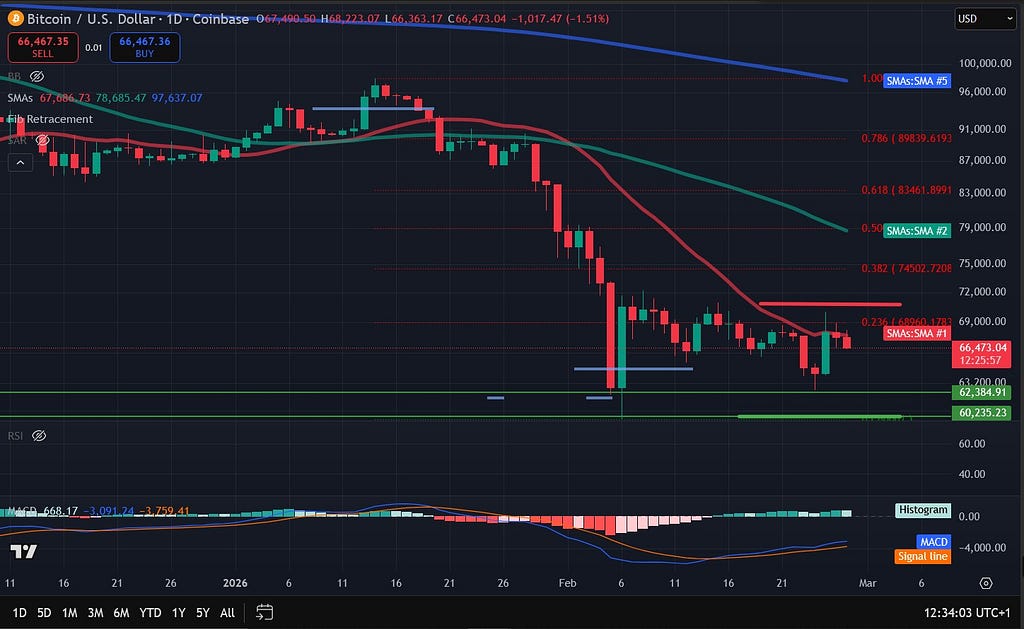
Bitcoin (BTC) retreated on Friday as its rebound lost momentum around the $70,000 mark. The flagship cryptocurrency and other altcoins fell alongside US equities thanks to Nvidia’s earnings-fueled pullback. Despite the downturn, BTC remains positive, albeit marginally, on the weekly timescale.
According to analysts, the latest downturn was likely due to a leverage flush rather than a structural trend reversal as buyers stepped in after overnight selling. BTC is down nearly 1% over the past 24 hours, trading around $67,726. Altcoins also declined, with Ethereum (ETH) down 1.41%, Ripple (XRP) down over 2%, and Solana (SOL) marginally down at $87.
Bitcoin Selling Pressure Nearly Exhausted
Crypto analyst Willy Woo believes Bitcoin investors are close to pausing their selling spree, a move that could bring some welcome relief and ease the downward pressure on the asset. The analyst stated in a post on X,
“This bearish sell down by investors seems to have exhausted, which gives the price a reprieve to consolidate sideways for maybe a month, even a rebound to mid 70s, which would likely be rejected. This is because the broader regime is heavily bearish, with both spot and futures liquidity deteriorating. I’ve never seen BTC rally when both sources of liquidity are bearish.”
Bitcoin has traded between $60,000 and $70,000 over the past few weeks as long-term holders dumped their holdings on the market. Woo believes the ongoing bearish trend could end by Q4 2026, and bullish momentum may return in Q1 2027. For now, the broader market remains bearish, with spot and futures liquidity deteriorating.
Ransomware Incidents Jump 50% In 2025
Ransomware attacks have soared 50% in 2025 as hackers focus on small and medium-sized targets. The numbers were reported in Chainalysis’s annual report, published on Wednesday. The report disclosed that there were 8,000 attacks in 2025, a 50% increase from 2024. However, despite the high number of incidents, on-chain ransom payments declined 8% to $820 million. According to the report, increased regulatory scrutiny, enforcement action against laundering infrastructure, and a general refusal by large organizations to pay ransom amounts led to the decline, forcing attackers to target smaller players. eCrime.ch founder Corsin Camichel was quoted in the report, stating,
“We’re seeing a structural shift in targeting: fewer large, headline-grabbing intrusions and more volume focused on small and medium enterprises. The assumption is simple — smaller victims pay faster. However, Chainalysis’ data shows payments trending downward despite an all-time high in public claims. That divergence is important. It suggests attackers are working harder for diminishing returns.”
The report attributed the increase in attempted attacks to a decline in the average “price for victim access” on the dark web, which fell from $1,427 at the beginning of 2023 to $439 at the beginning of 2026. Chainalysis added that cheap software and ransomware strains combined with AI had led to increased output by hackers.
“We are seeing industrialized access pipelines, AI-assisted tooling, and a proliferation of infostealer logs that lower the barrier to entry, which has resulted in an oversupply of cheap but operationally constrained inventory that floods the market and depresses pricing.”
Crypto Market Reeled Under Pressure In February
The cryptocurrency market faced substantial pressure in February as prices struggled to build momentum. Markets have also struggled to cope with slower stablecoin growth, a hawkish Federal Reserve, and weak US manufacturing data. As a result, the total cryptocurrency market capitalization has dropped from over $3 trillion to $2.3 trillion, while the crypto Fear and Greed Index has plunged to record lows.
One CryptoQuant analyst has warned that declining stablecoin reserves could become a major risk factor. According to on-chain data, Tether exchange balances have dropped from $60 billion to $51.1 billion, a decline that has impacted trading liquidity since January. The analyst believes declining stablecoin reserves are a clear sign that capital is leaving crypto markets. Active crypto wallet addresses have also dropped from 376,000 to 263,000, indicating that retail and institutional interest has taken a backseat. Daily trading volume has also declined 6% to $399 million, indicating little speculative activity in the market.
Bitcoin (BTC) Price Analysis
Bitcoin (BTC) retreated on Friday as the cryptocurrency market slipped back into bearish territory, with most tokens trading in the red. Traders continued de-risking following Nvidia’s earnings-driven pullback. The firm’s stock tumbled over 5% as investors remained concerned over its involvement in the AI sector. Despite robust financial results, the company has struggled to reassure investors amid growing unease over AI and the potential disruption of various industries, spanning from logistics to software.
According to analysts, Bitcoin’s latest downturn is likely due to a leverage flush rather than a structural breakdown. The downturn mostly happened overnight, with buyers stepping in at lower levels and propping up the price. Daniel Reis-Faria, CEO of ZeroStack, stated,
What you’re seeing right now is Bitcoin trading with the broader risk market. Nasdaq fell after Nvidia earnings, and crypto followed. Bitcoin pushed closer to $70,000 pretty quickly, and when momentum in equities stalls, that fast money comes off just as quickly in Bitcoin.”
Analysts remain divided about Bitcoin’s price action. However, most agree that the flagship cryptocurrency could face substantial volatility in the near term. Some analysts have warned that Bitcoin could slide further if the $60,000 support breaks. Meanwhile, the $70,000 mark remains a major barrier to a sustained recovery. VanEck’s Mathew Sigel described the downturn as “orderly deleveraging,” arguing that leverage had cooled and the market was adjusting. Meanwhile, Bitwise analysts remain bullish about Bitcoin’s long-term potential and view the recent pullback as an accumulation opportunity.
While Bitcoin rallied to an eight-day high on Wednesday and formed a double-bottom around the $62,000 level, it remains considerably lower than a month ago. This, according to analysts, suggests Bitcoin bulls are unlikely to come out on top following Friday’s $10.5 billion options expiry. Deribit leads with $4.5 billion in call options and $3.4 billion in put options. OKX follows with $610 million in call options and $385 million in put options, and CME with $255 million in call options and $287 million in puts.
Bitcoin (BTC) has traded between $62,000 and $70,000 over the past two weeks. The flagship cryptocurrency registered substantial volatility at the beginning of the previous week before settling at $68,858. Selling pressure returned on Tuesday as the price fell by over 2% to $67,466. Sellers retained control on Wednesday as BTC fell 1.55% to $66,419. Despite the overwhelming selling pressure, the price recovered on Thursday, rising nearly 1% to $66,972. Buyers retained control on Friday as BTC rose 1.51% to $67,984.
Source: TradingView
Price action was muted over the weekend as BTC registered a marginal decline on Saturday and fell 0.50% on Sunday. Selling pressure intensified on Monday as the flagship cryptocurrency plunged over 4% to $64,625. The price fell to an intraday low of $62,534 on Tuesday before settling at $64,068. BTC rebounded on Wednesday, rising over 6% to $67,992. However, it was back in bearish territory on Thursday, dropping almost 1% to $67,490. BTC is down over 1% during the ongoing session, trading around $66,720.
Disclaimer: This article is provided for informational purposes only. It is not offered or intended to be used as legal, tax, investment, financial, or other advice.
Bitcoin Price Analysis: BTC Bounce Loses Momentum As Risk-Off Sentiment Persists was originally published in Coinmonks on Medium, where people are continuing the conversation by highlighting and responding to this story.