
When people hear the words “mixer” or “anonymous pool”, they usually imagine the same thing. Someone is “laundering” money. Someone is hiding something. Someone is bypassing the rules.
These words automatically carry suspicion — even when we are talking about something as basic as privacy.
The problem is that we are used to looking at finance through the eyes of banks, exchanges, and government systems. In that world, every movement is a record, a log, a permanent history. If there is no history, something must be wrong.
But real life works very differently.
We transfer value without history all the time. We hand over cash. We give someone a key. We pass a gift to another person — without creating a financial dossier about each other afterward. And no one finds this suspicious.
Yet in the digital world, we somehow decided that every action must be archived forever.
Why Even Vitalik Needs Anonymity
There is a telling fact that is rarely discussed openly. Vitalik Buterin has publicly mentioned more than once that he used mixers when sending funds to charity.
Not because the money was “dirty”. Not because he was trying to hide something illegal.
The reason was much simpler.
He didn’t want every donation to automatically become a public event — a signal for analysts, news headlines, and endless interpretations. He simply didn’t want to be constantly visible.
This example highlights a fundamental misunderstanding of anonymity.
We often confuse the desire to leave no traces with the desire to hide wrongdoing.
In reality, it is normal human behavior: not wanting to become a target of attention.
Vitalik Buterin says that privacy is normal
Why Classical Mixers Create More Problems Than Solutions
Classical mixers are built around the idea of flows.
There are many inputs. There are many outputs. Somewhere in the middle, everything gets “mixed”. Formally, this makes analysis harder. But at the same time, it creates new risks.
Entering a mixer and exiting it are both observable events. These events are easy to label, collect into lists, and analyze later. Over time, they become toxic — not because something was done wrong, but because participation itself leaves a trace.
Moreover, mixers always rely on timing, amounts, and probabilities.
Wherever there is a flow, patterns eventually emerge.
That is why today the word “mixer” is often perceived not as a privacy tool, but as something risky and problematic.
An Anonymous Pool Is Not a “Laundry”, but a Safe
My anonymous pool is built on a completely different logic (One example of this approach is the LAC project). It does not try to confuse flows and does not generate “noise”. There is no concept of mixing at all.
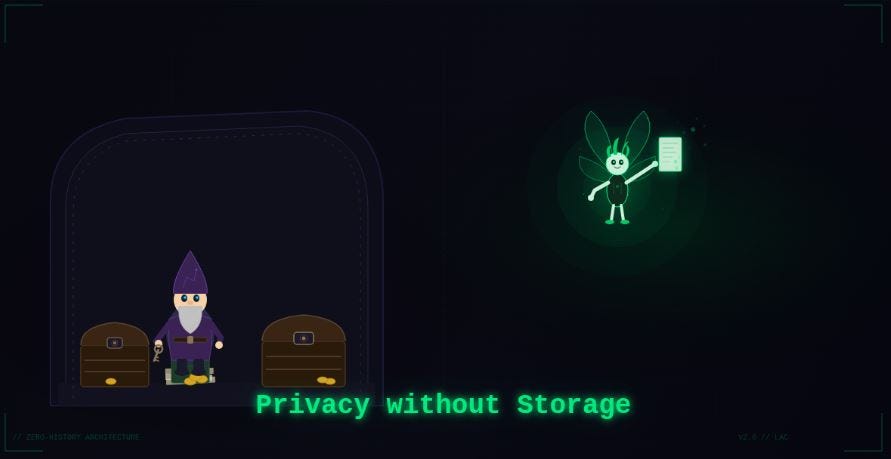
The easiest way to think about it is as a safe.
When you send funds into the pool, you are not transferring them to another person. What happens instead is the creation of a receipt — a right to withdraw a specific amount from the pool.
This receipt is not tied to an address, a name, or an account. For the system, only one fact exists: funds were deposited, and a valid right to withdraw them exists.
There is no history of “from whom to whom”. There is no chain of events.
The Most Important Part: The Transfer Happens Outside the System
This is where anonymous pools do what classical mixers cannot.
The receipt can be passed to another person in any way. In person. Through a messenger. As a QR code. On a piece of paper. Offline, without the internet.
At that moment, nothing happens on the blockchain.
The system does not see the transfer. It does not know who gave the receipt to whom, or why. It cannot reconstruct this event later, because it simply does not exist in the logs.
When someone eventually uses the receipt to withdraw funds from the pool, the system sees only one thing: a valid receipt was presented, and the funds were withdrawn.
For the protocol, this looks exactly like a safe: the money was inside, then it was taken out.
Why This Is Not Money Laundering
Money laundering is an attempt to disguise the origin of funds, bypass sanctions, or hide a criminal trail.
An anonymous pool does not disguise anything.
It simply does not create long-term links that can be analyzed years later.
This is closer to handing over cash or giving someone a key than to any financial scheme.
We don’t call this laundering in the physical world.
We are just not yet used to the idea that privacy in digital systems can exist without total logging.
Conclusion
An anonymous pool is not about escaping rules or operating in the shadows. It is about defining the boundary between what a system has the right to know — and what should remain between people.
Vitalik used mixers not because he was doing something illegal, but because he didn’t want to be permanently visible. Ordinary people want the same thing — no more and no less.
An anonymous pool is a digital safe: the system sees the money, but it does not see the people.
And perhaps this is exactly what normal digital privacy should look like.
#privacy #blockchain #cryptography #anonymity #fintech #web3 #zero-history
Why Everyone Thinks Anonymous Pools Are “Money Laundering” — and Why They’re Not was originally published in Coinmonks on Medium, where people are continuing the conversation by highlighting and responding to this story.