
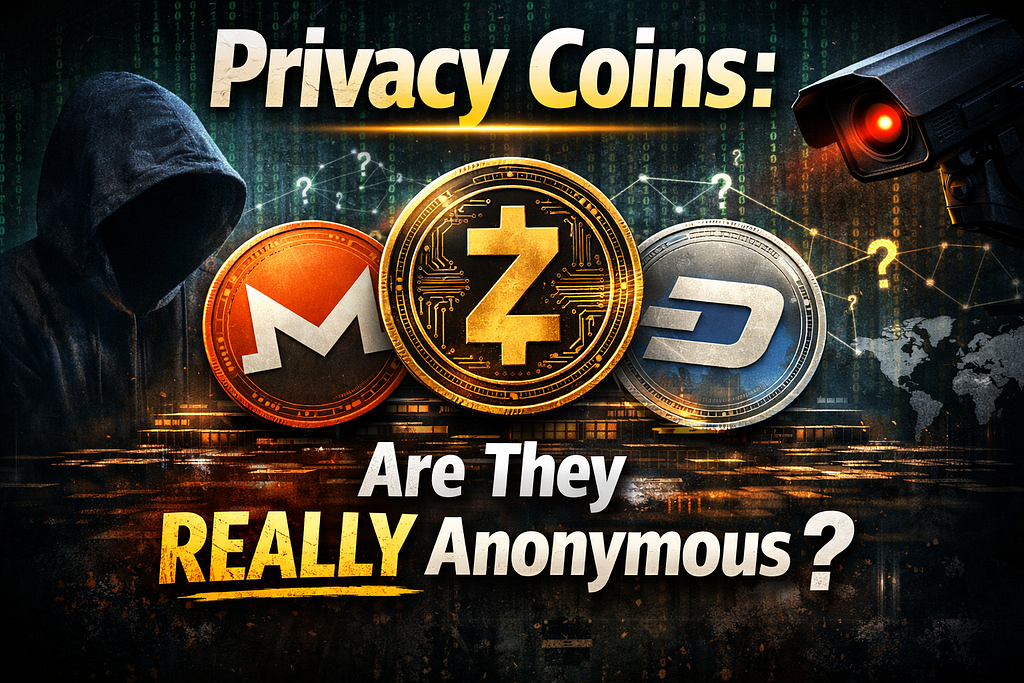
What Monero, Zcash, and Dash really hide — and why true anonymity in crypto is harder than most investors think.
Privacy Coins Explained: Are They Actually Anonymous?
If your crypto transaction can be tracked, was it ever really private?
In an era where blockchain analytics firms can map wallets, governments can subpoena exchanges, and a single on-chain transaction can expose years of financial behavior, privacy has quietly become crypto’s most uncomfortable question.
Bitcoin was once hailed as anonymous money. Ethereum followed with programmable transparency. But today, both are closer to public financial ledgers than private cash.
That’s where privacy coins enter the conversation — promising anonymity, untraceability, and financial sovereignty in a world moving rapidly toward total visibility.
But here’s the uncomfortable truth most headlines skip:
Privacy coins are not all equally private — and some aren’t anonymous at all.
So what are privacy coins really? Do they actually work?
And in 2026, are they tools for freedom… or regulatory red flags?
Let’s break it down — clearly, honestly, and without the hype.
What Are Privacy Coins?
Privacy coins are cryptocurrencies designed to obscure transaction details such as sender, receiver, and transaction amount using cryptographic techniques that go beyond standard blockchain privacy.
Unlike Bitcoin or Ethereum — where transactions are pseudonymous but publicly visible — privacy coins aim to make transactions untraceable by default.
The Key Difference
What Are Privacy Coins? (The Key Difference)
This difference fundamentally changes who can see, analyze, or control your financial activity.
Why Privacy Coins Exist (And Why They Matter More Than Ever)
Privacy coins didn’t emerge because people wanted to hide crimes.
They emerged because financial surveillance became the default.
Three Forces Driving Privacy Demand
1. Blockchain analytics
Firms like Chainalysis and Elliptic can now cluster wallets, trace flows, and identify users with frightening accuracy.
2. Exchange KYC requirements
Your “anonymous” wallet becomes very identifiable the moment it touches a regulated exchange.
3. Government pressure
Increasing regulation has turned financial privacy into a compliance issue — not a personal right.
In 2026, privacy is no longer about secrecy. It’s about control.
The Big Question: Are Privacy Coins Actually Anonymous?
Sometimes — but not always.
It depends on how the privacy coin is built, how it’s used, and who is analyzing it.
Let’s unpack this properly.
The Three Levels of Crypto Privacy
Understanding privacy coins requires understanding privacy depth.
Level 1: Pseudonymity (Bitcoin, Ethereum)
Addresses aren’t namesTransactions are fully visibleIdentity can be inferred through behavior
Verdict: Not anonymous
Level 2: Optional Privacy (Zcash, Dash)
Users can choose private or public transactionsPrivacy is not enforced by default
Verdict: Privacy exists, anonymity is conditional
Level 3: Mandatory Privacy (Monero)
All transactions are private by defaultNo transparent option exists
Verdict: Strong anonymity (with caveats)
How Privacy Coins Actually Work
This is where most articles get vague. Let’s be specific.
Monero (XMR): The Gold Standard of Privacy?
Monero is widely considered the most private cryptocurrency in active use today.
How Monero Hides Everything
Monero uses three core technologies:
1. Ring Signatures
Your transaction is mixed with others, making it impossible to identify the real sender.
2. Stealth Addresses
The recipient’s address never appears on the blockchain.
3. Confidential Transactions (RingCT)
Transaction amounts are hidden.
Result:
Sender hiddenReceiver hiddenAmount hidden
Even Monero’s blockchain explorers can’t show balances.
Is Monero Truly Anonymous?
Technically: Yes, by design.
Practically: Mostly — but user behavior still matters.
Mistakes like reusing addresses off-chain or interacting with KYC exchanges can still compromise anonymity.
Zcash (ZEC): Privacy You Have to Opt Into
Zcash takes a very different approach.
How Zcash Privacy Works
Uses zk-SNARKs (zero-knowledge proofs)Supports two address types:Transparent (t-addresses)Shielded (z-addresses)
The Problem? Most users still use transparent transactions.
Privacy that isn’t default… often isn’t used.
Is Zcash Anonymous?
Shielded transactions: Strong privacyNetwork-wide anonymity: Weak
Because so few users use shielded addresses, anonymity sets remain small.
Dash: Privacy or Marketing?
Dash markets “PrivateSend” — but let’s be blunt.
How Dash “Privacy” Works
CoinJoin-style mixingOptional and limited roundsNot cryptographically enforced
Reality Check
Transactions are traceable with enough dataDash is not considered a true privacy coin by researchers
Verdict: Privacy-adjacent, not anonymous
Privacy Coins vs Bitcoin Mixers
Some argue you don’t need privacy coins — just use mixers.
That argument is outdated.
Why Mixers Aren’t Enough
Many mixers are now sanctioned or shut downOutputs can still be probabilistically tracedRegulatory risk is extremely high
Mixers add friction. Privacy coins redesign the system.
Can Privacy Coins Be Traced?
Here’s where nuance matters.
The Honest Answer
Bitcoin: Easily traceableEthereum: Easily traceableZcash: Conditionally traceableMonero: Extremely difficult, but not magic
No system is immune to:
User errorsEndpoint surveillanceNetwork metadata leaks
Privacy coins reduce on-chain traceability — they don’t make users invisible.
Why Exchanges Are Delisting Privacy Coins
This isn’t about technology. It’s about risk.
Exchange Concerns
AML complianceRegulatory pressureInability to monitor flows
That’s why:
Monero is frequently delistedZcash faces ongoing scrutinyPrivacy coins trade at liquidity discounts
Ironically, the coins designed for privacy are punished because they work.
Are Privacy Coins Illegal?
No — but context matters.
Legal Reality in 2026
Privacy coins are legal in many jurisdictionsSome countries restrict exchange listingsPossession does not imply criminal intent
Using privacy coins for lawful purposes is still legal — but increasingly inconvenient.
Legitimate Use Cases for Privacy Coins
Let’s kill the myth that privacy equals crime.
Real-World Use Cases
Protecting financial data from competitorsSafeguarding personal wealthAvoiding targeted scamsOperating under oppressive regimesPreserving donor anonymityPreventing address blacklisting
Financial privacy is a feature — not a flaw.
Privacy Coins vs CBDCs: A Coming Collision
As governments roll out Central Bank Digital Currencies, the contrast becomes stark.
Privacy Coins vs CBDCs: A Coming Collision
This isn’t just a tech debate — it’s a philosophical one.
The Future of Privacy Coins
Privacy coins won’t disappear — but they will evolve.
What’s Likely Ahead
Increased delistingsPeer-to-peer usage growthPrivacy layers on existing chainsHybrid compliance modelsMore sophisticated analysis tools
Privacy will survive — but it won’t be convenient.
Final Verdict: Are Privacy Coins Actually Anonymous?
Privacy coins are not magic cloaks — but they are the strongest tools currently available for on-chain financial privacy.
Some provide real anonymityOthers offer optional or cosmetic privacyAll require informed use
In crypto, privacy isn’t something you buy. It’s something you practice.
If you found this breakdown useful, clap to help it reach more readers.
Do you believe financial privacy is a right or a risk?
And would you use privacy coins if regulation tightened further?
Drop your take in the comments section.
Privacy Coins Explained: Are They Actually Anonymous? was originally published in Coinmonks on Medium, where people are continuing the conversation by highlighting and responding to this story.