
Web3 Infrastructure
You click “Swap” on Uniswap. MetaMask pops up. Transaction flies to Ethereum. Magic? Nope.
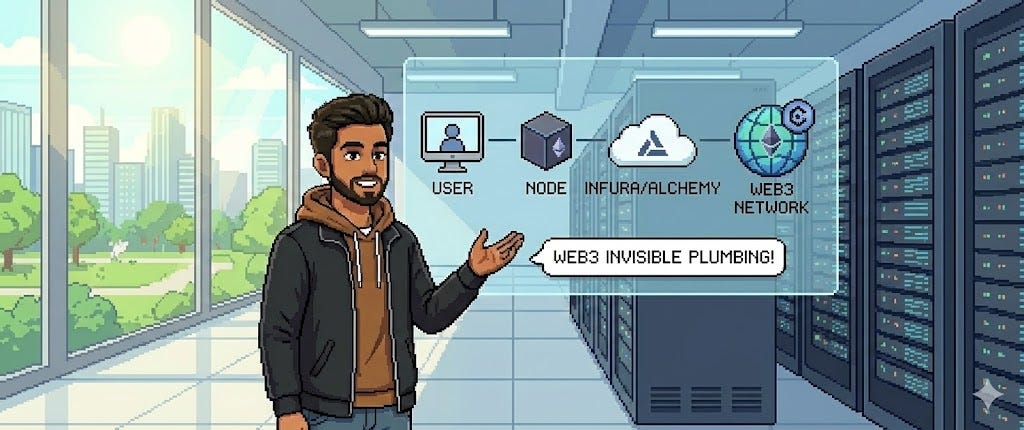
There’s invisible plumbing making every wallet click and smart contract call possible: RPC nodes.
Today on Day 23 we pull back the curtain on what actually powers your MetaMask, dApps, and every blockchain interaction. 🛠️
Blockchains are “blind” without nodes
Remember Day 6? Smart contracts live on-chain. But they can’t “see” your wallet balance, pending transactions, or even the current block without asking someone.
That “someone” is an RPC node — a computer constantly synced to the blockchain, ready to answer questions like:
“What’s my ETH balance?”“Did my transaction confirm?”“What’s the latest block?”
Without nodes, MetaMask is just a fancy calculator with no internet connection.
Analogy: Your phone doesn’t store the entire internet. It asks Google (“Hey, what’s the weather?”). RPC nodes are Web3’s Google.
What is an RPC node? (Simple version)
RPC = Remote Procedure Call — fancy talk for “computer A asks computer B to run a function and send results back.”
RPC Node = A full blockchain copy that:
Downloads every block, transaction, and smart contract stateSpeaks JSON-RPC (standard language for blockchain queries)Serves as a middleman between your dApp/wallet and the chain
Every time you:
Check balance in MetaMaskSend a transactionQuery Uniswap prices MetaMask sends an RPC request to a node somewhere.
Real example: When you deployed your first contract on Sepolia (Day 9), Remix IDE asked an RPC endpoint: “Hey, broadcast this transaction for me.”
The RPC URL — Web3’s “phone number”
Every blockchain connection starts with an RPC URL like:
https://eth-sepolia.g.alchemy.com/v2/YOUR_API_KEY
https://mainnet.infura.io/v3/YOUR_PROJECT_ID
Breakdown:
eth-sepolia = Ethereum Sepolia testnetalchemy.com / infura.io = the node providerYOUR_API_KEY = your free developer account
MetaMask settings → Networks → Ethereum Mainnet → RPC URL = exactly this.
Pro tip: Copy your Alchemy/Infura URL from their dashboard, paste into MetaMask custom networks. Instant connection to any chain.
Running your own node vs using providers
Option 1: Run your own (hardcore)
$ geth –sepolia –http –http.api eth,net,web3
Downloads 100s of GBs. Runs 24/7. Full control. But… electricity bill + crashes when your laptop sleeps.
For: Privacy nuts, MEV bots, enterprise dApps
Option 2: Use providers (99% of devs)
Infura (ConsenSys) + Alchemy power 90% of Web3.
Why they win:
99.99% uptime (your node crashes = your dApp dies)Auto-scaling (Uniswap does 1M+ requests/sec)Free tiers (300k requests/day)Built-in analytics, debugging, archiving
Day 9 Sepolia deploy? You used their node without knowing.
Infura vs Alchemy — The node provider showdown
My pick: Alchemy. Better free tier + dashboard makes debugging way easier.
Switching test: Both give free API keys. Try deploying the same contract to both. Speed + reliability identical for small projects.
Real-world: How MetaMask + RPCs actually work
You click “Swap ETH → USDC” on UniswapUniswap asks RPC: “What’s my ETH balance? USDC price?”MetaMask asks RPC: “Can I sign this tx? Gas price?”You approve → MetaMask broadcasts tx via RPCRPC broadcasts to Ethereum miners/validators6 blocks later → RPC confirms “Tx success!”
Every step? RPC call. No RPC = no Web3.
“What if Infura goes down?” → Switch RPC URL in MetaMask settings. 30 seconds.
Why this matters for builders (the DevRel angle)
Junior dev: “My contract deploy failed!” → Check RPC status first.
Scaling dApp: Free tier ends → paid plans start at $49/mo
Privacy-focused: Run your own node + Tor
MEV bot: Need archive nodes (full historical data)
From my Sepolia deploys: Spent 2hrs debugging “transaction underpriced” before realizing my RPC was rate-limited. Never again.
Pro move: Always have 2–3 RPC URLs ready. Primary + backup + self-hosted.
Hands-on: Set up your own RPC pipeline (5 mins)
Sign up: alchemy.com (free)Create app → Copy Sepolia RPC URLMetaMask → Settings → Networks → Add Network:
Name: Sepolia (Alchemy)
RPC URL: https://eth-sepolia.g.alchemy.com/v2/YOUR_KEY
Chain ID: 11155111
Currency: ETHTest: Send 0.001 Sepolia ETH to your address. Watch it appear instantly.
Challenge: Deploy Day 9 contract using your Alchemy RPC vs Infura. Compare speed.
Reflection: The “aha” moment
RPCs felt boring until I realized: MetaMask isn’t magic. It’s just a fancy RPC client.
Understanding nodes = understanding why:
Transactions “get stuck” (RPC rate limits)dApps crash during congestion (provider overload)“Private” wallets aren’t private (shared RPCs see everything)
Next time someone says “Web3 is just JSON over HTTPS,” nod knowingly.
Key Takeaway
RPC nodes are Web3’s Google — every wallet click, swap, and contract call goes through them. Infura/Alchemy handle 90% of traffic so you don’t have to.
What to do next
Learning:
Set up Alchemy account + custom RPC in MetaMaskRead Day 23 (On-chain identity) knowing ENS queries hit RPCs too (Stay Tuned)
Building:
Bookmark 3 RPC providers (Alchemy, Infura, QuickNode)Never hardcode single RPC URL in production
Join us:
Drop your “RPC horror story” below 👇Web3ForHumans Telegram — share your node setups!
Follow me on Medium | Twitter | Future
Further Reading
Alchemy — RPC Node Guide
https://www.alchemy.com/overviews/rpc-node
Cherry Servers — What is an RPC Node
https://www.cherryservers.com/blog/what-is-an-rpc-node
MetaMask — How to add custom RPC
https://support.metamask.io/configure/networks/how-to-add-a-custom-network-rpc
Alchemy vs Infura comparison
https://www.alchemy.com/overviews/alchemy-vs-infura
Web3 Infrastructure: RPCs, Nodes, Infura/Alchemy (The Invisible Plumbing) was originally published in Coinmonks on Medium, where people are continuing the conversation by highlighting and responding to this story.