
After Trump commented to Nvidia’s board, the firm re-appointed its CEO.
At the same time, a bank-sponsored special purpose vehicle is using $63B to fund Anthropic’s chip requirements. Additionally, the United States has reportedly prompted TSMC and Samsung to halt certain exports to China.
Where does control over AI currently reside?
Last Monday morning, even before the United States stock markets opened, the world’s key chip company changed its mind on whether to re-appoint its CEO. By lunchtime, the president of the United States was on CNBC commenting on the situation.
It is highly atypical of the way companies are normally run. But this is how AI is now run.
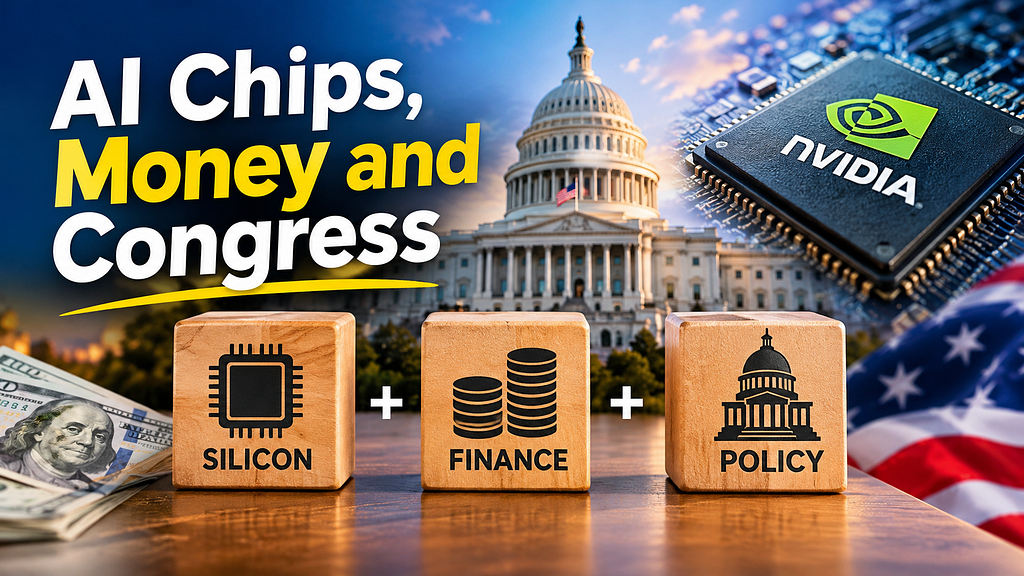
Whilst for the past three years there has been much debate about which chatbot is best, which test has been defeated and which has the most impressive showreel, this appears to now be secondary. Control over AI is being decided in three areas, largely invisible to most users.
Image Generated by ChatGpt
1. Chips where a CEO becomes a matter of national security
Following allegations that Jensen Huang had an affair with a Chinese intelligence source, the Nvidia board had previously decided to fire him. However, after Trump conversed with the board and provided “assurances” regarding national security issues, Huang was re-appointed.
Washington Post
In a statement, Nvidia noted that it had taken advice from high-level officials in the US government. It is therefore confident that Huang’s re-appointment does not present a national security issue. Furthermore, it added that an independent investigatory committee will still reach a decision on this issue.
sec
Trump was more blunt. He told CNBC he had been “speaking to the board directly and indirectly.” CNN reported that he had instructed Vice President JD Vance to personally assist in facilitating communication between Huang and the board.
NBC News
CNN
Wall Street responded swiftly, with Nvidia’s stock rising around 30%.
CNN
Reflect on that. Almost a third of the value of the firm which provides the ‘pick and shovel’ for the AI gold-rush was influenced by one human resource decision involving the White House. Clearly, or chillingly, the market is valuing political connections as an asset. Unsurprisingly.
2. Money — your AI may not even show up on your balance sheet
Now to the second strand of the AI narrative — which has unfortunately not attracted the same level of interest as it should have done.
On October 26, a consortium comprising Bank of America, Blackstone, Citigroup and Morgan Stanley committed $63 billion to provide Anthropic with chips. This is done via a new special purpose vehicle which purchases chips from Broadcom and then sub-leases them to Anthropic. Chip supply to Anthropic is due to commence in 2027.
Bloomberg
If jargon has left you cold, then here’s a simplified explanation. Rather than a firm acquiring chips itself, another body — which is bank-funded — does so and then sub-leases them. The AI research laboratory receives the computing power. The banks receive sub-lease income. Crucially, Broadcom is also providing a form of backstop for part of this money, in relation to the value of the chips. Should their value fall short of expectations in the future, Broadcom is committing itself to taking on some of that value loss.
Bloomberg
One report noted that AI infrastructure is transitioning away from being financed from a firm’s own balance sheet and is now being provided via more sophisticated, asset-backed funding methods. Consequently, part of the risk of technology becoming outdated is being transferred from the AI developer to the chip provider.
credence research
Interestingly, the news was released on the same day that Anthropic submitted an IPO prospectus. (Full disclosure: this is the company for which I also work. Please base your assessment on the facts rather than my association).
aim media house
Although this may sound dubious, the concept of equipment sub-leasing is in fact a long-established method of financing. However, what is novel here is the size. Where one client’s hardware leasing reaches $63 billion, AI ceases to be purely a software concern and instead becomes a credit-related issue. Unfortunately, credit stories often unfold in unforeseen ways.
3. Congress — the green light
Finally, we arrive at the entity with the most explicit authority to deny approval.
On November 19, the Commerce Department’s export bureau implemented fresh guidelines. Previously, chip makers could export high node chips to China, provided they had independently confirmed that these were not subject to US restrictions on AI chips. Now, however, such exports require a licence.
silicon
Accordingly, TSMC and Samsung have reportedly suspended deliveries of some chips to China whilst their licence applications are processed. Moreover, TSMC has refused to accept 16nm and lower process orders from Chinese clients that do not possess US export licences.
tradingview
bloomingbit
This is not solely an issue relating to AI chips. TSMC also supplies smartphone chips to Chinese companies including Oppo, Vivo and Xiaomi. Samsung’s biggest Chinese clients are Baidu and ByteDance. As Nikkei Asia noted, interviewees indicate that the new regulations apply not just to high-end AI chips, but also to general mobile and consumer technology — and that this impact is not confined to Chinese developers.
tradingview
aiweekly
Even within China, major companies are affected. Last week, Alibaba stated that it expects the new regulations to likely hinder expansion of its data centre operations next year.
silicon
Observe what is occurring. Regulation emanating from Washington is dictating what can and cannot be exported from Taiwan or South Korea to China. Clearly, there was no vote on this in either Taipei or Seoul. Yet this is the nature of global supply chains. Everything — whether hardware, software or licences ultimately originates in American hands.
So who does control AI?
Honestly, no one does.
Yes, models are important. But their value is reliant upon them being run on suitable computing power. And the supply of computing power is in turn dependent upon funds being available for it. Both finance and chips can only flow so long as they are approved to do so by governments which currently regard silicon as strategically significant.
Imagine three different keys for three separate locks:
Silicon is in the hands of Nvidia and foundries.
Finance is in the hands of banks and venture capital.
And the green light is in the hands of Washington.
All three are required to open the lock. As the Huang situation has shown, the holder of the third key is not above entering a boardroom and using it.
Next time you hear that the AI race is focused on developing the most intelligent model, challenge yourself to ask not just who is doing that, but also who is financing the chips, who is permitted to purchase them and who gets to speak to the board if Washington dislikes a board decision.
This is where the race now lies, and it is not taking place in a laboratory.
Do you believe that political control over AI infrastructure is positive or problematic? Let me know your view in the comments below.
AI chips, money and Congress was originally published in Coinmonks on Medium, where people are continuing the conversation by highlighting and responding to this story.