
A detailed guide to trading XAUUSD breakouts using market structure, session timing, confirmation, risk management, and a mechanical approach to London and New York.
Gold doesn’t need to be complicated.
Yet open almost any chart of XAUUSD and you’ll find traders stacking indicators on top of indicators, drawing dozens of lines, switching between five different timeframes, and waiting for some perfect combination of signals before taking a trade.
Then the market does what gold often does.
It breaks the level.
Runs without them.
And suddenly they are asking:
“Why didn’t I enter?”
The irony is that many gold breakout setups don’t require ten indicators.
They require something much simpler:
A meaningful level.
A defined trading session.
A breakout.
Confirmation.
And disciplined risk management.
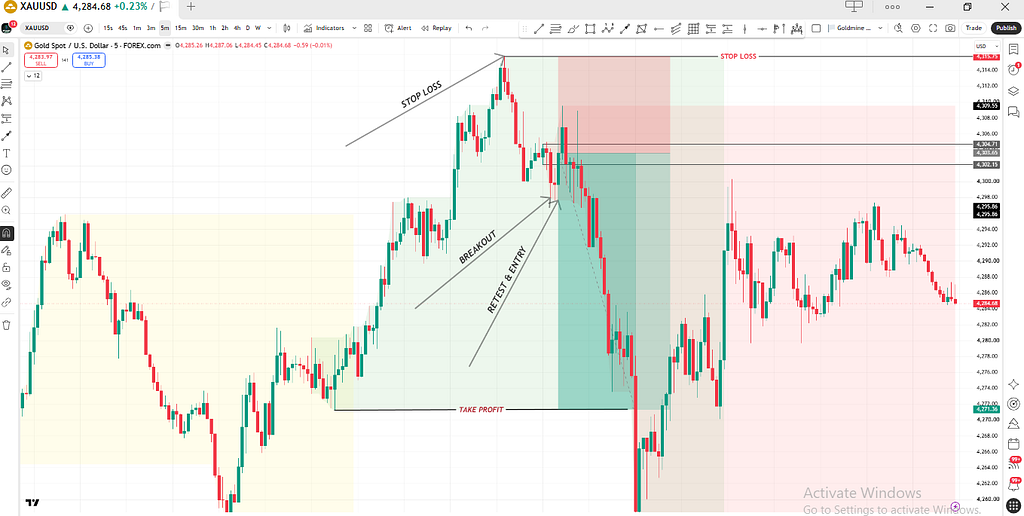
One of the most useful frameworks for studying this behavior is the 5-minute gold breakout setup.
The concept is simple.
The execution is where most traders make it complicated.
In this article, we’ll break down how to think about 5-minute XAUUSD breakouts, why London and New York matter, how false breakouts develop, where lower-timeframe entries can become useful, and how a more mechanical gold trading framework can help eliminate some of the emotional decisions traders make every day.
I’ll also explain how I developed the Goldmine Strategy V2 around session-based gold trading and how the Goldmine Trading Bot takes the concept further by turning a defined methodology into an MT5-based automated system.
Why the 5-Minute Chart Works So Well for Gold
The 5-minute chart sits in an interesting middle ground.
The 1-minute chart can provide extremely precise entries, but it also contains a huge amount of noise.
The 15-minute chart provides cleaner structure, but the entry can become less precise.
The 5-minute chart gives you enough information to see short-term market structure while still allowing you to identify relatively early breakouts.
For XAUUSD, this can be particularly useful around active trading sessions.
Instead of watching every candle throughout the day, you can focus your attention around specific periods when liquidity and participation increase.
That immediately makes the process more manageable.
The basic idea becomes:
Don’t trade every movement. Trade specific movements around specific levels during specific conditions.
That’s a major difference.
The First Mistake: Treating Every Breakout as a Trade
Suppose gold is trading inside a range.
You identify resistance.
Price approaches it.
A 5-minute candle closes above resistance.
The obvious reaction is:
BUY.
But this is where the problem begins.
A breakout candle by itself isn’t necessarily a trading signal.
Gold can temporarily move above a level, trigger breakout traders, attract buy orders, and then reverse aggressively.
This is commonly called a false breakout or bull trap.
The same thing happens below support.
Price breaks the level.
Sellers enter.
Then price reverses and moves back into the range.
So instead of asking:
“Did gold break the level?”
A better question is:
“What happened when gold broke the level?”
That distinction is extremely important.
Step 1: Find the Level Before You Look for the Breakout
The breakout is only meaningful because of the level it breaks.
This sounds obvious, but many traders begin with the candle instead of the structure.
They see a large green candle and immediately start looking for an entry.
I prefer the opposite approach.
Start with the market structure.
Look for areas such as:
previous highsprevious lowssession highssession lowsconsolidation rangessignificant intraday supportsignificant intraday resistanceprevious-day levelsareas where price repeatedly reacted
The question is:
Where is price likely to encounter a decision?
Once you have the level, the breakout becomes interesting.
Without the level, you’re often just trading a candle.
Why Session Timing Matters
Gold trades almost continuously during the global trading week, but that doesn’t mean every hour has the same character.
London can bring a major increase in activity after the quieter Asian period.
New York can introduce another major expansion in liquidity and volatility.
This is one of the reasons session-based gold strategies can be more structured than simply saying:
“Trade XAUUSD whenever the chart looks good.”
Instead, you can divide the market into meaningful periods.
For example:
Asian session → context
London → potential expansion
New York → potential expansion or continuation/reversal
The exact behavior changes from day to day, but the framework gives you something important:
A clock.
And a clock creates boundaries.
The Asian Session Can Provide Context
One of the most useful things about the Asian session isn’t necessarily finding a trade.
It can be used to understand what happened before the major European and U.S. sessions became active.
Gold may spend part of the earlier session moving within a relatively defined range.
That range can later become important.
You can mark:
Asian high
and
Asian low.
Now you have two reference points.
If London or New York subsequently pushes through one of them, you have something meaningful to evaluate.
But remember:
A break isn’t automatically an entry.
It is an event that requires interpretation.
XAUUSD Scalping Bot: Complete Guide to Automated Gold Trading
The 5-Minute Breakout Sequence
A useful way to think about the setup is as a sequence rather than a single candle.
1. Context
Where is gold trading?
Is the market ranging, trending, compressing, or expanding?
2. Level
What price needs to break for the setup to become interesting?
3. Breakout
Does the 5-minute candle actually push through the level?
4. Confirmation
Does price demonstrate acceptance beyond the level?
5. Entry
Where is the most logical place to participate?
6. Risk
Where is the trade invalidated?
7. Target
Where is price likely to encounter the next meaningful obstacle?
That sequence is much more useful than simply saying:
“Buy when the candle breaks resistance.”
What Makes a Breakout More Interesting?
Let’s imagine gold is approaching resistance.
Scenario A:
Price slowly approaches the level.
A candle spikes above resistance.
The candle closes back inside the range.
The next candle sells off.
That’s questionable.
Now consider Scenario B.
Price approaches resistance.
Momentum increases.
A 5-minute candle breaks through the level.
The candle closes beyond it.
Price doesn’t immediately collapse back into the previous range.
A subsequent candle confirms that buyers are still defending the breakout area.
Now you have a much more interesting situation.
The difference isn’t simply:
Break vs. no break.
It’s:
Break + behavior after the break.
The Retest: The Part Traders Often Ignore
One of the most useful concepts in breakout trading is the retest.
Instead of chasing the initial breakout candle, some traders wait for price to return toward the broken level.
For example:
Resistance sits around a certain price.
Gold breaks above it.
Instead of buying the top of the breakout candle, you wait to see whether the former resistance area can act as support.
If price returns to the area and buyers respond, that can provide a more structured entry.
The same principle can apply to a downside breakout.
Support breaks.
Price returns toward the broken support.
The area fails to recover.
Sellers remain in control.
That can provide another confirmation layer.
But there is an important warning.
Not every breakout retests.
Sometimes gold simply leaves the level and keeps moving.
That’s why waiting for a perfect retest can also become a problem.
A good trading framework needs to define what happens in both situations.
Why Gold Breakouts Can Be So Violent
Gold has a reputation for moving quickly.
This is precisely why breakout traders need to think carefully about risk.
A breakout that looks perfect can move dozens of points extremely quickly.
That creates two psychological problems.
Problem 1: FOMO
The trader sees the candle expanding and thinks:
“If I don’t enter now, I’ll miss it.”
So they chase.
Problem 2: Oversized risk
Because the move looks convincing, the trader increases position size.
Then a normal retracement becomes emotionally unbearable.
The result is often a trade that was technically reasonable but financially irresponsible.
The solution isn’t avoiding gold.
The solution is defining risk before entering.
Stop Loss Should Represent Invalidation
A stop loss shouldn’t simply be placed at an arbitrary number because someone says:
“Use 20 points.”
The market doesn’t care about your preferred stop size.
Instead, your stop should have a relationship with the setup.
Ask:
What price movement would tell me my breakout thesis is wrong?
For a breakout strategy, that might involve:
a return through the breakout levelfailure of the structurerejection of the breakoutmovement beyond a defined invalidation point
The exact placement depends on the methodology, market conditions and position size.
The important principle is:
The stop defines where your idea is invalidated.
Then position size can be adjusted to fit the amount you’re willing to risk.
Risk Comes Before the Entry
Suppose you’re willing to risk 1% of your account.
You identify your entry.
You determine where the setup becomes invalid.
Then you calculate the position size accordingly.
This is much safer than deciding:
“I’ll use 0.50 lots because that’s what I normally trade.”
Your lot size should not determine your risk.
Your risk should determine your lot size.
That one change can dramatically improve consistency.
What About Take Profit?
A breakout strategy also needs a logical exit framework.
Possible targets can be based on:
previous highs/lowsnearby support/resistancerange projectionsmeasured movespredefined risk-to-reward objectivessession structuretrailing rules
The mistake is entering first and thinking about the target afterward.
Before entering, you should have a reasonable answer to:
Where could price realistically go?
If the potential reward doesn’t justify the risk, skipping the trade can be the correct decision.
London Gold Breakouts
London is particularly interesting for XAUUSD because the market is transitioning from the quieter Asian period into a more active European trading environment.
A structured London strategy can therefore focus on what happened earlier and whether price begins expanding through important levels.
One possible framework is:
Asian range → London approach → breakout → confirmation → execution.
But the key is not blindly buying the London breakout.
You want to understand what the breakout means within the broader market structure.
Is London breaking an important range?
Is it sweeping liquidity and reversing?
Is it continuing an established move?
Is the market trapped inside a larger range?
Those questions matter.
New York Gold Breakouts
New York provides another important trading window.
This is where the Goldmine Strategy V2 places particular emphasis.
The New York session can create significant movement in gold, and the opening period can produce rapid expansions, reversals and breakouts.
Rather than watching XAUUSD all day, a session-based methodology can define a specific New York trading window and establish rules around what happens there.
This is one of the biggest advantages of a mechanical approach.
Instead of:
“Gold looks bullish today.”
You can work with something closer to:
“These are the conditions I require during my New York trading window. If they appear, I evaluate the setup. If they don’t, I stay out.”
That is a much more repeatable process.
Unlocking Wealth: Gold Trading Strategies for Profit
The Goldmine Strategy V2 Approach
This is one of the ideas behind the Goldmine Strategy V2.
The objective isn’t to make gold trading look more complicated.
It’s to make the decision-making process more structured.
The V2 framework incorporates session-based trading for XAUUSD, including dedicated approaches around the New York and London sessions.
Instead of relying on random entries throughout the day, the methodology is built around identifying specific market conditions and waiting for the appropriate setup.
That means the trader isn’t required to predict every move gold makes.
The objective is to participate when the market presents a setup that fits the framework.
And that’s a very different philosophy from trying to trade every candle.
Why I Prefer Mechanical Rules
Discretion has a place in trading.
But too much discretion creates a problem.
On Monday:
“This looks like a perfect breakout.”
On Tuesday:
“Maybe I’ll wait for confirmation.”
On Wednesday:
“The market feels different.”
On Thursday:
“I’ll enter because momentum looks strong.”
Now you have four different strategies.
That’s difficult to backtest.
It’s difficult to evaluate.
And it’s difficult to improve.
A more mechanical approach gives you repeatable conditions.
For example:
If X happens → evaluate Y.
If Y confirms → look for Z.
If the invalidation condition occurs → exit.
If the setup isn’t present → don’t trade.
The more objective your rules become, the easier it becomes to identify whether the strategy itself is working.
The 1-Minute Chart Can Still Have a Role
This doesn’t mean you should only look at the 5-minute chart.
The higher timeframe can provide context.
The 5-minute chart can provide the primary setup.
And a lower timeframe such as the 1-minute chart can sometimes help refine execution.
For example:
Higher timeframe → direction/context
5-minute → breakout/structure
1-minute → entry refinement
The mistake is using every timeframe to generate a completely different opinion.
If the 5-minute chart says bullish, the 1-minute says bearish, the 15-minute says neutral, and the hourly says bearish, you haven’t created confirmation.
You’ve created confusion.
Each timeframe should have a job.
A Simple Example
Imagine gold spends the early session trading inside a defined range.
You mark the range high and low.
London approaches the upper boundary.
Price briefly breaks above it.
But the 5-minute candle closes back inside the range.
There is no convincing follow-through.
Instead of buying because the level was technically broken, you wait.
Later, price approaches the same level again.
This time, the 5-minute candle closes beyond resistance.
Momentum remains strong.
Price holds above the breakout zone.
A continuation structure develops.
Now the setup is different.
You’re no longer trading:
“A candle went above resistance.”
You’re evaluating:
“Price broke a meaningful level and demonstrated behavior consistent with acceptance beyond that level.”
That’s the difference between a simple breakout and a structured breakout methodology.
When NOT to Trade the Breakout
This may be even more important than knowing when to trade.
There are situations where doing nothing is the best decision.
For example:
The breakout is too extended
If price has already traveled aggressively before you enter, chasing can produce poor risk/reward.
The breakout immediately fails
A rapid return into the previous range can invalidate the original thesis.
Major news is approaching
Economic releases can produce extreme volatility and unpredictable execution.
The level isn’t meaningful
If you’re trading every tiny intraday high and low, you’re likely creating artificial signals.
Risk is too large
If the logical stop is too wide for your account risk, skip the trade or reduce exposure.
The market is messy
Sometimes gold simply doesn’t provide a clean setup.
That’s okay.
A strategy doesn’t need to trade every day.
The Biggest Breakout Trading Lesson
Here’s the lesson I wish more traders understood:
A trading strategy isn’t defined by the trades you take.
It’s also defined by the trades you refuse to take.
If your rules only tell you when to enter, you don’t have a complete system.
You need rules for:
market selectionsession timingsetup identificationconfirmationentrystop lossposition sizingprofit targetstrade managementinvalidationno-trade conditions
That’s what turns an idea into a framework.
From Manual Setup to Automation
Once a strategy becomes sufficiently mechanical, another possibility appears:
automation.
This is where an MT5 Expert Advisor can become useful.
Instead of manually watching charts and trying to remember every rule, an EA can be programmed to monitor predefined conditions and execute according to its rules.
This is the philosophy behind the Goldmine Trading Bot.
The bot is designed around the Goldmine trading framework and brings the methodology into an automated MT5 environment.
That doesn’t mean automation magically makes trading risk-free.
It doesn’t.
A bot can execute rules.
It cannot remove market risk.
But automation can help address a completely different problem:
human inconsistency.
Why Automation Can Matter for Gold
Think about what happens when you’re manually trading XAUUSD.
You might miss the setup because you’re away from the computer.
You might hesitate because the previous trade lost.
You might enter late because the candle moved quickly.
You might move your stop because you don’t want to take the loss.
You might close a winning position too early because you’re afraid the market will reverse.
These aren’t necessarily strategy problems.
They’re execution problems.
An automated system can approach predefined conditions without experiencing those emotional reactions.
That’s one reason I see automation as a natural extension of a mechanical trading methodology.
But a Bot Isn’t a Money Printer
This distinction is extremely important.
Buying an EA doesn’t mean every trade will win.
No legitimate trading system should be presented that way.
Markets change.
Volatility changes.
Execution conditions change.
Economic events happen.
Strategies experience drawdowns.
The purpose of automation is to execute a defined process consistently — not to eliminate uncertainty.
The same principles still apply:
Risk management.
Position sizing.
Testing.
Monitoring.
Drawdown awareness.
Understanding the strategy before deploying it.
Asian Session Gold Trading Strategy: How to Trade XAUUSD Like a Pro Before London Opens
The Real Goal: Fewer Decisions, Better Decisions
That’s ultimately what I like about the 5-minute breakout concept.
It gives you a framework for reducing unnecessary decisions.
Instead of:
“Should I trade gold?”
You ask:
Is this the session I trade?
Then:
Is price approaching a meaningful level?
Then:
Did the breakout occur?
Then:
Was it confirmed?
Then:
Where is the invalidation?
Then:
Does the reward justify the risk?
Then:
Execute or skip.
That’s it.
You don’t need twenty indicators.
You don’t need to predict every candle.
You don’t need to know exactly where gold will be five hours from now.
You need a process.
The Goldmine Ecosystem
For traders who want to take this concept beyond a basic 5-minute breakout tutorial, this is where the Goldmine ecosystem comes in.
The Goldmine Strategy V2 takes a broader approach to structured XAUUSD trading, with specific session-based frameworks covering New York and London.
The objective is to turn the concepts of timing, structure, breakout behavior and confirmation into a more complete trading methodology rather than leaving the trader to improvise every decision.
And for traders who want to take the process further into automation, the Goldmine Trading Bot brings the methodology into an MT5 Expert Advisor environment.
So the progression can look like this:
Learn the market → Understand the setup → Apply the Goldmine methodology → Build consistency → Explore automation.
You can start by studying the Goldmine approach and then decide whether the manual strategy, the V2 framework, or the automated approach fits your trading style.
Grab The Goldmine Strategy V2 + Complete AI Trading System
The 5-Minute Breakout Doesn’t Need More Indicators
The biggest lesson isn’t that the 5-minute chart is magical.
It isn’t.
The lesson is that simplicity becomes powerful when it is structured.
A breakout isn’t simply a candle crossing a line.
It’s a sequence.
Context.
Level.
Session.
Breakout.
Confirmation.
Risk.
Execution.
Management.
When those pieces are defined, the chart becomes easier to read.
And when they aren’t defined, traders often compensate by adding more indicators, more timeframes and more complicated rules.
But complexity doesn’t automatically create accuracy.
Sometimes it simply creates more opportunities to second-guess yourself.
Final Takeaway
If you trade XAUUSD, start paying attention to what happens around the important session windows.
Watch the Asian range.
Mark meaningful highs and lows.
Pay attention to London.
Pay attention to New York.
Study how gold behaves when it reaches important levels.
Don’t automatically buy the first breakout candle.
Study what happens after the break.
Look for confirmation.
Know where your idea is invalidated.
Calculate risk before entering.
And, most importantly, don’t feel obligated to trade every movement.
The best setup isn’t necessarily the biggest candle on your screen.
It is the setup that fits your rules.
That’s the philosophy behind the Goldmine Strategy V2 as well: less random clicking, more structured decision-making.
And once those rules become sufficiently mechanical, automation becomes a logical next step through the Goldmine Trading Bot.
Gold will always move.
The question isn’t whether you can predict every move.
The better question is:
Can you build a process that tells you when a move is worth trading — and when it isn’t?
Explore the Goldmine Trading System
If you want to go beyond this basic 5-minute breakout framework and study a more complete approach to trading XAUUSD around the London and New York sessions, explore the Goldmine Strategy V2.
For traders interested in taking a mechanical approach further, the Goldmine Trading Bot is designed for MT5 and brings the strategy framework into an automated trading environment.
The objective isn’t to make gold trading more complicated.
It’s to make the decision-making process more structured.
Trading gold and other financial markets involves substantial risk. Past performance does not guarantee future results. The examples and frameworks in this article are educational and should not be considered financial advice. Never risk money you cannot afford to lose.
Grab The Goldmine Strategy (Core Strategy Only)
Grab The Complete System + Bot
Grab The Goldmine Grid System + Indicator + Bot and AI Trading
The 5-Minute Gold Breakout Setup Traders Keep Overcomplicating was originally published in Coinmonks on Medium, where people are continuing the conversation by highlighting and responding to this story.