
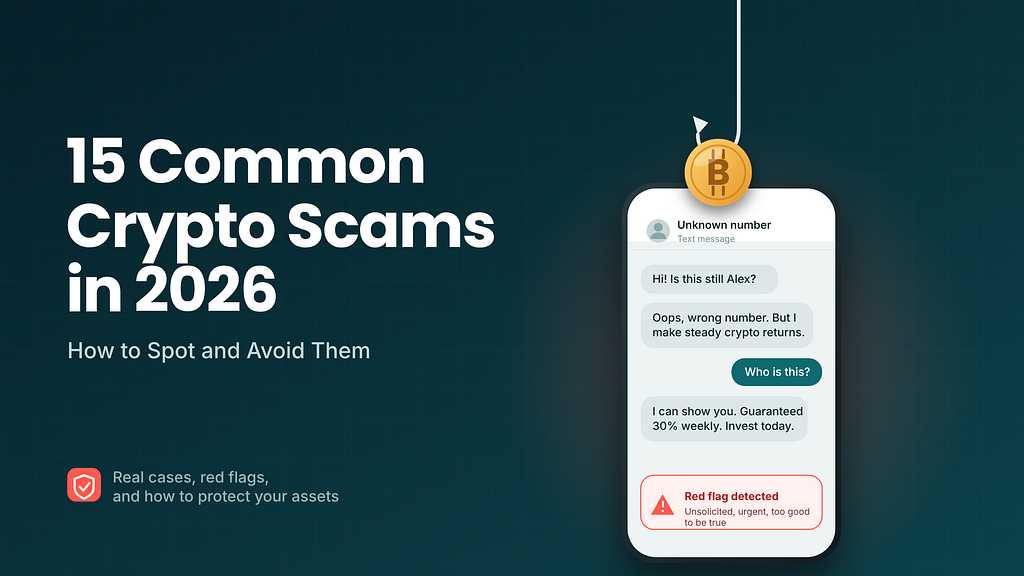
Crypto fraud has gone industrial. Here is how each scam works, who it targets, the warning signs, and how to protect your assets.
15 Common Crypto Scams in 2026 — How to Spot and Avoid Them
The friendly stranger who texted you “by mistake” may not exist. The face on your video call may be generated. The “support agent” helping you secure your wallet may be the person emptying it.
Crypto scams are no longer limited to fake tokens and sketchy websites. Today’s fraud operations combine AI-generated identities, long-game romance manipulation, wallet drainers, and polished impersonation campaigns, often run from industrial-scale compounds staffed by trafficked workers.
The numbers explain why this guide matters. The FBI’s 2025 Internet Crime Report logged $11.37 billion in crypto-related losses across 181,565 complaints, a 22% jump from 2024. Crypto investment fraud alone cost Americans $7.2 billion, the single costliest category of internet crime. Blockchain analytics firm Chainalysis estimates that crypto scams took in at least $14 billion on-chain in 2025, with projections above $17 billion as more wallets are identified.
Below are the 15 most common crypto scam types, organized the way you need them: how it works, who gets targeted, red flags, and how to protect yourself.
Quick Answer: What Are the Most Common Crypto Scams in 2026?
The most common crypto scams in 2026 are pig butchering investment fraud, romance scams, AI deepfake endorsements, exchange and government impersonation, crypto ATM scams, fake trading platforms, wallet drainers, address poisoning, recovery scams, rug pulls, Ponzi schemes, giveaway scams, phishing and fake support, sextortion, and supply-chain attacks on crypto platforms. The details of each follow.
Why 2026 Is Different: Trust Is the Target
Chainalysis reported that impersonation scams grew roughly 1,400% year over year in 2025, and that scams linked to AI vendors were about 4.5 times more profitable than those without. The FBI tracked AI as a complaint descriptor for the first time and recorded 22,364 AI-related complaints with $893 million in losses, likely an undercount.
The lesson: scammers are no longer hacking your computer first. They are hacking your trust. That is why most defenses below are about slowing down, not software.
Part 1: Relationship and Investment Scams
1. Pig Butchering (Fake Investment Relationships)
How it works: Scammers build rapport over weeks, then steer you to a fake platform showing fabricated profits. Small withdrawals work at first. Then a “tax” or “fee” blocks the big one.
Documented case: In October 2025, the U.S. Justice Department charged Prince Group chairman Chen Zhi and filed to forfeit 127,271 bitcoin, worth about $15 billion at the time, calling it the largest forfeiture action in its history. Prosecutors allege forced-labor compounds in Cambodia ran these scams. Treasury sanctioned 146 individuals and entities.
Who is targeted: Anyone on dating apps, social media, or messaging apps, especially people who answer wrong-number texts.
Red flags: A stranger who pivots to crypto, “insider” platforms, pressure to deposit more, surprise withdrawal fees.
Protect yourself: Never invest through a platform someone you met online recommends. Search the platform name plus “scam” before sending anything.
2. Romance Scams With AI-Generated Identities
How it works: Fraudsters use stolen or synthetic photos, voice cloning, and face-swap video to look real on camera. The relationship is the hook; crypto is the payment rail.
Who is targeted: Widowed, divorced, and isolated people, though anyone can be hit.
Red flags: They refuse live video or always have a technical excuse. Declarations of love arrive fast. Money requests follow a crisis.
Protect yourself: Run a reverse image search, request a spontaneous video call with a specific gesture, and never send crypto to someone you have not met in person.
3. Deepfake Celebrity and Influencer Endorsements
How it works: AI-generated videos or hacked accounts show a famous face promoting a “guaranteed” token or trading bot.
Who is targeted: Retail traders scrolling social feeds and video platforms.
Red flags: Celebrity giving financial advice in a clip with odd lip movement, urgency, links to unfamiliar sites.
Protect yourself: Go to the celebrity’s verified channels directly. Real public figures do not run crypto giveaways in the comments.
4. Exchange and Government Impersonation
How it works: A caller or email claims to be your exchange’s fraud team, the FBI, the IRS, or a bank, says your funds are “compromised,” and instructs you to move them to a “safe wallet.” Chainalysis highlighted a 2025 campaign in which scammers posing as Coinbase took nearly $16 million from victims.
Red flags: Unsolicited contact, urgency, requests to move funds or share codes.
Protect yourself: No legitimate agency or exchange will ask you to transfer crypto to protect it. Hang up and call the number printed on the official website.
5. Crypto ATM Scams
How it works: A scammer, often impersonating a government or bank official, directs you to a crypto kiosk to deposit cash and send it to their wallet. The FBI logged 13,460 complaints and $389 million in losses tied to crypto ATMs in 2025, a 58% rise in losses.
Who is targeted: Older adults especially. Across all internet crimes, FBI data shows seniors reported $7.8 billion in 2025.
Red flags: Anyone on the phone while you are at a kiosk. Any “official” who demands cash deposits.
Protect yourself: Treat any request to use a crypto ATM as a scam until proven otherwise. Tell your family about this one.
6. Fake Trading Platforms and Apps
How it works: Slick dashboards show growing balances while nothing is real. The FBI notes victims are shown fake profits or offered loans to encourage bigger deposits.
Red flags: Unregistered operators, guaranteed returns, withdrawals requiring more deposits.
Protect yourself: Check regulator registries first. Test with the smallest amount possible and attempt a withdrawal before depositing more.
Part 2: Technical Theft Scams
7. Wallet Drainers and Signature Phishing
How it works: A fake mint page or airdrop asks you to sign a message that looks harmless but grants a token-spending permission. Security firm Scam Sniffer tracked about $83.85 million stolen by drainers across 106,106 victims in 2025, down 83% from 2024, though it warns the ecosystem remains active and shifted toward smaller, more frequent hits.
Red flags: Surprise airdrops, urgent “claim now” pages, signature requests you cannot read.
Protect yourself: Never sign what you do not understand. Use a wallet with transaction simulation, keep a separate wallet for experimentation, and revoke old token approvals regularly.
8. Address Poisoning
How it works: Attackers send tiny transactions from lookalike addresses so a fake one appears in your history. If you copy it later, your funds go to the thief. Scam Sniffer reported a $50 million loss to this method in December 2025 and another $12.25 million in January 2026, and noted cheaper Ethereum fees made mass poisoning more attractive.
Protect yourself: Never copy addresses from transaction history. Verify the full address, use saved contacts, and send a small test transaction first.
9. Phishing, Fake Support, and Seed Phrase Theft
How it works: Fake support accounts reply to your public complaint, or a spoofed email links to a cloned exchange. The goal: your seed phrase or login.
Red flags: Anyone asking for your recovery phrase, ever. Support that DMs you first.
Protect yourself: Your seed phrase is never required by real support. Use hardware wallets, passkeys or app-based two-factor authentication, and bookmark official sites.
10. Supply-Chain and Platform Compromises
How it works: Attackers compromise the tools people trust. In the February 2025 Bybit incident, North Korea-linked attackers compromised a Safe{Wallet} developer machine and spoofed the signing interface, resulting in about $1.46 billion in losses, according to Scam Sniffer’s analysis.
Protect yourself: Not every loss is user error. Limit funds on exchanges, verify transaction details on a hardware wallet screen, and spread holdings across custody methods.
Part 3: Hype, Greed, and Pressure Scams
11. Rug Pulls and Pump-and-Dump Tokens
How it works: Developers hype a token, drain the liquidity pool, and vanish. Pump-and-dump groups inflate a price, then sell into the buyers.
Red flags: Anonymous teams, locked-down sell functions, influencer paid promotions, no audit, concentrated token ownership.
Protect yourself: Check contract ownership and liquidity locks, avoid hype-driven buys, and never invest more than you can lose.
12. Ponzi and High-Yield “Staking” Schemes
How it works: Early investors are paid with new investors’ deposits and promised fixed, guaranteed returns.
Red flags: Guaranteed yield, referral bonuses, vague strategy.
Protect yourself: If returns sound too risk-free, the risk is hidden.
13. Giveaway and “Send 1, Get 2” Scams
How it works: A fake account, a hijacked verified profile, or a livestream promises doubled crypto if you send some first.
Protect yourself: Real giveaways never require you to send funds. Block and report.
14. Crypto Sextortion
How it works: A scammer builds a flirtatious connection, obtains intimate content, then demands payment. The FBI received over 75,000 sextortion-related complaints in 2025, including roughly 11,000 from people under 20, and says shame keeps many victims silent.
Protect yourself: Stop contact, do not pay, preserve evidence, and report. Paying rarely ends it. Teens and parents should know this: you are not in trouble for reporting.
15. Recovery Scams (Getting Scammed Twice)
How it works: After a loss, “recovery experts,” lawyers, or fake agents contact you and demand an upfront fee to retrieve your funds. The FBI logged 10,516 recovery scam complaints and $1.4 billion in losses in 2025, and notes scammers even pose as the IC3 itself.
Red flags: Unsolicited contact, guaranteed recovery, requests for upfront payment, requests for your wallet access.
Protect yourself: FINRA and the CFTC both warn that fraudsters pose as government officials, attorneys, or recovery companies in advance-fee frauds. Nobody can guarantee recovery.
Where to Check a Platform and Get Help
Research before you invest, and get answers fast if something goes wrong.
ScamBrokerCheck (SBC) has an investment scam database where you can look up brokers and crypto platforms against reports from other investors, and see documented complaints before you deposit. SBC also offers a 100% free consultation for anyone who has been hit by an investment scam or incident. SBC operates a zero upfront payment policy, meaning you are never asked to pay before getting help. That matters, because upfront fees are the signature move of the fake recovery outfits above.
Reporting also helps others, because every documented case makes the next scam easier to spot.
The 5-Step Crypto Protection Checklist
Pause on urgency: Every scam above creates time pressure. Waiting 24 hours defeats most of them.Verify independently: Use official websites and phone numbers you find yourself.Guard your keys: Never share your seed phrase. Use a hardware wallet for long-term holdings.Test small: Send a tiny amount and try a withdrawal first.Report fast: Use ic3.gov in the U.S. The FBI says speed matters, and its Recovery Asset Team froze $679 million in 2025 through rapid Financial Fraud Kill Chain actions.
Frequently Asked Questions
What is the most common crypto scam?
Investment fraud, especially pig butchering. It is the largest source of reported crypto losses to the FBI.
Can you recover stolen crypto?
Sometimes, but rarely and not on demand. Act immediately, report to law enforcement, contact the exchange involved, and avoid anyone demanding upfront fees.
Are crypto scams only about fake coins?
No. Many involve no token at all: relationship manipulation, impersonation, and technical tricks like malicious signatures.
Where do I report a crypto scam?
In the U.S., file at ic3.gov and with the FTC. Elsewhere, contact your national financial regulator.
Final Thought: Share This With Someone Who Needs It
Almost every victim says the same thing afterward: “I never thought it would be me.” Scammers rely on that confidence.
If this guide taught you something, clap, follow, and repost it to a parent, a friend who just bought their first coin, or a group chat where crypto talk happens. One forwarded article can interrupt one scam.
The 15 Most Common Crypto Scam Types in 2026: A Practical Investor Protection Guide was originally published in Coinmonks on Medium, where people are continuing the conversation by highlighting and responding to this story.