
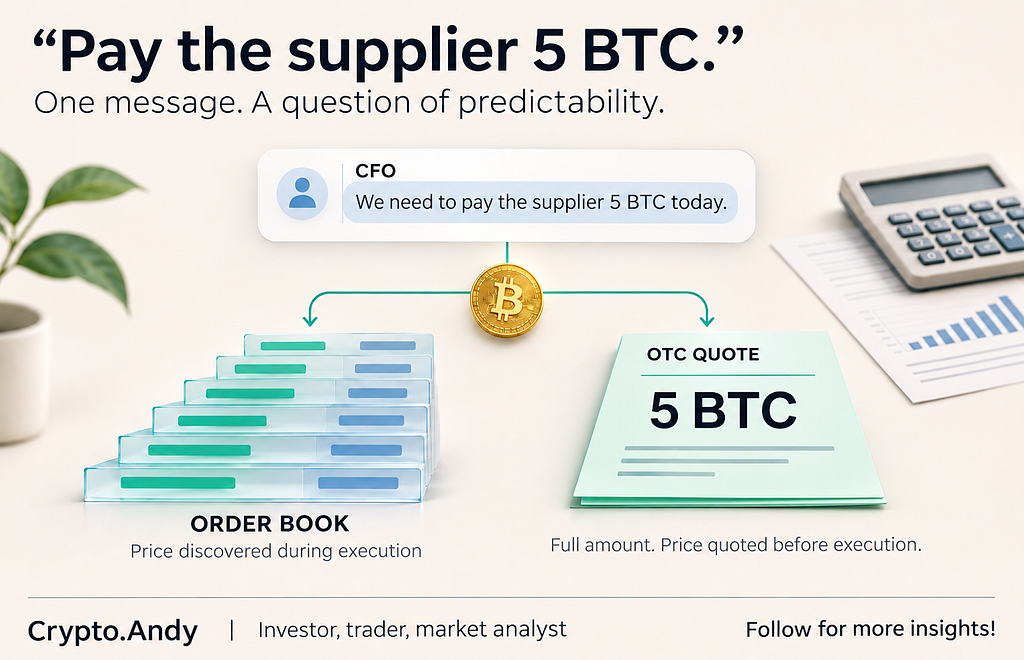
What a single “pay the supplier 5 BTC” message teaches a finance team about predictability, order books and OTC desks.
Crypto payments are quietly moving from experiment to routine. In a survey PayPal published in January together with the National Cryptocurrency Association, 39% of US merchants said they already accept crypto at checkout, and 84% expect crypto payments to become common within five years.
Statistics like these feel abstract until they land on someone’s desk. And sooner or later, they land on the finance team’s.
What My CoinMarketCap Audience Said
I ran a poll in my CoinMarketCap community and asked how often they would convert BTC earned by their company; 38.9% chose once a month, 27.8% would convert every time they get paid and another 27.8% would simply hold. Only 5.6% picked a few times a month.
So the monthly rhythm is already the most popular choice. Yet more than a quarter would convert after every payment, which is exactly where flat withdrawal fees start to add up.
When The CFO Asks You To Pay A Supplier 5 BTC
Imagine you work in accounting. It’s an ordinary morning and a short message from your CFO pops up: “We need to pay the supplier 5 BTC today.”
The company doesn’t hold BTC. It holds dollars, so before anyone can pay the supplier, someone has to buy the coins. The first instinct is simple: open an exchange account, place a buy order, send the BTC.
For the CFO, the question here is predictability: how much will this payment actually cost and can we know that before we commit?
Why Buying Bitcoin on an Order Book Makes the Final Cost Unpredictable
A public order book is a queue of sellers at different prices. When you buy, you take the cheapest offers first. If your order is small, that’s barely noticeable. If it’s large, your order keeps climbing through the queue, and each next piece of bitcoin can cost a little more than the one before.
So the final cost of the purchase only becomes clear after it’s done. The supplier still expects exactly 5 BTC, so every bit of price movement along the way ends up on the company’s side of the ledger.
How An OTC Deal Fixes The Price Before The Company Pays
An OTC desk works the other way around. Instead of discovering the price while buying, the company learns it first.
It starts before any trading happens. The company agrees the exact BTC amount with the supplier in writing, so the size of the purchase can’t shift halfway through. It’s a small step that’s easy to skip and skipping it means that any later change from the supplier makes the quote useless.
With the amount fixed, the company asks the desk for a quote on the full 5 BTC. The desk returns one price for the whole deal. If the company accepts it, the trade is executed off the public order book and the Bitcoin goes on to the supplier.
In numbers, it looks refreshingly dull. With BTC around $64,000, a quote for 5 BTC would mean roughly $320,000. Finance knows that figure before it pays anything. The supplier receives exactly what was agreed. The books show one clear cost, with no average price to reconstruct afterwards.
How WhiteBIT, Transak, and HashKey Handle Large Crypto Purchases
OTC desks share the same idea, but each puts the emphasis in a slightly different place.
Transak OTC opens the door to smaller tickets, with a standard minimum of $5,000. It works with high-net-worth individuals, institutions, VCs and professional traders, supports BTC, ETH, USDC and USDT against USD, GBP, CAD and MXN.
WhiteBIT OTC is built for large fiat-to-crypto trades with minimal market impact. It provides real-time quotes, executes deals off public order books and doesn’t cap trade size, typically starting from $100,000. A personal manager agrees the amount and price in a private chat 24/7 and settlement is available in USD, EUR, GBP, CHF, USDT and USDC.
HashKey OTC in Singapore offers licensed block trading with a request-for-quote mode, where a firm price is held for a few seconds so the client can review it before executing. It supports nearly 60 cryptocurrencies and fiat currencies including USD, SGD, HKD, JPY and EUR.
Four Steps To Pay A Supplier In Bitcoin Without Surprises
If I were in that accounting seat, I’d come back to the same few habits every time: confirm the BTC amount with the supplier in writing, ask for one quote on the full amount rather than buying in pieces, check settlement currencies and timing with the desk, and send the coins only to a verified supplier address.
None of this is complicated. It simply moves the moment of certainty from after the payment to before it and for a finance team, that’s the whole point.
How does your team handle supplier payments in crypto today?
Disclaimer: This is not financial or investment advice. Do your own research before making any decisions. Use at your own risk.
How I’d Pay a Supplier in Bitcoin Without Watching the Price Run Away was originally published in Coinmonks on Medium, where people are continuing the conversation by highlighting and responding to this story.