
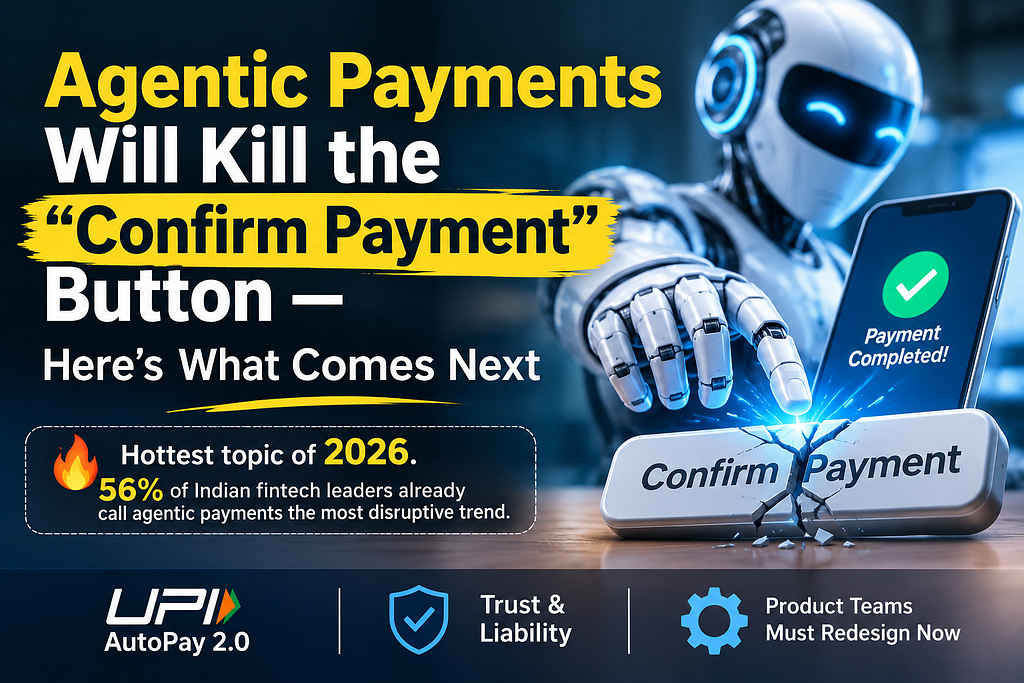
How AI agents will pay on our behalf, where the trust and liability problems sit, and what product teams should redesign now
AI agents are about to start making payments for us. Here is how agentic payments could work in India through UPI AutoPay-style mandates, the trust and liability questions they raise, and what fintech product teams should change now.
Generative AI
Think about the last time you paid a bill. You probably opened an app, checked the amount, tapped a button, and entered a PIN. It took maybe ten seconds. Now imagine you never did any of that. Your AI assistant noticed your electricity bill was due, compared your usage with last month, paid the right amount from the account you chose, and sent you a short note saying it was done.
That is the shift people are starting to call agentic payments. It is probably the most talked-about topic in Indian fintech this year, and a lot of industry leaders already see it as the most disruptive trend ahead. The “confirm payment” button, which has been the heart of digital money for over a decade, is starting to look like a transitional step.
So how would an AI agent actually pay?
The easiest way to picture it is through mandates. India already has a version of this with UPI AutoPay, where a customer authorises recurring debits for things like subscriptions, EMIs, and SIPs. The customer sets the limit, the frequency, and the merchant once, and the system handles the rest.
Agentic payments extend that idea. Instead of a fixed schedule, you grant an agent a bounded mandate: spend up to a set amount, on these categories, with these merchants, for this purpose, for this period. Within those walls, the agent decides when and what to pay. Outside them, it has to come back to you.
I think of it like handing a trusted assistant a corporate card with a spending policy. They can book the cab and order the stationery, but they cannot buy a laptop without asking.
The trust problem is the real problem
Here is where I get cautious. The technology to move money is the easy part. The hard part is knowing that the agent did what you wanted.
A few questions keep coming up for me:
Intent: If you said “get me the cheapest flight to Goa,” and the agent picked a flight that was cheap but had a 14-hour layover, did it fail?Verification: How does a bank know a payment request came from you and not from a manipulated prompt or a compromised agent?Drift: An agent that is allowed to act repeatedly can slowly move away from your original instruction. Who notices?
Most of us will accept a small amount of imperfection in exchange for convenience. But when money goes missing, people want clear answers, and right now those answers do not exist in most systems.
The liability question nobody has settled
Suppose an agent pays a fraudulent merchant. Who is responsible: the user who granted the mandate, the agent developer, the app that hosted it, the bank that processed the payment, or the merchant? Under current frameworks, the answer is usually the user, and that is unfair when the user never saw the transaction happen.
Regulators, banks, and fintechs will have to decide how liability is split. My guess is that we will see tiered rules: low-value, pre-approved, category-limited payments with strong consumer protection, and higher-value actions that still require a human confirmation. But I am not going to pretend that is settled.
What product teams should redesign now
If you build payment products, waiting for regulation to finish is a mistake. There is plenty you can do today.
Redesign consent as a policy, not a click. A single “Allow” on a pop-up does not describe what an agent may do. Show the limit, the categories, the merchants, the expiry date, and an obvious way to revoke it. Make the policy readable in a few seconds.
Make every agent action visible. Every payment an agent makes should appear in a clear activity feed with the reason attached. “Paid ₹1,240 to electricity board because usage rose 18% and bill was due Friday” builds far more trust than a bare debit alert.
Build a real undo. Where rails allow it, offer a cancellation window. Where they do not, make dispute and refund paths obvious and fast.
Set hard limits in code, not in prompts. The agent’s spending boundaries should be enforced by the payment system itself, not by instructions the model is asked to follow.
Log decisions, not just transactions. Store what the agent knew and why it acted. When something goes wrong, you will need that trail, and so will your customers.
Design for the moment the agent should stop. Good agentic products know when to ask. Unusual amounts, new merchants, and changed behaviour should pull the user back in.
The button is not dying tomorrow
I want to be honest here. The confirm-payment button will not vanish overnight. People will keep tapping it for big purchases, for new payees, and for anything that feels uncertain. The change will be gradual, and the winners will be the teams that treat trust as a product feature rather than a legal footnote.
The companies that get this right will not be the ones with the cleverest agents. They will be the ones whose customers can answer one simple question at any time: what is my money doing right now, and who approved it?
If you are building in this space, start there.
Agentic Payments Will Kill the “Confirm Payment” Button. Here’s What Comes Next was originally published in Coinmonks on Medium, where people are continuing the conversation by highlighting and responding to this story.