
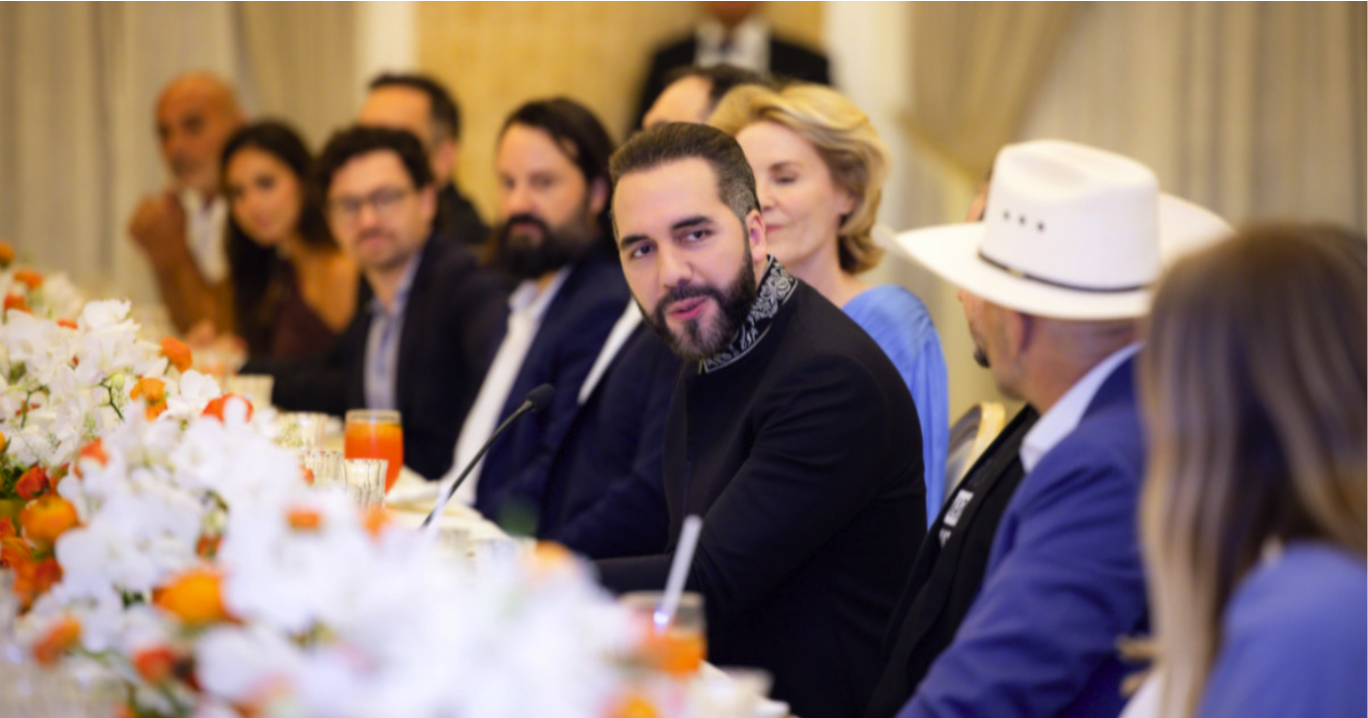
This November 10, in the midst of the Bitcoin Histórico conference taking place in the Historical Center of San Salvador, a group of Bitcoiners representing a wide range of sectors within the industry met with President Bukele.
The dinner was organized by The Bitcoin Office, which is part of the Office of the President, and was led by Stacy Herbert and Max Keiser. The dinner went on from about 7:30 pm to 10:30 pm local time and included about thirty Bitcoiners, many regular visitors to El Salvador.
Among the guests was billionaire Ricardo Salinas Pliego, founder of Grupo Salinas, which owns Banco Azteca. Salinas is a known Bitcoiner, who has made public appearances with Keiser and Herbert in the past, and is speculated to be planning a run at the next Mexican Presidential election. Salinas met privately with the President besides the dinner and reportedly gifted him volumes one and two of Manuscripts of the Conquistadors, works curated and edited by Jorge Nikaido, Chief of Staff of Grupo Salinas.
Representing investors and founders were Parker Lewis, founder of Unchained Capital, Mike Peterson of Bitcoin Beach fame, Katie Ananina of Citizen X, and Aleks Svetski, entrepreneur and founder of Satlantis. Bitcoin miners also attended, such as Beau Turner, CEO of Abundant Mines, Nacho Pauls, CCO of OCEAN Mining, and Adam Ortolf of Denver Bitcoin mining. Jon Atack, a Bitcoin core contributor, was also at the dinner alongside engineer Giacomo Zucco of Plan B Network, and AI tech entrepreneurs Ginger Gaetz of the ANIA AI initiative and Marc Seal, Founder of Aevonix.
The academic and media side of the industry was also heavily represented, with none other than Michael Goldstein, also known as Bitstein and co-founder of the Nakamoto Institute. Eric Yakes, economist and author of The 7th Property, was there, as well as Efrat Feningson, independent journalist and podcaster. Local Bitcoiner Michael Ruiz also attended the dinner; he is the founder of Build in El Salvador (BIS), an increasingly popular kind of business club and Bitcoin meetup mix.
Setting the Table
The guests arrived at the Casa Presidencial earlier in the evening and were chatting and networking while waiting for the president. Max Keiser, always a showman, arrived at the Casa Presidencial with a gift some might speculate carried a magical artefact. Photographed above, the case was said to contain a Stetson El Presidente cowboy hat, though some have speculated it might in fact have carried the Philosopher’s Stone.
Upon arrival, Bukele shook everyone’s hand and quickly invited them to take their assigned seats, dine, and relax- no big speeches or over-the-top formalities, Ananina told Bitcoin Magazine, describing the dinner as a kind of open mic.
“President Bukele’s table was adorned with bitcoin orange florals,” Herbert told Bitcoin Magazine; “we gathered anarchists, billionaire tycoons, Wall Street bankers, circular economy activists, VC investors, bitcoin miners, and content creators” at the country’s equivalent of the White House.
A three-course meal began to be served, with steak — of course — being the main course, followed by a three-layered chocolate dessert. In between were three hours of conversation which left a very strong impression on the individuals interviewed on the night. Bukele had his own microphone, while a couple of other mics were passed around. Six to seven major questions were asked throughout the night.
Salinas and Energy Investments
At some point, energy generation came up, and Salinas in particular engaged the topic with the President.
Baeu Turner, one of the three bitcoin miners at the dinner, told Bitcoin Magazine that Bukele described El Salvador’s electricity generation as “being roughly matched to the country’s current demand.” Bukele described plans to add more than a gigawatt of additional generation across multiple projects, including geothermal and generation using imported liquefied natural gas.
“What stood out to me,” added Turner, “was how directly he connected those development plans with demand for compute. Bukele said they can develop this power knowing there are users who can put it to work, whether that’s Bitcoin mining or other data centers. The demand could come from the Salvadoran government’s own operations or from outside companies bringing equipment and investment into the country.”
Other miners responded positively to that idea, including Salinas, who has deep investments and experience with energy production. His Grupo Dragón is involved in geothermal, wind, solar, and natural-gas generation across Mexico.
Immigration and Gentrification
Immigration was also discussed. Spurred by Max Keiser’s enthusiasm about the country, where he roughly said that the world should recognize El Salvador’s arc and that people — bitcoiners presumably — should migrate; suddenly the topic was set on the table. Ruiz, whose family is from the region but was born and raised in the U.S., moved to El Salvador three years ago and has become a recognizable figure in the local Bitcoin community. He followed up with a question about immigration, in particular about gentrification and possible resentment from the local population towards Western migrants, pointing to very negative online comments about some Bitcoiners, such as being called “colonizers”.
Bukele asked back, “When you go out, walk around, and interact with Salvadorans, what are the interactions like?”, The question, to anyone that’s spent time in El Salvador in recent years, answers itself. Salvadorians are very welcoming, Ruiz told Bitcoin Magazine; “there’s a lot of love. People receive us with open arms, and they’re glad we’re here, and they’re happy”.
Immigration in El Salvador actually tends to be from regional countries like Honduras, Nicaragua, Guatemala, and Colombia, with smaller numbers reported from the United States. Bukele went on to dismiss concerns about immigration, joking that you could host the whole population of the world in El Salvador by matching the population density of Manhattan. This was not a statement meant to be taken as a goal or ideal, but rather to set the topic in context. He added that the country is obviously looking for the most capable and intelligent people, and even said that “all great empires were built with immigrants’ help”, which says a lot about the President’s mindset on the topic.
In response to concerns about gentrification, the President told the story of a fisherman and house caretaker who got a raise from $300 to $800 a month from an American who bought the property. As a result, the fisherman was able to buy a motor for his boat, which he used to fish and row by hand before that. The scale-up of his fishing business was so productive that the caretaker even got his son a boat, doubling his fishing fleet. The only people who complained about this growth in wages were the neighbours, so the story goes, who must have been feeling the pressure from their own villa’s caretakers, wanting a raise from meager wages.
Among other Topics
At some point Efrat asked, “How come you are criticized around the world despite El Salvador’s GDP growth, a strengthening economy and popularity at home, which I saw firsthand talking to locals and visiting some of the areas once worst hit by gang violence?”
“Because I’m not part of their club,” the President allegedly responded, “I’m not the kind of ruler they like”. He added that there are evil people in the world who use mainstream media to criticize leaders like him and “call him names”, central bankers, including the ECB, came up as one of the forces behind the negative media campaign against Bukele.
Beyond the clear hit pieces, he noted that many people in governments or the international political establishment are not evil per se, but are often ‘order followers’, who operate on certain narratives and resist new paradigms.
The recent wins for the country in terms of education reform were also discussed. Bukele allegedly said that many private schools are now integrating similar AI tutoring programs as the one led by his administration. The results made international news when the pilot program deployed in public schools over the past couple of years brought PISA test results to par with Germany and Switzerland.
Renaissance 2.0
When asked about their reflections on the presidential dinner and the Bitcoin Histórico conference in general, Max Kaiser shared his vision in a manner that merits being printed in full:
“Bitcoin Histórico promised two days of Excellence Only, as the Bitcoin Office likes to say, and it delivered big time. The National Palace was a regal setting to showcase the Renaissance 2.0 taking shape in El Salvador with presentations by the best Bitcoin minds and builders in the world. Audience members felt like they had been transported to a time and place found nowhere else in the world right now, where hope and happiness are in abundance. No doom.”
Stacy Herbert, whose presence and attention to detail were felt throughout the festivities, told Bitcoin Magazine, “We promoted Bitcoin Histórico as an elevated bitcoin conference experience with Philosopher King meets Renaissance 2.0 vibes. In every detail, my team and I achieved that, including with the official Bitcoin Office dinner at Casa Presidencial.” She added that guests were free to ask any question they wanted, and that no topic was off limits.
“They grilled the President for several hours. His wit, his charm, his intelligence – all unscripted – was there for all to see firsthand. And they will have walked away understanding why it is that El Salvador is winning under his leadership.” Herbert added. As far as attendees to the dinner who Bitcoin Magazine spoke with, both claims remain very much corroborated.
This post Inside Bukele’s Casa Presidencial Dinner: Bitcoiners Discuss Energy, Immigration, and El Salvador’s Future first appeared on Bitcoin Magazine and is written by Juan Galt.