
I measured seven hours of trading on Elysium, Kinetiq’s new Layer 2 for Hyperliquid: 135,627 DEX trades, $13.6 million in volume and 694 new pools. The GraphQL query behind each number is included.
Elysium opened to the public on 9 November 2026. Five days later, the chain was handling more than 19,000 token trades per hour. If you build a trading app or a bot, you need a way to read that activity.
Elysium is a Layer 2 chain built by Kinetiq for the Hyperliquid ecosystem. A Layer 2 runs its own transactions and records the results on a parent chain. Elysium’s parent chain is HyperEVM, fees are paid in HYPE, and the chain ID is 99901.
I measured the chain through the Bitquery API on 14 November 2026, from 01:00 to 08:00 UTC. Every figure in this story comes from those seven hours. Each query is printed in full, so you can run it and compare.
Elysium in seven hours: what the API returned
135,627 DEX trades worth $13.6 million, made by about 6,900 wallets394,898 transactions sent by about 12,000 wallets537,197 token transfers across about 1,100 tokens694 new pools, most of them created by token launchpads
96% of DEX trades ran on Uniswap v4-style pools
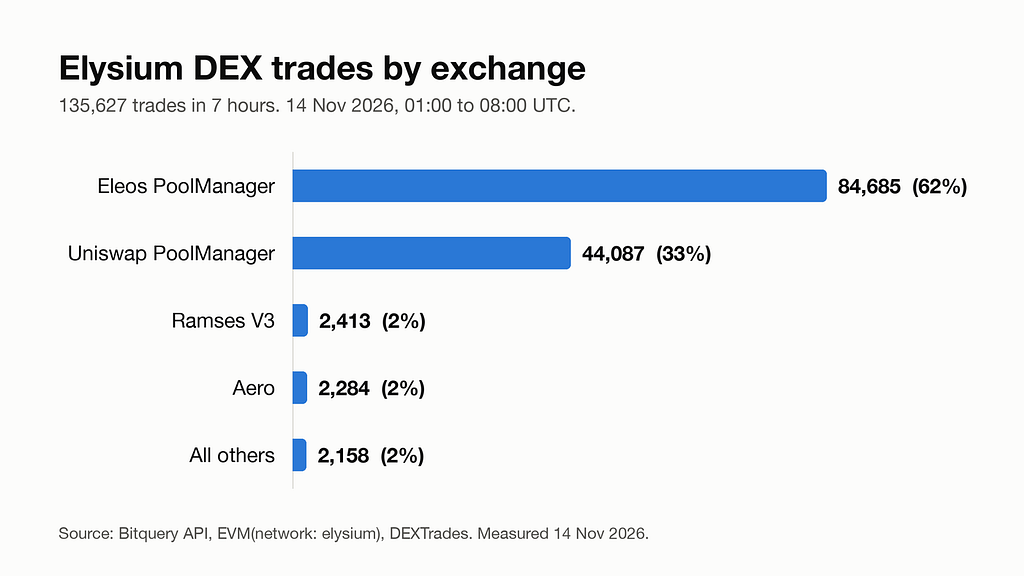
Uniswap v4 keeps all of its pools inside a single contract called a PoolManager. Seven contracts of this type had trades in my seven hours, and together they carried 129,847 of the 135,627 trades. Two of the seven carried 128,772 of them:
The Eleos launchpad’s own PoolManager: 84,685 trades (62% of all DEX trades), $5.5 millionUniswap’s PoolManager: 44,087 trades (33%), $6.9 million
Eleos had 62% of the trade count and 41% of the dollar volume. The average trade was $65 on Eleos and $156 on Uniswap’s PoolManager.
Two more exchanges stand out in the remaining 4%:
Ramses V3: 2,413 trades, $385,000Aero: 2,284 trades, $700,000
An indexer that decodes only Uniswap v2 and v3 swaps would miss 96% of the swaps on this chain.
694 new pools in seven hours
A token launch on a launchpad creates a new pool, and a new pool shows up as an Initialize event on a PoolManager. The two large PoolManagers logged 694 of these events. About 320 wallets sent them through 15 contracts.
Montra launchpad: 371 pools (53%)PositionManager, the standard contract for creating a Uniswap v4 pool by hand: 185 poolsEleos launchpad: 88 poolsAscend launchpad: 13 pools
The four contracts in this list created 657 of the 694 new pools, so a launch tracker can start with them.
The busiest hour had four times the trades of the quietest
The busiest hour of the window had 30,340 trades, or about 8 per second. The quietest hour had 7,491. If you consume the live stream, size your consumer for the busy hour.
How to query the Elysium API
The GraphQL endpoint is https://streaming.bitquery.io/graphql. Every request carries an access token in the Authorization header. The docs explain how to generate a token. Inside a query, the chain is EVM(network: elysium).
To try a query without writing code, paste it into the Bitquery IDE.
Get the latest Elysium DEX trades
{
EVM(network: elysium) {
DEXTrades(limit: {count: 10}, orderBy: {descending: Block_Time}) {
Block { Time Number }
Transaction { Hash From }
Trade {
Dex { ProtocolName SmartContract }
Buy { Amount AmountInUSD Currency { Symbol SmartContract } }
Sell { Amount Currency { Symbol SmartContract } }
}
}
}
}
Each row carries the block time, the transaction hash, the pool type and both tokens of the trade, with the amount in USD.
See which exchanges carry the volume
This query produced the 96% figure. Here it covers the last 24 hours, so your counts will differ from mine.
{
EVM(network: elysium) {
DEXTrades(
where: {Block: {Time: {since_relative: {hours_ago: 24}}}}
orderBy: {descendingByField: “trades”}
limit: {count: 6}
) {
Trade { Dex { ProtocolName SmartContract } }
trades: count
volumeUsd: sum(of: Trade_Buy_AmountInUSD)
traders: uniq(of: Transaction_From)
}
}
}
For a v4-style pool, SmartContract is the PoolManager. For a v2 or v3 pool, SmartContract is the pool address.
Detect new token launches
{
EVM(network: elysium) {
Events(
where: {
Log: {
Signature: {Name: {is: “Initialize”}}
SmartContract: {in: [
“0xe2e105d3f7209a9da11f83ccf3e7398a753823f1”,
“0x5c54a7293d96b11a29a0256ee8dfdbc3059637da”
]}
}
Block: {Time: {since_relative: {hours_ago: 24}}}
}
orderBy: {descendingByField: “pools”}
limit: {count: 10}
) {
Log { SmartContract }
Transaction { To }
pools: count
creators: uniq(of: Transaction_From)
}
}
}
Transaction.To is the contract that the creator called, and it tells you the launchpad:
Montra: 0x38d3ef3a06d18fa3286fb5deafe611be725fcd15Eleos: 0x9c73d179b2911e89a4edc47cfd78765990bc6761Ascend: 0x63f6a8a8d0257c0363251a50cde8a8b1046e4d19
The Elysium launchpads API page has queries that return the details of each launch.
Rank tokens by volume
Bitquery’s Trading API prices every pair in USD. In the Trading API, the network is bid:elysium.
{
Trading {
Trades(
where: {
Pair: {Market: {NetworkBid: {is: “bid:elysium”}}}
Block: {Time: {since_relative: {hours_ago: 24}}}
}
orderBy: {descendingByField: “volumeUsd”}
limit: {count: 10}
) {
Pair {
Token { Symbol Address }
QuoteToken { Symbol Address }
Market { Protocol Program }
}
trades: count
traders: uniq(of: Trader_Address)
volumeUsd: sum(of: AmountsInUsd_Base)
}
}
}
In my seven hours, the largest pair was HYPE against USDC on Uniswap’s PoolManager, with $456,000 in volume. Five of the top eight pairs were launchpad tokens priced in HYPE on Eleos.
Stream Elysium trades over WebSocket
The Elysium API also works over WebSocket. Send the same fields as a subscription, and each new trade arrives as a message. The WebSocket address is wss://streaming.bitquery.io/graphql.
subscription {
EVM(network: elysium) {
DEXTrades {
Block { Time }
Transaction { Hash }
Trade {
Dex { ProtocolName SmartContract }
Buy { Amount AmountInUSD Currency { Symbol SmartContract } }
Sell { Amount Currency { Symbol SmartContract } }
}
}
}
}
I tested this subscription on 14 November 2026. A trade stamped 10:02:01 UTC reached my client at 10:02:02 UTC.
For a heavier feed, Bitquery publishes the chain to four Kafka topics:
elysium.transactions.protoelysium.tokens.protoelysium.dextrades.protoelysium.dexpools.proto
Kafka uses its own credentials, which Bitquery issues on request. The Kafka streams page has the connection settings and a Python consumer.
Four things to know before you build
History starts on 13 November 2026. The first block in the API is 6,149,924, stamped 22:48 UTC that day. Earlier blocks are not in the API today.uniswap_v4 names a pool type. Eleos and Uniswap both use that pool type, each with its own PoolManager. To separate the two, filter on the PoolManager address: 0x5c54a7293d96b11a29a0256ee8dfdbc3059637da for Eleos and 0xe2e105d3f7209a9da11f83ccf3e7398a753823f1 for Uniswap.uniswap_v3 also covers Aero and Ramses V3. Filter on the factory in Trade.Dex.OwnerAddress: 0xefd7a089d3057f05189b05f74ffcf30610c42891 for Aero and 0x29cd8852ff040cfe74fb20277a121ed1293afb41 for Ramses V3.Native HYPE has no token contract. The Trading API returns an empty address for native HYPE. Wrapped HYPE (WHYPE) is 0xba876237b0f021a6c6d852d6c26e107997cc5e81.
Elysium API or Elysium RPC?
Kinetiq runs a public RPC for the chain. That RPC is not a Bitquery service. An RPC and an indexed API answer different questions. An RPC returns a single block, receipt or contract call per request. The Bitquery API returns decoded trades, transfers and events that you can filter, group and total in a single query, and it streams the same data live.
The 96% figure took a single API query. Getting the same figure from an RPC means fetching about 138,000 blocks and decoding every swap log yourself.
Elysium API or Hyperliquid API: which do you need?
Hyperliquid’s own exchange, HyperCore, runs the perpetual futures and spot order books. Bitquery’s Hyperliquid API covers that exchange: trades, orders, liquidations, funding and positions.
Elysium is a separate chain with its own tokens, pools and launchpads, so its data sits under EVM(network: elysium). A team that follows HYPE across both places reads both APIs.
FAQ
What is the Elysium chain ID?
The chain ID is 99901, or 0x1863d in hex.
Is Elysium the same as HyperEVM?
No. HyperEVM is Hyperliquid’s own EVM chain, with chain ID 999. Elysium is a Layer 2 built by Kinetiq that settles to HyperEVM, with chain ID 99901.
Which token pays for gas on Elysium?
HYPE, the native token of Hyperliquid.
Does the Elysium API support WebSocket?
Yes. Trades, events and blocks can each be streamed as a GraphQL subscription on wss://streaming.bitquery.io/graphql.
How far back does Elysium API data go?
To block 6,149,924 on 13 November 2026, 22:48 UTC.
Which exchanges and launchpads does the Elysium API cover?
Trades on Uniswap v2, v3 and v4, Aero and Ramses V3 are decoded as DEX trades. Launches on Eleos, Montra and Ascend can be read from pool events.
Where to go next
Elysium API overview: what the API coversElysium API docs: trades, prices, transfers, balances, events and callsUniswap API on Elysium: v2, v3 and v4 trades and poolsElysium chain ID and connection details: endpoints and a block streamA live stream in the IDE: runs in the browser
The Bitquery Data Store has no Elysium files today. Hyperliquid’s own trading history is sold as files in the Bitquery Data Store.
Elysium API: 96% of DEX Trades on Kinetiq’s Hyperliquid L2 Run on Uniswap v4-Style Pools was originally published in Coinmonks on Medium, where people are continuing the conversation by highlighting and responding to this story.