
A six-step method that starts at the contract, not the dashboard.
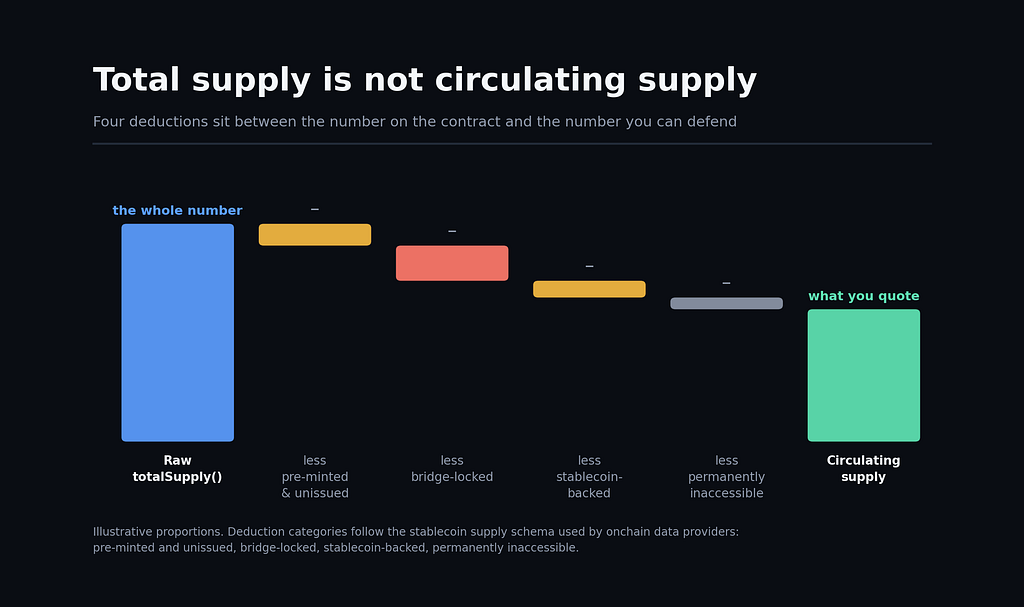
Four deductions separate raw contract supply from the circulating supply figure you can actually defend.
Pick a large stablecoin. Open three data sites. You will get three different circulating supply numbers.
None of them is lying. They are answering three different questions.
And the gap is not cosmetic. In June 2026, one widely used aggregator reported roughly $371 million more USDS than the Ethereum mainnet contract did. No hack. No stealth mint. Escrowed supply counted twice.
If you hold a stablecoin, lend against one, or carry one on a balance sheet, you need a figure you can defend in a risk meeting. Here is the six-step method.
Three published supply figures for the same stablecoin, read at the same block on the same day.
Why does the same stablecoin show three different circulating supply numbers?
Three structural reasons, and not one of them involves anybody being dishonest.
Different starting point. Some sources read totalSupply() straight off the token contract. Others rebuild supply by summing mint and burn events. Onchain data schemas now carry an explicit flag for which of the two is authoritative, row by row, because the two disagree often enough to matter.Different exclusions. CoinGecko deducts locked addresses that project teams report to it (published methodology). Allium strips four separate categories out of raw supply before calling anything circulating.Different scope. One token, or the whole family? USDS alone sat at $6.81B on 26 October 2026. Sky Ecosystem reported $11.48B of stablecoin supply the next day, because that figure counts USDS and DAI together as protocol liabilities.
Same dollar. Three honest answers.
Circulating supply is not a fact you look up. It is a definition you choose, then measure.
Step 1. Read the contract before you read the dashboard
Every real audit starts with one call: totalSupply() on the issuing contract, at a named block.
Not a screenshot. A block height.
Yearn’s risk team did exactly that to USDS on 9 September 2026 at block 25939320. Mainnet totalSupply() came back at 6,645,559,216, down 15% from their previous reading.
They also pulled the protocol’s own internal debt figure, so the token number could be checked against the issuer’s books rather than against another website. The full working is public.
That is the standard worth copying. Two independent reads, same block, both published.
Step 2. Subtract the supply that is not actually circulating
Raw total supply overstates circulation almost every time. Four buckets come out:
Pre-minted and unissued. Tokens the issuer created but has not released against backing.Bridge-locked. Supply sitting in a source-chain escrow while a mirrored token trades somewhere else.Stablecoin-backed. Supply locked only to mint another tracked stablecoin.Permanently inaccessible. Burn addresses and dead contracts.
The bridge bucket is where most errors live. In that same September reassessment, native-escrow USDS fell from about $448M to $102M, escrowed sUSDS from about $812M to $343M, and LayerZero-locked USDS from roughly $48.7M to $6.67M. Miss those and a cross-chain total quietly counts real money twice.
Bridge escrow and locked balances move fast, and a supply audit has to re-read them every time.
Step 3. Do not count the yield-bearing wrapper twice
This one catches careful people.
sUSDS is not extra supply. It is a claim on USDS that has been supplied to the Sky Savings Rate module. One dollar of USDS wrapped into sUSDS is still one dollar of stablecoin liability, not two.
Count the base token as supply.Count the wrapper as a holding of the base token.Never add the two together.
Scale is why this matters. Roughly half of USDS supply sits in sUSDS, and the Ethereum sUSDS pool showed $4.85B on 26 October 2026. That is a lot of float to misclassify.
Adding the yield-bearing wrapper to the base token counts the same dollars twice.A yield-bearing wrapper is a claim on supply. It is never new supply.
Step 4. Check what backs the supply, not just how big it is
Supply tells you the size of the liability. It tells you nothing about whether that liability is covered.
So pull the collateral figure next, from the same issuer, on the same day.
On 27 October 2026, Sky Ecosystem published $14.15B in Total Collateral against $11.48B in stablecoin supply.
That is roughly $1.23 of collateral behind every dollar of supply, which is the entire point of an overcollateralized design.
Two surfaces let you check it yourself instead of taking it on trust:
financial.skyeco.com for the balance sheet, Gross and Net Protocol Revenue, Protocol Surplus and Sky Reserves.info.skyeco.com for the live onchain view of collateral composition, USDS and sUSDS.
Credit agencies have started running the same exercise. Moody’s assigned Sky Protocol a B3 issuer rating with a stable outlook on 7 October 2026, the first rating it has given any stablecoin protocol, after S&P Global affirmed B- on 1 October.
Both flagged reserve depth as the constraint. That is what an outside read of the collateral side looks like, and it is worth more than a logo on a trust page.
Collateral against supply, plus the two outside credit reads, as published in October 2026.
Step 5. Ask whether that supply can actually leave at a dollar
A supply number is only as good as the exit. Three questions:
Is there a direct conversion path with the issuer, or only a market?What caps sit on that path?What does using it cost?
Sky Protocol runs Peg Stability Modules, smart contracts that convert supported stablecoins into USDS and back at 1:1 directly with the protocol rather than against another trader, under governance-set caps. Moving between USDS and sUSDS carries no lockup in either direction.
Redemption depth is the part of a supply audit most people skip, and the part every stress event tests.
Step 6. Date the number, or bin it
Stablecoin supply moves daily. A figure without a timestamp is a rumour with decimal places.
Write the audit line in four fields: source, metric, value, block or date.
This is about to stop being a matter of taste. On 21 October 2026 the OCC finalised its GENIUS Act rule.
From 18 January 2027, permitted issuers must publish the monthly composition of their reserves on their own websites by noon on the last day of each month, and file weekly confidential reserve reports.
As Forbes noted, an accurate weekly reserve figure demands daily reconciliation between tokens outstanding onchain and reserves held at the custodian.
Monthly PDFs are becoming weekly reconciliation. Protocols that already publish live will barely feel it.
What does a finished circulating supply audit look like on USDS?
Six lines, dated 26 to 27 October 2026, each checkable in under ten minutes:
Mainnet token supply: $6.81B USDS, third largest dollar stablecoin.Protocol family supply: $11.48B, USDS and DAI together.Total Collateral: $14.15B, around $1.23 per dollar of supply.Wrapper: sUSDS, roughly half the USDS float, excluded from the supply line.Exit path: Peg Stability Modules at 1:1, governance-capped.Outside read: rated by both Moody’s and S&P Global, so far the only stablecoin protocol with both.
A defensible number, with the working shown.
Why the Sky Savings Rate belongs in a supply audit
Here is the part most supply write-ups leave out.
Supply that pays nothing is a static liability. Supply that pays has to be funded, and that funding has to come from somewhere real.
The Sky Savings Rate is a variable rate set by Sky Governance and accessed by holding sUSDS.
It is funded from revenue Sky Protocol accrues as the Sky Agent Network, independent allocators including Spark, Grove, Osero, Keel and Obex, draws USDS liquidity under governance-set risk parameters and deploys it.
So when you audit the supply, audit the engine behind it:
Where does the yield come from?Who sets the rate, and is the decision public?Does the revenue appear on a published income statement?
Galaxy appears to have run some version of that test. On 23 September 2026 it added $100 million of sUSDS to its corporate treasury and approved sUSDS as eligible collateral across its institutional trading business.
Audit the supply. Then audit whatever pays it.
The 60-second circulating supply checklist
Run this before you quote any stablecoin supply figure:
Read totalSupply() at a named block.Subtract pre-minted, bridge-locked, stablecoin-backed and inaccessible balances.Exclude the yield-bearing wrapper from the supply line.Pull collateral from the same issuer on the same day.Confirm the redemption path and its caps.Write the date next to the number.
Six steps. One figure you can put in front of a risk committee.
So what should circulating supply actually mean?
The stablecoin market sat near $308B in August 2026, below its May peak of $322.4B. That is a lot of dollars measured by methods most holders have never read.
Which leaves the question I actually want argued in the comments.
Does circulating supply mean tokens that exist, tokens that can move, or tokens someone can redeem at par today?
Pick one. Then run the six steps on whatever stablecoin you hold and post the number with its date underneath. I will check mine against yours.
How to Audit a Stablecoin’s Real Circulating Supply was originally published in Coinmonks on Medium, where people are continuing the conversation by highlighting and responding to this story.