
This post contains affiliate links. We may earn a commission at no extra cost to you. The Deel links are my referral links. Remote did not pay for or see this post.
The short answer
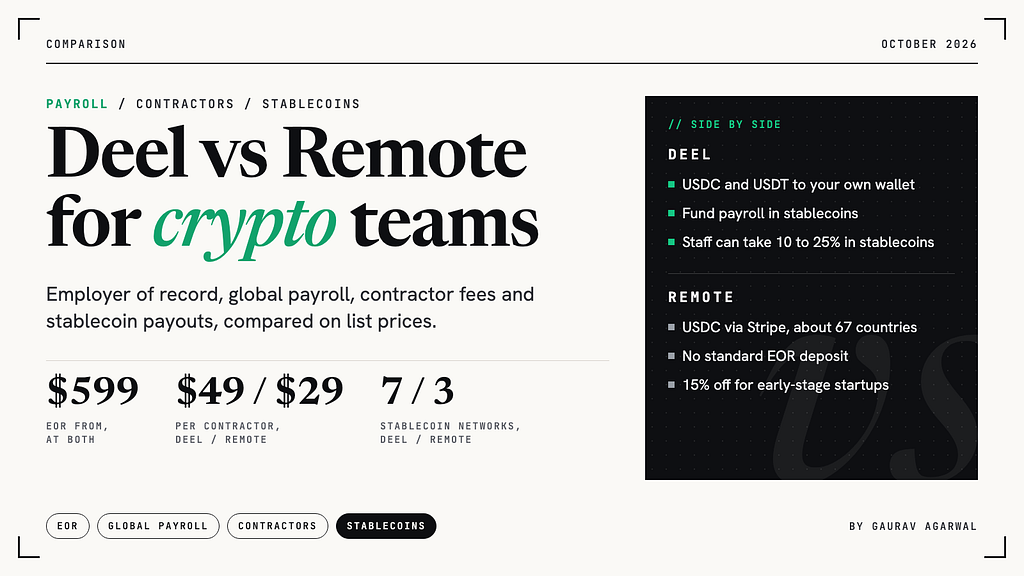
Deel and Remote list the same starting price to employ someone for you abroad: $599 per employee per month. Remote is cheaper for contractors, at $29 per contractor per month against $49, and it does not ask for an employer-of-record deposit as standard.
Deel goes much further with stablecoins. A company can fund its invoices in USDC or USDT. Employees can take up to 25% of their net pay in stablecoins. Contractors can withdraw USDC or USDT to their own wallet across seven networks, Solana and Tron among them. Remote’s stablecoin option is USDC only, for contractors only, paid through Stripe in about 67 countries.
A crypto company that keeps its money in stablecoins and has people who want to be paid in them should pick Deel. A team that pays contractors in local bank money and watches every dollar of fees will pay less at Remote.
How we use Deel
We have paid a small team of contractors through Deel, between 6 and 20 people, all by bank transfer. Setup was fast: adding a contractor and getting the contract signed took little effort. Payments landed on time. And Deel produced the contracts, invoices and tax forms, so we never had to build that paperwork ourselves.
We have not used Remote, and none of our contractors withdrew in crypto. The Remote and stablecoin sections below rely on each company’s own pricing pages, help articles and fee tables, read on 26 October 2026.
Three products that people mix up
Both companies sell three different services, and their prices are far apart.
Employer of record (EOR)
You want a full-time employee in a country where you have no company. The provider’s local company becomes the legal employer. It runs payroll, withholds tax, pays social charges, provides the benefits the law requires, and handles the contract and any termination under local labor law. You still direct the work. This is the product that starts at $599 per month.
Global payroll
You already own a company in that country and only want someone to run its payroll: pay, tax and filings. You stay the legal employer. Both charge $29 per employee per month.
Contractor management
The person is self-employed and sends you invoices. The provider issues the contract, collects invoices and tax forms, and pays out in many currencies. Deel charges $49 per contractor per month and Remote charges $29.
A fourth service sits between the last two. Under a contractor of record setup, the provider signs the freelancer itself and takes on the misclassification risk, meaning the chance that a tax office decides your contractor was really an employee. Both list it from $325 per month.
Our own setup is all contractors. A team that needs someone on the books in a particular country adds EOR hires on top.
Plans and prices side by side
For employer-of-record hires, both list $599 per employee per month as a starting price, and the real figure depends on the country. Deel’s EOR page claims 150+ countries, with its own companies in 130+ of them. Remote covers 90+ countries and says every one runs on a company it owns. Deel takes a deposit for each EOR hire of 1 to 1.5 times the monthly cost (salary, employer costs and fees) and refunds it after the final invoice. Remote’s pricing page says there is no standard deposit, though a refundable reserve may apply in some cases. On onboarding speed, Deel claims as little as one day and Remote quotes a three-day average.
Global payroll costs $29 per employee per month on both. Deel lists 130+ countries on its pricing page. Its payroll specialists run it for you, and in the US and Canada your own team can run it instead. Remote lists 100+ countries and lets you choose self-serve or managed.
Contractors are where Remote is cheaper: its base plan costs $20 less per contractor per month. Remote also sells Contractor Management Plus at $99, which adds $100,000 of misclassification cover per contractor, up to $1 million per company. Deel’s $49 plan includes invoicing, tax-form collection and payments in 120+ currencies, plus a possible fee of up to $5 per month for any contract with no payments recorded for two months in a row.
Remote gives pre-seed, seed and Series A companies 15% off EOR and contractor plans for their first 12 months. Deel’s pricing page shows no matching discount.
Crypto and stablecoins side by side
Paying contractors in stablecoins
Deel gives contractors three routes into crypto. The most direct is a withdrawal to their own wallet: USDC on Ethereum, Base, Polygon, BNB Chain or Solana, or USDT on Ethereum, Tron, BNB Chain, Polygon or Tempo. The fee table lists a 2% service charge plus a $1 network fee, with a $5 minimum, and the route does not work for accounts in the US or the UK.
Contractors can also cash out through Coinbase. BTC, ETH and SOL cost 1.5%. USDC costs a flat $5 under $300 and 1.6% above that. Withdrawals into BTC or ETH also carry an exchange fee on top.
The third route is the DLUSD wallet, launched in June 2026 and live in 80+ countries across Latin America, Africa, the Middle East and Asia-Pacific, though not in the US, the UK, the EU or Australia. Moving money between the wallet and the contractor’s Deel balance is free, and Deel pays the blockchain fees.
Deel’s help center calls DLUSD “Deel’s internal USD-equivalent digital balance” and says plainly that it is not a cryptocurrency. Stripe, whose Bridge unit issues it, calls it a custom stablecoin settled on the Tempo blockchain. I would treat it as a dollar balance inside the app that runs on crypto rails. At launch it could not be sent to an outside wallet. Deel called that a planned feature, and we found no page saying it has shipped.
Deel said in June 2026 that 10,000 contractors in 100 countries already got paid in stablecoins.
Remote gives contractors one route: USDC through Stripe, on Base, Aptos or Polygon, into a wallet the contractor controls, such as MetaMask. Stripe says the money arrives within minutes. The company must be billed in US dollars, and the contractor must be an individual or a sole proprietor, because Stripe does not yet pay out to companies. The contractor must also live in a country on Stripe’s list, which had 67 entries when we read it. Germany, the UK, Spain, Italy, India, Brazil, Nigeria, Ukraine, Vietnam, Indonesia, Pakistan, Turkey and Japan are not on it. Neither Remote nor Stripe publishes a fee for these payouts.
What a $3,000 payout costs on Deel
Take a contractor who bills $3,000 in US dollars. Here is the Deel fee on each route, from Deel’s own fee table. Converting to another currency adds exchange costs on top.
Local bank transfer in the same country and currency: $0 ($5 if the money crosses a border)Wise or Revolut: $0USDC or USDT to the contractor’s own wallet: $61 (2% plus $1)USDC through Coinbase: $48 (1.6%), plus any exchange feeInto the DLUSD wallet: $0, though the money stays inside Deel until it goes out by one of the routes above
Putting stablecoins into your own wallet costs about 2% of the payment, while plain dollars to Wise or a local bank carry no Deel fee. Whether that 2% is worth it depends on what the contractor would pay to buy the same stablecoins on an exchange.
Paying employees partly in stablecoins
Deel lets EOR and payroll employees take 10% to 25% of their net salary in USDC, EURC or USDT, with the rest going to their bank. It covers employees in the US, the UK and 30 European countries, though USDT is not offered in the EU. Employees pay nothing. The employer pays $10 per month for each employee who uses it.
Remote has no such option. Its stablecoin payouts cover contractors only.
Funding payroll from a crypto treasury
Deel accepts invoice payments in USDC (Ethereum, Polygon, Base or Solana) or USDT (Ethereum, Polygon, Tron or Tempo), sent to a deposit address unique to your company and converted to dollars at 1:1. Deel says most of these payments settle within minutes. Its two help pages disagree on the provider fee, 1% in one and 1.5% in the other, so budget for 1.5%. The option does not cover the US payroll product or US contractor payments.
Remote’s payment methods are bank transfers, direct debit and cards. Crypto is not on the list.
That fee adds up. On a $50,000 monthly payroll, 1% to 1.5% comes to $500 to $750. Whether that beats selling stablecoins for dollars and wiring them depends on your exchange and bank fees. What Deel saves you is the trip through an exchange and the wait for a wire to land.
A worked example: 10 contractors and 2 employees
Take a seed-stage crypto company that pays 10 contractors and employs 2 people through EOR, at list prices.
Deel: 10 × $49 plus 2 × $599 comes to $1,688 per month, or $20,256 per year.Remote: 10 × $29 plus 2 × $599 comes to $1,488 per month, or $17,856 per year. With the 15% startup discount, the first year drops to about $1,265 per month.
Remote saves this company $200 per month at list price and about $423 per month in its first year. Deel also holds an EOR deposit of 1 to 1.5 months of each employee’s full cost.
For a crypto company, the extra $200 buys reach. Suppose four of the ten contractors live in Germany, India, Brazil and Nigeria and want stablecoins. Remote’s USDC route does not reach those countries. Deel’s help page names only US and UK accounts as excluded from its own-wallet route, so ask Deel to confirm each country. If the two employees want part of their salary in USDC, only Deel offers that. And if the company’s treasury sits in USDC, only Deel takes it directly.
Verdict
Pick Deel if you run a crypto company whose money sits in USDC or USDT, whose contractors want stablecoins in countries Stripe does not cover (or want USDT on Tron or USDC on Solana), or whose employees want part of their pay in stablecoins. Any one of those is reason enough. Our own use of Deel for contractors gives us no reason to doubt the basics: setup was quick and payments arrived on time. You can see the plans and sign up through my referral link.
Pick Remote if your contractors are happy with bank payouts and price is the deciding factor. An early-stage team gets the 15% discount and the $29 contractor fee, and its EOR hires need no standard deposit.
Five checks before you sign
Ask for an EOR quote for each country you hire in. The $599 figure is a starting price on both platforms.Check your contractors’ countries against Stripe’s stablecoin list (for Remote) and Deel’s excluded countries.Find out whether your contractors invoice as individuals or through a company. Remote’s USDC route only pays individuals and sole proprietors.Ask Deel which crypto funding fee applies to you, 1% or 1.5%.Ask Deel whether DLUSD can now be sent to an outside wallet. At launch it could not.
Deel vs Remote for Crypto Teams: Payroll, Contractors and Stablecoin Pay was originally published in Coinmonks on Medium, where people are continuing the conversation by highlighting and responding to this story.