
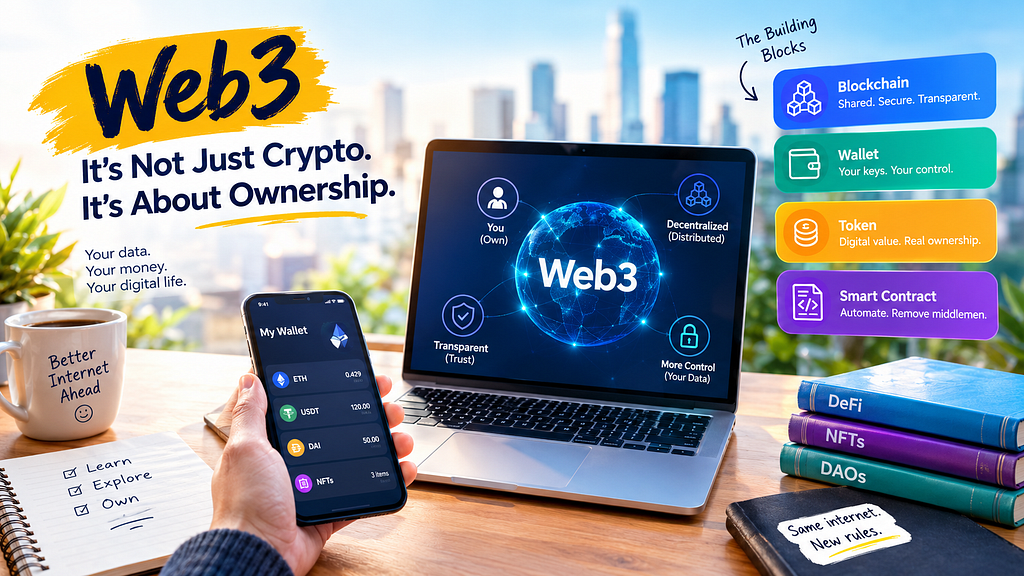
What Web3 actually is, without the jargon, the cartoon monkeys or the “to the moon” nonsense.
Every time someone said “Web3,” I zoned out.
Wallets. Gas fees. DAOs. Every explanation came with three more explanations I hadn’t asked for, and the person explaining usually had a cartoon ape as their profile picture. Not a great look.
Then a friend who works in payments watched me nod along for the tenth time and said, “Stop thinking about the tech. Just ask who owns what.”
That’s it. That’s the whole thing. I wish someone had said it to me in 2021.
Image Generated by ChatGpt
Two internets down, one to go
Web1 was a library. You walked in, read something, walked out. Late 90s, early 2000s. Somebody built the page and you looked at it.
Web2 is the one you’re on now. You can post, comment, upload, sell, review. Instagram, YouTube, Amazon. And it’s great, genuinely. But somewhere along the way the deal changed. You make the stuff. They hold the keys.
Web3 is the idea that you could read, write and own. The last word is the one doing all the work.
Quick test
Think about something you’ve built online. A following, a channel, a gaming account you’ve put hundreds of hours into.
Who can switch it off?
Not you. I know people who’ve lost accounts to a wrong automated flag, then spent weeks pinging a support form that answered with a template. Weeks without income, waiting on a reply from something that isn’t even a person.
Web3 is a bet that this setup is a design choice, not a law of nature. What if your account and your money and your stuff were with you, and the apps just plugged in?
What’s under the hood
It sounds complicated and it mostly isn’t. Four pieces.
Blockchain. A shared record book. Thousands of computers each hold the same copy. Somebody writes “Priya sent Tom five euros,” every copy updates, done. To fake an entry you’d need to fool most of them simultaneously, which is why nobody needs a bank to vouch for the book.
Wallet. Your account, except no company holds it. You hold a private key. Think front door key. Lose it and there’s no locksmith and no “reset password” link. Some people hear that and feel free. Others feel sick. Both reactions make sense to me.
Token. A digital item recorded on a blockchain. Could be money, a ticket, a membership, a piece of art. It sits in your wallet, so nobody can quietly take it back.
Smart contract. A small program that runs on the blockchain and does what it was told. Payment lands, item gets released. No middleman. Which is lovely until the code has a bug, because then there’s nobody to phone.
NFTs, DeFi, DAOs, all the names you keep hearing: those are just these four stacked in different combinations.
Picture a musician
She uploads a track to a streaming platform. The platform decides what a play is worth. Money arrives weeks later, after the label and the distributor each take a bite. If the platform changes the rules, she adapts or leaves.
Now imagine the split is written into a smart contract. Each sale divides automatically between her, the producer and the co-writer, in the percentages they agreed to. Minutes, not months. Nobody emails anybody about a missing payment.
Is that real today? In small pockets, yes. Will it replace Spotify next year? No chance. But it shows you the shape of the idea, and once you see it it’s hard to unsee.
The scam part (I won’t skip it)
Skipping this is how people get hurt, so here goes.
Web3 has an ugly history. In 2021 and 2022 people paid silly money for NFT images, and most of those prices fell off a cliff. Loads of crypto projects were pure speculation. Some were just fraud. People lost savings, and that’s not a small thing.
My own view, and you’re free to disagree: the technology and the casino that grew around it are two different things. A lot of people came for the casino and called it Web3. The dot-com crash wiped out a pile of companies in 2000 and the internet is still around.
Still, I’m careful. My rules:
Guaranteed returns means a lie. Walk away.Your seed phrase stays with you. No real support team will ever ask for it.If I can’t say in one sentence how a project makes money, I don’t touch it.Only money I could lose without crying. Dull advice. Still true.
Where it’s quietly going
Forget the memes. The serious work is in finance. Banks and institutions are testing tokenized assets, faster settlement and payments that carry their own rules. Cross-border transfers are slow and pricey today, and blockchain rails could change that. Central banks have been running experiments with digital versions of their currencies too.
Nobody tweets about settlement times. That’s partly why it’s easy to miss.
So, should you care?
Know it. Don’t obsess over it.
You don’t need to buy anything this week. You don’t need a wallet by Friday. But the question underneath all of this, who owns your digital life, isn’t going away. More of our work, money and identity moves online every year, and someone will answer that question with or without your input.
Knowing the basics is also just self-defence. The people who get burned are usually the ones who didn’t know what they were buying.
At a dinner party
If someone asks, try this: “It’s the idea of an internet where you own your accounts, your money and your stuff, instead of renting them from a few big companies.”
Good enough. Nod at the rest.
I Ignored Web3 for Years. One Question Finally Made It Click was originally published in Coinmonks on Medium, where people are continuing the conversation by highlighting and responding to this story.