
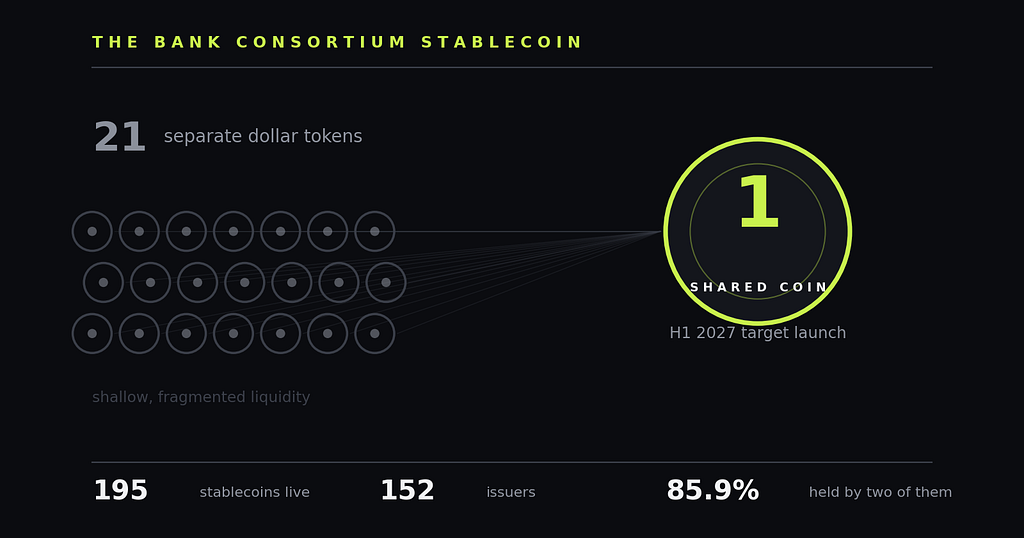
There are already 195 stablecoins and 152 issuers. Two of them hold 85% of the money. The banks ran that math before they ran the press release.
Twenty-one issuers, one shared dollar. The consortium did the liquidity math first.
On 1 September 2026, twenty-one of the largest financial institutions on earth agreed to build one coin.
Bank of America. Citi. Goldman Sachs. UBS. Deutsche Bank. Santander. BBVA. MUFG. Wells Fargo. Fidelity. Names that compete on everything, lining up behind a single dollar token.
They did not announce a company name. Or a CEO. Or a blockchain. Or who owns what.
What they announced was the shape of the thing. One coin. Not twenty-one.
That choice is the real story, and almost nobody wrote about it.
Any one of these institutions could have shipped its own dollar token this quarter. They chose not to. Liquidity does not split twenty-one ways.
Why one bank consortium stablecoin instead of twenty-one competing ones?
Because a stablecoin is not a product. It is a network.
The market already ran this experiment, at full scale, with real money. As of 1 October 2026 there were 195 stablecoins from 152 issuers across 47 blockchains, about $300.9 billion in total supply, and 308.4 million holder addresses.
Out of all of that, two names hold roughly 85.9%. No third issuer clears $10 billion.
195 stablecoins exist. Two of them are the market. That is the case for one shared coin, in one chart.
That is the whole lesson in one line:
A dollar token is only useful where it is acceptedAcceptance follows depth, not brandingTwenty-one competing bank coins would be twenty-one shallow poolsOne coin with twenty-one distribution networks behind it is a completely different animal
Banks understand shared rails better than anyone. Correspondent banking, card schemes, CLS, SWIFT.
Every one of them is a case of rivals agreeing to pool the boring layer so they can compete on the layer above it.
The consortium is not being generous. It is being correct.
What the bank consortium stablecoin actually commits to
Strip out the commentary and here is what was on the page:
A jointly owned company to be formed in H2 2026, subject to closing conditionsA USD stablecoin targeted for market launch in H1 2027A euro version identified as the next priority, then other G7 currenciesReserves in cash and short-term Treasuries, built around the GENIUS Act and MiCAMembers spanning North America, Europe, East Asia, the Middle East and AfricaEleven months from ten banks exploring to twenty-one committing. Still no company name.
It grew out of something smaller. In October 2025, ten global banks said they were exploring a reserve-backed digital payment asset on public blockchains. Eight of those ten are still in.
Read the verb carefully, though. They committed to form a company. Nothing has launched.
The GENIUS Act question nobody in the press release answers
Section 4 of the GENIUS Act is blunt. A permitted payment stablecoin issuer cannot pay the holder any form of interest or yield, in cash, tokens or anything else, purely for holding the token.
So picture the finished product in 2027.
A corporate treasury holds the consortium dollar. The reserves sitting behind it are earning in Treasury bills. The treasury holding the token earns zero.
Same dollar, same rulebook, two very different destinations for the yield.
That is not an oversight. Congress wrote it that way on purpose, so a payment token would not quietly turn into a competitor for bank funding.
There is already a well-worn workaround, and it is worth knowing about. Issuers cannot pay holders, but they can pay distribution partners, and nothing stops those partners from paying users.
Circle discloses that it passes a share of its reserve income to Coinbase. The money still reaches the end holder.
It just takes a detour through someone else’s balance sheet, and picks up someone else’s incentives on the way.
The consortium is building a very good dollar. It is not building a reason to hold one.
Here is the part that matters for anyone planning around 2027. The restriction names issuers. It does not name third parties. Which means the yield question does not disappear.
It just moves one layer out, to whoever is willing to put that capital to work and take responsibility for how.
Six of the twenty-one are hedging their bet, and that tells you plenty
Six consortium members, among them Citi, Bank of America, Wells Fargo, PNC, Santander and TD, are also backing The Clearing House’s shared tokenized deposit network. Seventeen institutions, announced in June, same H1 2027 target.
Two competing designs. Overlapping backers. Identical deadline.
Tokenized deposits stay inside the banking system as bank liabilities. A GENIUS stablecoin is a separate instrument with segregated reserves.
Nobody at that table knows which one wins, so several of them bought tickets to both.
And they are not the only ones racing:
Open USD, the Visa and Stripe-backed effort with around 140 companies behind it, has been live since JulyThirty-nine state bankers associations are building BankChain Alliance on a similar 2027 timelineQivalis and the Eurøpe Consortium are chasing MiCA-compliant euro stablecoins
Almost everyone is building the issuance layer. Very few are building the layer underneath it.
Issuance is the easy half. Capital allocation is the hard half.
Ask anyone who has run a treasury desk. The hard question was never how to hold the dollar. It was always what the dollar is doing while you hold it.
Minting a fully backed token is an engineering problem with known answers.
Deciding where billions in collateral actually go, under limits anyone can audit, with a rate that holds up when conditions change, is a different kind of problem.
It is operational, it is continuous, and you cannot ship it once and walk away.
That second half is what Sky Ecosystem is built around.
Sky Protocol is a capital allocation network. Independent allocators, the Sky Agent Network, access USDS liquidity under risk parameters set in public by Sky Governance.
They deploy it across diversified strategies. The revenue those deployments generate flows back to the protocol.
The allocators are operating businesses, not line items on a slide. Spark runs lending markets. Grove runs institutional credit.
Figures as shown on the Sky Ecosystem dashboard at the time of writing:
$14.15 billion in Protocol Collateral$11.48 billion in stablecoin supplyRoughly $1.23 of collateral sitting behind every dollar in circulationOvercollateralised and published in public. Both numbers are checkable on the dashboard right now.
You can check all three yourself. That is the point of publishing them.
Why sUSDS and the Sky Savings Rate sit on the other side of that gap
USDS is the base unit. Fully backed, converts 1:1, deep liquidity, no drama.
sUSDS is where the Sky Savings Rate lives. Hold sUSDS and the position accrues the governance-set rate programmatically. No lockups, no minimums, redeem back to USDS whenever you want.
The distinction worth holding onto: the rate is not a promise from an issuer. It is the output of an allocation network that has to keep working for the number to hold.
And institutions have started treating it that way.
On 23 September 2026, Galaxy Digital (Nasdaq: GLXY) put $100 million of sUSDS on its balance sheet and approved sUSDS as eligible collateral across an institutional trading business carrying a $1.4 billion average loan book and more than 1,600 counterparties.
What institutional adoption of a yield-generating stablecoin looks like in numbers, not adjectives.
The detail I keep coming back to: clients who post sUSDS against a loan keep accruing the Sky Savings Rate on the full position for as long as the loan runs. Collateral that does not go to sleep while it is pledged.
That relationship did not start there. Grove had already extended Galaxy a $500 million warehouse lending facility. Galaxy has since borrowed on Spark as well.
For context on the base underneath it: Sky Protocol entered Q3 2026 with $5.41 billion supplied through independent allocators and institutional tokenized funds, including anchor positions in BlackRock’s BUIDL and Janus Henderson’s JTRSY.
sUSDS supply closed Q2 2026 at $5.52 billion, up 149% year on year, on $107.35 million of Gross Protocol Revenue and $33.29 million of Protocol Surplus for the quarter.
What 2027 probably looks like
My guess is the consortium ships, roughly on time, and the coin is clean, compliant and boring in the best possible sense. Widely accepted, too. Twenty-one distribution networks is a serious advantage.
And on day one, its holders will start asking the question the GENIUS Act will not let the issuer answer.
If you are tracking this, watch the follow-on announcements rather than the launch. Which chain they pick. How custody is handled.
Whether the euro version slips. Those three will tell you more than any launch-day release.
By 2027 there will be no shortage of dollar tokens. There will be a shortage of places to put them.
So, back to the title.
Twenty-one separate bank stablecoins would have been twenty-one failures. One shared coin is the right call, and the people who made it know exactly why.
But a shared dollar with no allocation engine behind it is half a product. The other half already exists, it is already audited in public, and it is already on a Nasdaq-listed balance sheet.
Which half do you think decides 2027: who issues the dollar, or who puts it to work? I would genuinely like to be argued with in the comments.
Twenty-One Banks Are Building One Stablecoin Together. Why Not Twenty-One Stablecoins? was originally published in Coinmonks on Medium, where people are continuing the conversation by highlighting and responding to this story.