
37 banks, one MiCA rulebook, and the awkward question nobody in Brussels wants to answer about euro stablecoin yield.
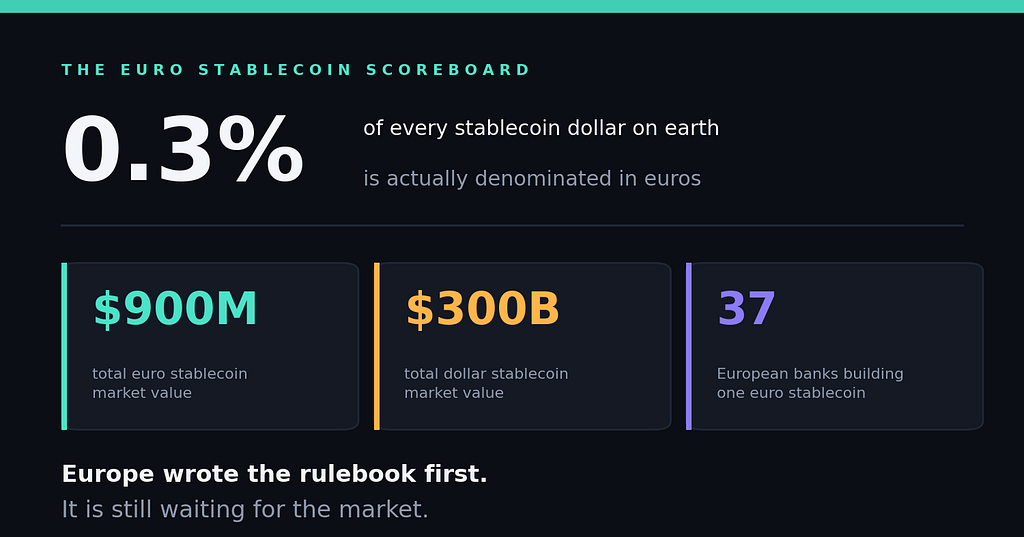
Europe wrote the rulebook first. It is still waiting for the market.
The euro is the second most used currency on earth. It accounts for roughly 20% to 30% of global FX reserves, SWIFT traffic and trade flows.
Onchain, it is a rounding error.
About 0.3% of all stablecoin value in the world is denominated in euros. Almost all of the rest is dollars.
Europe noticed. Thirty-seven banks now sit behind a single euro stablecoin project. They are arriving at a market that was effectively decided three years ago.
Here is what the euro stablecoin MiCA picture actually looks like in October 2026, and the structural problem underneath it that very few people are saying out loud.
Why does the euro settle global trade but almost no stablecoins?
Start with the scoreboard:
Total euro stablecoin market value: about $900 million as of late September 2026, an all-time highTotal dollar stablecoin market value: roughly $300 billionEuro share of the global stablecoin market: about 0.3%Euro stablecoin growth over the last twelve months: roughly 100%
So euro stablecoins doubled. The entire category is still smaller than a mid-size lender’s overnight book.
Some of that growth was forced rather than earned. Europe’s crypto-asset service provider transition period closed on 30 June 2026, pushing unlicensed firms out of the EU market and consolidating whatever supply was left into the licensed names.
Euro stablecoin market value, June 2025 to September 2026. Sources: CoinGecko, Token Terminal, Decta.
The market is also top-heavy. Circle’s EURC holds about 62.6% of euro stablecoin supply on its own. Societe Generale’s EURCV holds another 19.6%. Two issuers, 82% of the market.
That concentration is not a scandal. It is what a market looks like when almost nobody bothered to compete.
What is the euro stablecoin consortium, and who is actually in it?
The vehicle is Qivalis, an Amsterdam entity. The timeline matters more than the headline.
September 2025: nine banks announce a MiCAR-compliant euro stablecoin issuer under Dutch supervision, including ING, UniCredit, CaixaBank, KBC, Danske Bank, DekaBank, Banca Sella, SEB and Raiffeisen Bank International. (announcement)
December 2025: BNP Paribas joins and Qivalis is incorporated in the Netherlands with twelve founding members. (BNP Paribas statement)
March 2026: Fireblocks is selected for tokenization, wallet infrastructure and custody.
May 2026: twenty-five more banks join, including ABN AMRO, Rabobank, Nordea and Intesa Sanpaolo. Membership reaches 37 institutions across 15 countries.
September 2026: confirmation that the token will issue on public Ethereum rather than a permissioned bank network.
The design is deliberately conservative. Backed 1:1. At least 40% of reserves in bank deposits, the remainder in short-term euro-area sovereign bonds spread across countries to avoid concentration risk. Redemption available 24/7. (reserve structure detail)
Qivalis membership growth, September 2025 to May 2026. Launch remains conditional on a Dutch e-money licence.
Thirty-seven banks. Fifteen countries. Zero tokens in circulation.
The e-money institution licence from De Nederlandsche Bank has not landed yet, and nothing ships until it does.
Does MiCA ban stablecoin yield? Article 50 in plain English
Yes, for issuers. This is the part most coverage skips entirely.
MiCA Article 50 prohibits issuers of e-money tokens, and the service providers distributing them, from granting interest to holders.
Article 50(3) closes the obvious loophole: any benefit tied to how long someone holds the token counts as interest. (legal analysis)
The intent is written into the regulation itself. Recital 46 states these tokens should function as a medium of exchange, not a store of value.
The practical effect is blunter than that. A regulated euro stablecoin earns on its reserve. The person holding it earns nothing.
Tether discontinued its euro token partly over this and the reserve custody rules.
Several platforms switched off stablecoin reward programmes for EU users on the day the rules bit.
So why would anyone hold a euro stablecoin that pays nothing?
This is the live question in Europe right now, and it is not a crypto-native complaint.
An April 2026 report from Blockchain for Europe argued that MiCA has produced a euro stablecoin segment that is safe but structurally uncompetitive. (report coverage)
The argument, compressed:
A euro bank deposit can pay a return. A MiCA euro stablecoin legally cannot.Instant payments across European bank rails have improved, which weakens the pure payments pitch.Reserve rules are stricter than other major jurisdictions, with 30% of reserves required in bank deposits and 60% for tokens designated significant.
The European Commission has since reopened a MiCA review, and the remuneration ban sits near the top of the reform list.
There is friction from the top as well. ECB President Christine Lagarde said in early May 2026 that stablecoins are not Europe’s best route to strengthening the euro’s international role, and cautioned against building euro counterparts to dollar-backed tokens. The central bank’s own answer, a digital euro, is not expected before 2029.
Read that back. Thirty-seven banks are building a euro stablecoin their central bank is lukewarm about, under a rule that stops it paying holders anything, three years ahead of a public alternative.
Meanwhile, dollar stablecoins solved the same problem without changing a single law.
Their issuers do not pay holders either. The yield simply lives somewhere else in the stack.
MiCA Article 50 binds the issuer. It does not convert an independent protocol into one.
Where can stablecoin yield legally come from after MiCA?
Read the prohibition carefully. It binds issuers and the service providers distributing their tokens. It does not turn a separately governed protocol into an issuer.
That distinction splits the stack into two very different jobs:
Issuance. Mint a token, hold the reserve, redeem at par. Heavily regulated and deliberately yield-free.Allocation. Decide what idle capital does next. Different function, different risk profile, different governance.
Europe has spent two years regulating job one. Job two is where capital actually decides whether to stay.
By most estimates, around 80% of global stablecoin supply is deployed into no source of yield at all.
What does the Sky Savings Rate actually pay out of?
Sky Ecosystem is a global savings and capital allocation network, and it is built around job two rather than job one. Here is the full architecture, but the short version runs in six steps.
USDS is the fully backed unit of account.The Sky Agent Network, independent allocators including Spark, Grove, Obex and Osero, draws USDS liquidity under risk parameters set in public.Each allocator pays a Base Rate on every USDS deployed, settled onchain monthly.That revenue, plus Stability Fees and Peg Stability Module flows, accrues to Sky Protocol.Sky Governance votes the Sky Savings Rate against that revenue.Holders access the rate through sUSDS, the world’s largest yield-generating stablecoin.The Sky Savings Rate is an output of a capital allocation system, not a promotional number.
Two consequences are easy to miss.
The rate is variable and set by Sky Governance, published live rather than promised in marketing.
You can check it, and every collateral position behind it, at financial.skyeco.com.
And an sUSDS holder is not a claimant on any single allocator, borrower or strategy.
If one allocator takes losses, its own risk capital absorbs them first, then the Surplus Buffer, before anything reaches the protocol level.
Why did Moody’s just rate a stablecoin protocol for the first time?
On 7 October 2026, Moody’s Ratings assigned Sky Protocol a B3 counterparty risk rating with a stable outlook. It was the first rating Moody’s has issued on any stablecoin protocol. S&P Global had already affirmed a B-. (Moody’s report)
Two agencies. Two separate teams. Two sets of criteria. Two independent conclusions. No other stablecoin protocol currently meets that bar.
The published numbers behind it:
$14.15B in total Protocol Collateral backing $11.48B in stablecoin supply$123.79M in Gross Protocol Revenue in Q1 2026, the highest quarter on record$33.29M in Net Protocol Surplus in Q2 2026, a fifth consecutive positive quartersUSDS supply up 149% year on year to $5.52BGalaxy added $100M of sUSDS to its corporate treasury in September 2026 and approved it as institutional loan collateralEvery figure here is checkable against a public dashboard rather than a press release.
What Europe still has to build
Qivalis is a serious project. Getting thirty-seven banks to agree on anything is genuinely hard, and a regulated euro settlement token has real uses in treasury operations and cross-border payments.
But a payment rail is not a savings layer. And right now Europe has no legal route to build the second one inside the issuer.
Does Europe want euro stablecoins that move, or euro stablecoins that people hold?
The rulebook has only answered the first half of that question. The second half is still open, and it is the half that decides whether the euro ever gets off 0.3%.
Dollar stablecoins did not win on regulation. They won because once the token existed, there was somewhere obvious for it to go next. Europe has built the token. The next part is still missing.
Your turn. Should the next MiCA revision lift the remuneration ban on euro stablecoins, or does paying holders quietly turn a payment token into a deposit substitute Europe cannot afford? Drop your take below. I reply to every serious argument.
Europe Finally Has a Euro Stablecoin Consortium. It Is Very Late. was originally published in Coinmonks on Medium, where people are continuing the conversation by highlighting and responding to this story.