
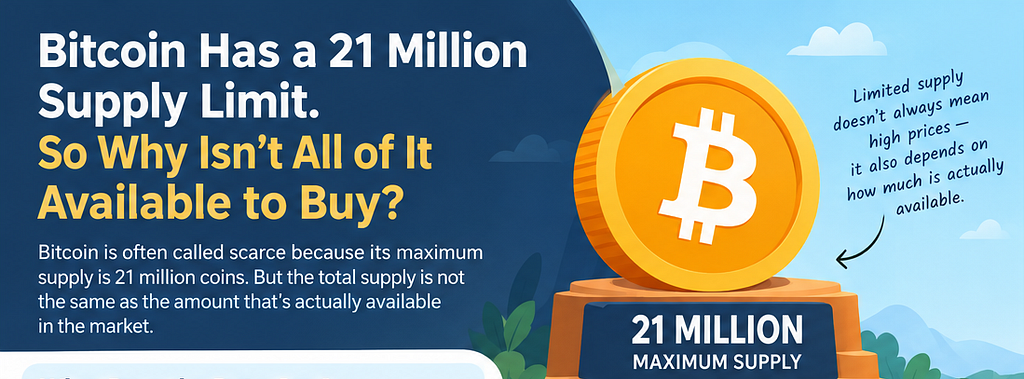
When people talk about Bitcoin, one of the first things they mention is scarcity.
Unlike traditional currencies, which central banks can issue more of, Bitcoin has a maximum supply of 21 million coins. This limit is part of Bitcoin’s design, and it is one of the main reasons people compare it to gold.
But there is an important detail that often gets overlooked: Bitcoin’s total supply is not the same as the amount of Bitcoin readily available in the market.
Some coins are held by long-term investors who rarely sell. Others sit in investment funds, company treasuries, or wallets that have not moved for years. Some Bitcoin may even be permanently inaccessible because its owners have lost their private keys.
This raises an interesting question: If Bitcoin has a fixed supply, how much of it is actually available for people to buy and sell?
Understanding the answer can help beginners make more sense of Bitcoin’s market behavior without getting caught up in every price prediction.
1. What Does Bitcoin’s 21 Million Supply Limit Actually Mean?
Let’s start with the basics.
Bitcoin was designed with a maximum supply of 21 million BTC. New coins enter circulation through mining, where participants use computing power to help secure the network and process transactions.
However, Bitcoin’s issuance schedule gradually reduces the number of new coins created. This process is known as halving, which cuts the block reward roughly every four years.
The idea is straightforward: Bitcoin’s supply grows according to a predictable schedule rather than depending on decisions made by a central authority.
Imagine a collectible item that can never be produced in quantities above a certain limit. If more people want that item while the number available for purchase remains small, competition among buyers may increase its price.
Bitcoin works differently from a physical collectible in many ways, but the basic supply-and-demand principle still applies.
There is one important catch, though.
A limited supply does not automatically guarantee a higher price. Demand still matters. If fewer people want Bitcoin, its price can fall even though its maximum supply remains unchanged.
And that brings us to the next part of the story.
2. Why Isn’t Every Bitcoin Available in the Market?
Think about the money in a bank account.
You might have ₹100,000 saved, but that does not mean you plan to spend all of it today. Some of that money may be reserved for emergencies, future purchases, or long-term savings.
Bitcoin holders behave in a similar way.
Someone who buys Bitcoin and plans to hold it for ten years may not be interested in selling when the price rises by 5% or falls by 10%. Their coins still exist, but they are not necessarily contributing to the supply available for immediate trading.
This is the difference between total supply and liquid supply.
Total supply refers to the Bitcoin that exists or has been issued, depending on the metric being used.
Liquid supply describes the portion that is more readily available to move or trade. The exact amount depends on how analysts classify wallets and holder behavior.
Bitcoin can be divided into several broad groups:
Actively traded Bitcoin: Coins that move relatively frequently between wallets and exchanges.Long-term holdings: Bitcoin kept by investors who rarely sell.Institutional holdings: Coins held by investment funds, companies, and other large organizations.Potentially inaccessible Bitcoin: Coins whose private keys may have been lost, making them difficult or impossible to spend.
These categories are not perfectly separate. For example, an ETF can hold Bitcoin on behalf of investors, while a long-term holder can decide to sell tomorrow.
The key point is that Bitcoin can exist without being readily available for someone else to buy.
3. What Is Bitcoin’s “Illiquid Supply”?
You may come across the term illiquid Bitcoin supply in cryptocurrency research.
In simple language, it refers to Bitcoin held in wallets that historically show little spending activity relative to their holdings. Analysts use wallet behavior to estimate how much Bitcoin is being held rather than actively circulated.
Coinpedia’s October 2026 research on Bitcoin’s idle supply reported that approximately 13.41 million BTC, or around 66.7% of its measured supply, was classified as illiquid in that dataset.
You can explore the figures and methodology in Coinpedia’s Bitcoin supply analysis.
For beginners, the number is useful because it highlights a difference that is easy to miss: Bitcoin’s headline supply tells us how much exists, while liquidity estimates try to explain how much may be available for spending or trading.
However, there is an important limitation.
Illiquid does not mean permanently unavailable.
A wallet that has remained inactive for years can suddenly become active. Its owner may decide to sell, transfer the coins, or move them to another wallet.
Similarly, an inactive wallet does not necessarily mean its owner has lost access. Some investors deliberately keep their Bitcoin untouched for long periods.
That is why illiquid supply should be treated as an estimate based on observed behavior, not a precise count of coins that can never enter the market again.
4. Why Do Long-Term Bitcoin Holders Matter?
Imagine that 1,000 people own a particular collectible, but only 100 are willing to sell theirs.
Now imagine that demand suddenly increases. More buyers begin looking for the collectible, but the number of willing sellers remains limited.
Buyers may need to offer higher prices to persuade existing owners to sell.
A similar dynamic can occur in Bitcoin markets.
When long-term holders keep their coins rather than selling them, fewer coins may be offered for sale at a given moment. If demand rises at the same time, that reduced availability can contribute to upward price pressure.
But the reverse is also possible.
If long-term holders begin selling, more Bitcoin can become available to buyers. If demand is weak, the additional selling pressure may contribute to a price decline.
This is why experienced market observers look beyond the number of Bitcoin that exists. They also study how holders behave.
Still, wallet activity alone cannot tell us exactly what every investor intends to do next. A coin that has remained untouched for years is not a promise that it will remain untouched tomorrow.
5. How Do Bitcoin ETFs and Companies Affect Supply?
Bitcoin ownership has changed as more financial institutions have entered the market.
Spot Bitcoin exchange-traded funds, commonly called spot Bitcoin ETFs, allow investors to gain exposure to Bitcoin through an investment product traded on a stock exchange.
When a fund receives new investment and creates additional shares, it may need to acquire more Bitcoin, depending on its structure and the way it handles creations and redemptions.
Companies can also hold Bitcoin on their balance sheets as part of their investment strategies.
These developments can affect how Bitcoin is held and how much is available for trading. But it is important to understand the difference between ownership and demand.
A company holding Bitcoin does not mean those coins have disappeared from the total supply. Likewise, Bitcoin held by an ETF is not automatically permanently locked away.
Funds can experience outflows, and companies can sell their holdings. Both can return coins to the market.
The useful question is not simply, “How much Bitcoin do institutions own?”
It is also, “Are these holders accumulating Bitcoin, maintaining their positions, or selling?”
That distinction helps explain why institutional holdings, fund flows, and exchange balances are often examined together.
6. What Happens When Bitcoin Demand Rises but Available Supply Is Limited?
Let’s use a simple example.
Suppose a market has 1,000 units of an asset. Of those, only 100 are currently being offered for sale. The remaining owners prefer to hold their units.
Now imagine that demand doubles.
Buyers cannot purchase all 1,000 units at the current price if most owners are unwilling to sell. They must compete for the smaller amount available, potentially pushing the price higher.
This example illustrates how limited available supply can influence a market.
Bitcoin can experience similar conditions. If demand from investors, companies, or funds increases while fewer existing holders are willing to sell, the balance between buyers and sellers may become more favorable to rising prices.
But this is only one possible outcome.
If demand falls, buyers may disappear even when the available supply is limited. If large holders begin selling, the amount of Bitcoin offered to the market may increase.
In other words, scarcity can amplify the effects of demand, but it cannot replace demand.
That is an important lesson for anyone trying to understand Bitcoin’s price movements.
7. Does Bitcoin Scarcity Mean Its Price Must Rise?
No. This is one of the most common misunderstandings about Bitcoin.
The 21 million supply limit is a feature of Bitcoin’s design. It does not guarantee that Bitcoin will become more valuable every year.
Prices are influenced by several factors, including:
Investor demand: Whether people want to buy, hold, or sell Bitcoin.Macroeconomic conditions: Interest rates, inflation expectations, economic uncertainty, and investor appetite for risk.Institutional activity: Changes in ETF demand and company holdings.Market sentiment: Confidence, fear, speculation, and expectations about future prices.Liquidity and selling pressure: How much Bitcoin holders are willing to offer and how easily buyers and sellers can trade.
For example, Bitcoin can become more scarce in the sense that fewer holders are willing to sell, yet its price can still fall if demand weakens sharply.
Likewise, rising demand can support prices even when the total number of Bitcoin available has not changed.
This is why supply data is most useful when combined with other market indicators rather than treated as a standalone prediction tool.
8. What Should Beginners Watch?
You do not need to track every Bitcoin transaction to understand the bigger picture. A few indicators can provide a useful starting point.
Exchange balances: These estimates show how much Bitcoin is held in wallets associated with cryptocurrency exchanges. Falling balances can indicate that fewer coins are sitting on exchanges, but they do not prove that all those coins are being held for the long term.
Long-term holder behavior: Analysts examine whether older coins remain inactive or begin moving. Increased activity may signal a change in holder behavior, although movement does not always mean selling.
ETF inflows and outflows: These figures can help explain changes in demand for investment products that hold Bitcoin. They should be interpreted alongside other market conditions.
Trading volume: Volume helps show how much buying and selling activity is taking place. A price move supported by strong trading activity may tell a different story from a move occurring in a thin market.
Price and broader economic conditions: Interest rates, market sentiment, and appetite for risk can influence demand regardless of Bitcoin’s fixed supply.
No single indicator provides a complete picture. The goal is to understand how several pieces of information fit together.
Final Thoughts: Bitcoin’s Scarcity Is About More Than 21 Million Coins
Bitcoin’s 21 million supply limit is easy to remember, but it tells only part of the story.
To understand the market, it helps to consider how existing coins are distributed, how frequently they move, and whether their owners are willing to sell.
Some Bitcoin is actively traded. Some is held for years. Some belongs to investment funds or companies. And some may be inaccessible because the keys needed to spend it have been lost.
These differences matter because markets respond not only to how much of an asset exists, but also to how much is available when buyers want it.
At the same time, inactive coins are not guaranteed to remain inactive, and limited supply does not guarantee rising prices. Demand, investor behavior, liquidity, and economic conditions all play a role.
For beginners, the most useful takeaway is simple: Do not look only at how much Bitcoin exists. Also look at how people are using, holding, and trading the Bitcoin that already exists.
That broader perspective provides a more practical way to understand Bitcoin’s scarcity — and why its market price can sometimes behave very differently from what the headline supply figure might suggest.
Bitcoin Has a 21 Million Supply Limit. So Why Isn’t All of It Available to Buy? was originally published in Coinmonks on Medium, where people are continuing the conversation by highlighting and responding to this story.