
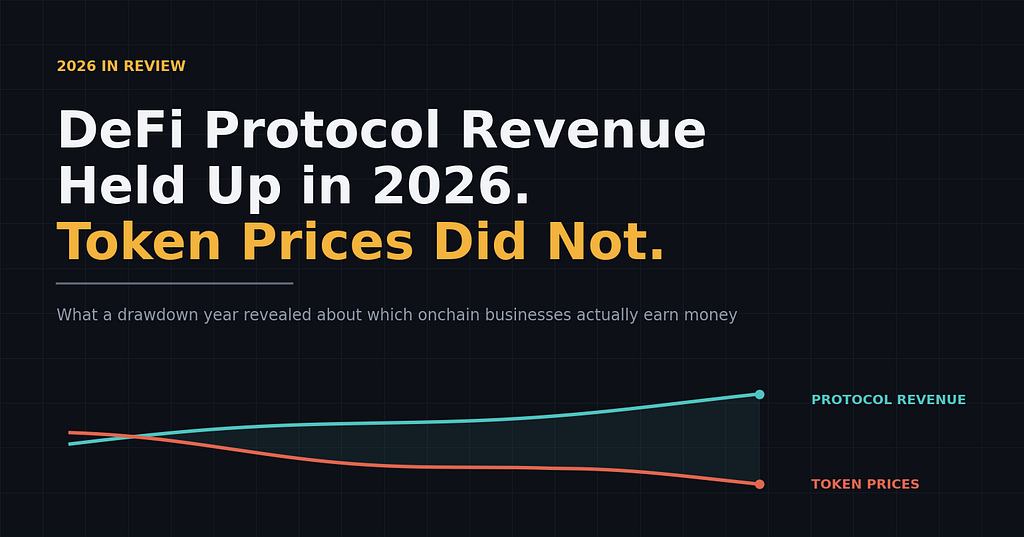
What a drawdown year revealed about which onchain businesses actually earn money.
On 7 October 2026, Moody’s put a credit rating on a stablecoin protocol for the first time.
Not a bank. Not a fintech. A protocol.
That happened in a year when crypto spent most of its time falling. Odd pairing. And it points at the thing almost everyone missed in 2026.
Revenue and price stopped telling the same story.
I have spent this year reading quarterly reports from onchain protocols. The gap between what they earn and what their tokens do has never been this wide.
A token price and a protocol income statement are two different instruments measuring two different things.
What actually happened to DeFi protocol revenue in 2026?
Short version: the money kept arriving while the charts kept sliding.
The market side first.
Total DeFi TVL fell about 37% in the first half of 2026, from roughly $114B in January to $71.77B by 18 June, per DefiLlama.Bitcoin was down around 33% at mid-year. Ether was down about 47%.Crypto’s total market capitalisation closed Q2 near $2.1T, roughly half its October 2025 peak.
Now the other side of the ledger.
Sky Protocol generated $107.35M in Gross Protocol Revenue in Q2 2026. That is up 10.5% on the $97.15M it generated in Q2 2025.
Net Protocol Surplus came in at $33.29M, the fifth consecutive positive quarter.
Protocol Collateral grew 45.5% year over year to $12.32B. sUSDS closed the quarter at $5.52B, up 149%.
For scale: Sky Protocol generated $338M across the whole of 2025. Q1 2026 alone brought in $123.79M, the strongest quarter on record. Q2 came in below that peak and still beat the same quarter a year earlier.
Gross Protocol Revenue and Net Protocol Surplus by reported quarter. Q2 2026 was the fifth consecutive positive quarter. Source: Sky Frontier Foundation.
Prices fell. The business grew. Analysts have started calling it the fundamentals decoupling, and 2026 is the year it became impossible to ignore.
Why did token prices fall while onchain revenue grew?
Three reasons keep showing up.
Liquidity left the whole asset class. Capital rotated into AI equities and metals. Gold and silver had a year. Crypto did not.Most protocols route revenue away from token holders. Fees go to liquidity providers. Tokens get diluted by emissions on the other side of the ledger.Revenue is backward looking. Price is a bet. A token can fall on a perfectly good quarter if the market has stopped believing in the next twelve.Some protocols are fixing it. Aave approved a permanent buyback budget funded from revenue. Uniswap switched on fee-funded burns across more chains through 2026. The plumbing is being rebuilt, slowly, in public.
None of that is a scandal. It is a reminder that these two numbers were never measuring the same thing.
Which makes a better question available: where is the revenue actually coming from?
Sky Protocol fundamentals against the wider crypto market in 2026. Sources: Sky Frontier Foundation, DefiLlama, Advisor Perspectives.
Where does Sky Protocol revenue actually come from?
This is the part worth slowing down for, because the mechanism is unusually boring. Boring is the point.
Sky Protocol does not earn by trading. It earns by lending its own liquidity at a published price.
Independent allocators in the Sky Agent Network borrow USDS from the protocol.They pay a governance-set wholesale rate, the Base Rate, on what they borrow.They deploy that capital across credit, lending markets and treasury strategies.Those fees settle back to the protocol on a monthly cycle.
Agent fees are the largest contributor. Vault stability fees, real-world collateral yield and Peg Stability Module fees land in the same pool.
The scale underneath that: Protocol Collateral stood at $11.10B at the end of August, up 18.2% year over year, against $9.53B of stablecoin supply. More collateral than supply, by design.
Sky Governance then sets the Sky Savings Rate as a separate parameter, calibrated against that revenue capacity.
sUSDS holders receive it automatically, and the rate is variable and published live rather than promised in advance.
Note the direction of travel. The rate is an output of the system. It is not a marketing number that the revenue is then expected to cover.
How revenue reaches the Sky Savings Rate. Simplified. Live parameters at financial.skyeco.com.
What happens to protocol surplus after the Sky Savings Rate is paid?
Since 13 August 2026 there is a published answer. Sky Governance ratified Stage 2 of the capital management framework. Each settlement cycle now allocates surplus like this:
22.5% to SKY buybacks for SKY Staking Rewards22.5% to USDS Staking Rewards5% to SKY buy and burnUp to 50% to the Surplus Buffer
Institutions read the last line first. Loss absorption comes before distributions.
Sky Reserves stood at $76.99M at the end of August against a governance-set $150M Solvency Reserve target. Roughly halfway.
You can watch the number move rather than wait a quarter to hear about it.
Stage 2 surplus allocation and progress toward the $150M Solvency Reserve target. Source: Sky Frontier Foundation, August 2026 update.
Did any stablecoin yield engine actually break in 2026?
One came close, and the contrast is the most useful thing in this article.
USDe, the synthetic dollar, peaked near $14.82B in October 2025. By 28 September 2026 supply sat around $4.95B. Its staked yield, once well above 30%, compressed toward the risk-free rate.
Nothing failed. No depeg, no panic. The engine simply did what it was built to do, and that engine runs on perpetual futures funding rates. Funding cooled, so the yield cooled, so the supply left.
sUSDS went the other way. Up 149% year over year to $5.52B at the Q2 close.
Same year. Same market. Two different revenue engines.
One is priced off derivatives positioning.One is priced off a rate charged to borrowers against diversified collateral.
Neither is right or wrong. But a yield source you cannot explain in one sentence is a yield source you cannot underwrite.
Only one of these two is currently legible to a credit analyst, which brings us to October.
Two stablecoin yield engines in the same market. Sources: DefiLlama, Sky Frontier Foundation Q2 2026 Quarterly Report.
Why would two credit rating agencies bother rating a stablecoin protocol?
Because the numbers were finally there to review.
Moody’s assigned Sky Protocol a B3 rating with a stable outlook on 7 October 2026.S&P Global had already issued a corroborated B- rating in the weeks before.Two separate teams. Two sets of criteria. Two independent conclusions.
Sky Protocol is so far the only stablecoin protocol formally rated by both.
Here is the honest part. Neither rating is investment grade. Moody’s flagged the level of Sky Reserves as central to its assessment, and the Foundation said publicly that it shares that view.
That matters more than a flattering headline would. An allocator can now assess an onchain protocol on the same scale they use for a corporate issuer, including the parts that are unflattering.
Independent ratings let institutional investors assess Sky through frameworks they already use across global markets. — Greg Feibus, Global Head of Capital Markets, Sky Frontier Foundation
Is institutional capital actually showing up, or is it just press releases?
Follow the allocations.
As of 1 September 2026, Sky Agents held approximately:
$1.23B with Janus Henderson$618.32M with BlackRock$304M with Galaxy$239.60M in PayPal USD$220M with Anchorage$103.11M with Securitize
Galaxy is the mover. Exposure stood at $27M at the Q2 close and reached roughly $304M by September, driven by a $500M warehouse lending facility with Sky Agent Grove.
Then on 23 September, Galaxy added $100M of sUSDS to its own balance sheet and approved it as collateral across its institutional trading business.
Token Terminal data from 21 August placed Sky Protocol at $4.6B in its tokenized funds ranking, the largest single issuer in a $34.4B category.
On the retail side, Sky.money reported $7.1B across its full product suite on 19 August, with $4.92B of that sitting in the Sky Savings Rate.
Where Sky Agent capital actually sits, as of 1 September 2026. Source: Sky Frontier Foundation.
What should you watch instead of the price chart?
Four things. All public, all updated continuously.
Gross Protocol Revenue, quarter over quarter. Growth without a rate rise is real demand.Protocol Collateral against stablecoin supply. That gap is the overcollateralisation cushion.Sky Reserves against the $150M target. Loss absorption before distributions.Agent allocations at token level. Published continuously, not quarterly.Whether the rate moves by vote or by market. A governance-set rate moves on a published rationale. A market-set rate moves whenever funding does.
One more from April that most people scrolled past. During the roughly $292M Kelp DAO rsETH bridge exploit and the multi-billion-dollar collateral contraction at Aave that followed it, Sky Protocol’s operations ran uninterrupted and sustained no losses.
That is not a metric. It is a stress test nobody scheduled.
So which number is wrong?
2026 sorted onchain businesses into two groups. Those with a revenue engine, and those with a narrative.
The price charts did not distinguish between them. The income statements did.
So here is the question I keep circling, and I would genuinely like to know where you land on it.
If a protocol’s revenue grows while its token falls, which of the two numbers is telling you the truth?
Leave your answer below. I read all of them, and I will argue with the good ones.
DeFi Protocol Revenue Held Up in 2026. Token Prices Did Not. was originally published in Coinmonks on Medium, where people are continuing the conversation by highlighting and responding to this story.